
Nuclear, agreement between Eagles consortium and authorisers on lead reactor
The agreement concerns the streamlining of the authorisation process through an international project. The company includes the Italian Ansaldo

2' min read
Key points
2' min read
The Eagles Consortium (of which Ansaldo Nuclear is a member), created for the construction of compact modular nuclear reactors (Smr), has started a pre-licensing initiative with the industry regulators of Belgium (Fanc), Italy (Isin) and Romania (Cncan), for its lead-cooled Eagles-300 reactor. The agreement was signed in Vienna, on the sidelines of the 69th General Conference of the International Atomic Energy Agency (Iaea).
Pre-licensing is, in fact, a preliminary exploratory process, to be held between nuclear regulators and technology developers, prior to the formal submission of a licence application. The purpose is to identify potential critical issues in advance, and to enable a more efficient subsequent licensing process. Today, each country applies its own licensing rules and procedures for Smr (small modular reactors), forcing developers to repeat licensing processes in each jurisdiction. International harmonisation can, therefore, make a difference, reducing duplication and accelerating product deployment.
Technicians: 'Unprecedented initiative'
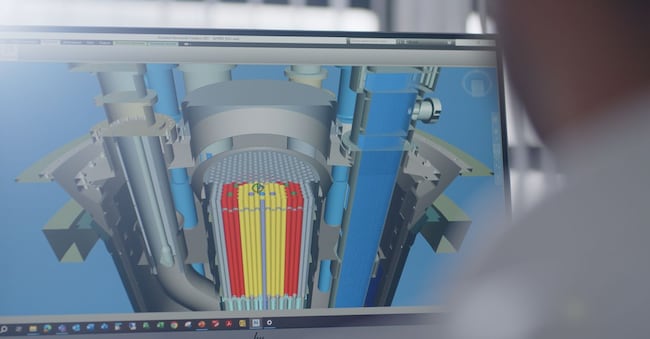
The Eagles-300 pre-licensing project, Ansaldo's engineers explain, is an unprecedented initiative: for the first time, national regulators are starting to collaborate at an early stage of development. Eagles-300 is a compact lead-cooled modular reactor with an output of around 300 megawatts of electricity. It should reach the market in 2039. The modular design allows for faster construction, lower investment costs and application flexibility. In addition to electricity, it can provide heat for industrial use and hydrogen production. The reactor will also use recycled fuel, reducing radioactive waste and increasing resource efficiency.
"Our support for this joint pre-licensing project," explained Rafael Mariano Grossi, Iaea Director General, "aims to ensure that Smr move from development to deployment in a safe and timely manner. Almost every day we receive requests about when small nuclear reactors will be available; they range from developing countries that want to upgrade their electricity grids, to technology companies that need electricity for data centres and artificial intelligence. The demand for reliable, low-emission nuclear power is real, and the Iaea is at the centre of the international effort to meet it safely and transparently'.


