
Nuclear energy, the virtuous path of the public-private alliance
Romanelli (Dtt consortium): 'Works at the Enea centre in Frascati will start in the second half of 2026'

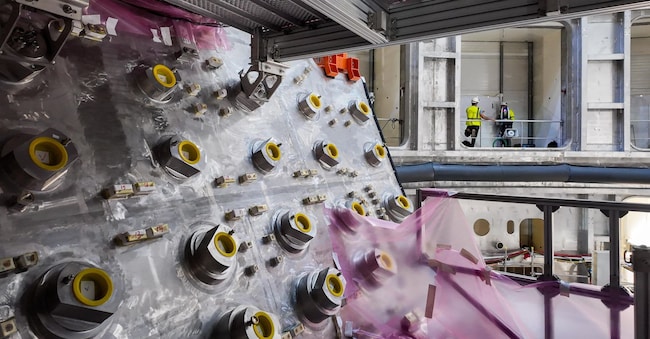
On the opposite side of the swarm of private start-ups buzzing around fusion energy is the pachyderm of public research, led by the Iter mega-programme, the largest research project in history, in which 34 nations (27 EU members plus China, India, Japan, Korea, Russia, the USA and Switzerland) are working in the South of France on a gigantic $25 billion reactor, which has recently entered its third phase, that of tokamak construction, with the prospect of generating the first plasma in 2033, after a series of serious delays. Iter's machine has a diameter of 28 metres, is just as high and is the result of the work of 3,500 researchers, to which the EU contributes more than 50% in terms of funds and components, but it is not designed to produce electricity to be fed into the grid.
A task assigned instead to the next generation of machines, called Demos, which loom as the heirs of Iter and around which variable-geometry alliances are already being drawn, in keeping with the spirit of post-globalised times.
The centre of Frascati
In Italia, at the Enea research centre in Frascati, work has already begun on the Divertor Test Tokamak (Dtt), designed to be able to withstand the thermal discharge levels of a future Demo-class fusion reactor. "As the component that extracts the helium ash from the tokamak's plasma chamber, a divertor in the Demo environment will have to withstand an enormous heat flux of 60 megawatts per square metre, i.e. three times more than the diverters designed for Iter can withstand," explains Francesco Romanelli, president of the Dtt consortium and lecturer in the Physics of Nuclear Energy at Tor Vergata. Developing a divertor capable of withstanding the heat fluxes present only on the surface of stars requires the development of a test centre that will push the limits of modern science and therefore has to be built from scratch.
"The civil works are scheduled to start in the second half of 2026. Overall, the construction of the Dtt will involve the construction of 150,000 cubic metres of technologically advanced facilities with a total budget of EUR 650 million, almost half of which is already committed to contracts,' Romanelli points out.
Which partnerships?
The big news is that not only public partners - such as ENEA, CNR, the National Institute of Nuclear Physics, various universities and research centres - are participating in this work, but also a private partner, Eni. Romanelli believes that 'a public-private partnership is the best model for effectively pursuing fusion research. Achieving this goal was not an easy task, but it was necessary in the face of the fusion race triggered in recent years by private industry, which is now moving faster than public research. "Academic researchers are aiming for the perfect solution, while private industry wants to get there as quickly as possible, with something that may not be perfect, but that works," Romanelli explains. It is time, therefore, to also involve the private sector in this publicly-led challenge, to steer the fusion towards commercially viable results, while keeping the spirit of international cooperation alive.

