
Nuclear, Italian-American alliance to produce micro-reactors in Marghera
Agreement between Ultra Safe Nuclear Italia and Piedmont-based Simic: the goal, once an adequate regulatory framework is in place, is to build Mmr of up to 50 Mw thermal power

2' min read
2' min read
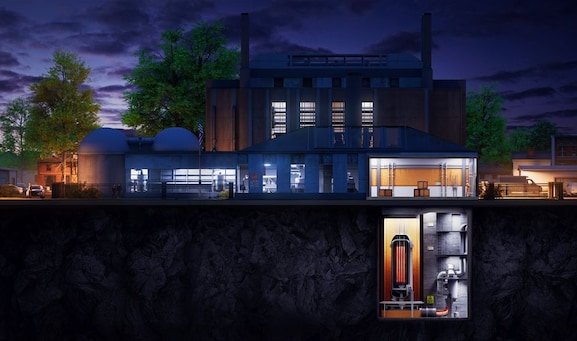
Italian-American alliance for Generation IV nuclear power. The Ultra Safe Nuclear Italia, a subsidiary of the US-based Usnc specialising in the development of mini-reactors with power up to 50 MW thermal, and the Piedmont-based Simic, focused on the production of complex industrial components in the Oil&Gas, Chemicals, Petrochemicals and Energy, have signed a memorandum of understanding aimed at the construction and assembly in Europe and Italy of Micro Modular Reactors, precisely the innovative nuclear fuel energy production system for which Usnc itself holds the patents.
A new factory in Marghera
The aim of the agreement, as reconstructed by Radiocor, is therefore - when the authorisation requirements are met - the production of modular micro-reactors for nuclear-fuelled power generation, considered ideal for supplying heat to energy-hungry companies, i.e. those belonging to sectors such as steel, glass, cement and paper. Production that, according to the plans of the two companies, should take place in Simic's sea-facing plant in Marghera (Venice) and for which Usnc will supply the design for the reactors manufactured in the Veneto plant, as well as those under construction on the campus of the University of Urbana-Champaign in Illinois and in Chalk River (Canada). Simic, for its part, will support Usnc for feasibility studies relating to the manufacture of Mmr, both in Italy and in Europe, as well as for the design of the production facilities in Italy.
The new Italian branch
.Propaedeutic to this alliance is the recent establishment of Ultra Safe Nucleare Italia, whose corporate purpose is 'the construction and industrial production of new-generation nuclear reactors for supplying heat toenergy-intensive industries, the production of electricity and hydrogen, and storage systems to complement renewables'. According to Usnc's top management, starting with CEO Francesco Venneri and senior advisor for Italy, Riccardo De Salvo,the nuclear technology in question is safe for three reasons: the elimination of water in the reactor cooling cycle, which precludes any possibility of explosion; the fuel used, which is ultra-safe and easily disposed of without treatment; and the impossibility of melting the reactor core, due to the natural self-switching off of the chain reaction caused by uranium 238.
"The possible way in 2030"
.Usnc has a pipeline of 20 projects worldwide. For now, the priority is to provide 'demonstrators' aimed at obtaining licences on standard units in various countries: in the USA (on the campus of the University of Urbana Champaign, Illinois), in the Chalk River laboratory in Ontario, on the campus of the University of Lappeenranta (Finland) and in Poland, Francesco Venneri recently pointed out to Il Sole 24 Ore. The first results will arrive between the end of 2026 and the beginning of 2027 and will be used to implement, together with the customer, the pre-approved product to power energy-intensive industries. Finally, we will need the approval of the authorities on two other key issues: site and fuel. These are all steps that, if the right regulatory framework and a good level of social acceptability are created, will also be necessary in our country, 'where there is great demand and we count on creating an ecosystem linked to the project'. The timeline for any plants? 'With the right conditions from 2030 we could see the first practical results in Italy,' Venneri concluded.


