
Bread, Nutella and fantasy
From 'Bianca' to Carotenuto, the Italian silver screen considers it fundamental, but does not celebrate it. Unlike the Americans with sandwiches and hot dogs
Key points
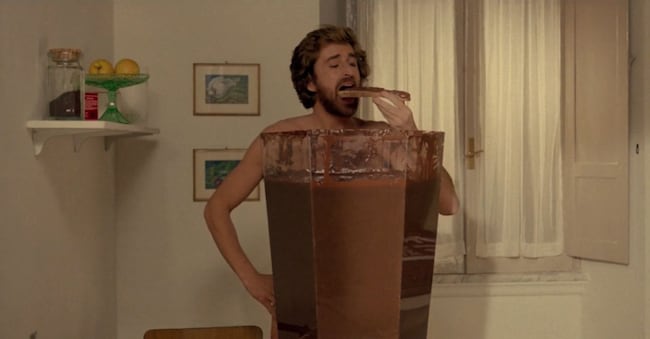
In the Nutellone scene in Bianca, with which Nanni Moretti realises the Italians' secret dream of diving into the most revolutionary gluttony of the industrial boom, the slices of rustic bread are hardly visible. Yet, without them, the ecstasy is not complete. It is 1984 and the viewer's eyes are on the nudity of Michele Apicella, covered in the pudenda by the enormous jar, as he fiddles with the knife and spreads, blowing desperation with every bite. The same kind of bread is held by the worker to whom Marshal Antonio Carotenuto-Vittorio De Sica passes by asking what it will be topped with: 'Fantasia', the man replies.
From Bread Love and Fancy to Bread and Tulips
It is post-war Italy that in Bread, Love and Fantasy (1953) is content with what it can, while in the already consumerist country of Bianca it vents anxieties and existential malaise in material pleasure. In 2000's Bread and Tulips Silvio Soldini records the need for escape in post-industrial society: the magnificent Bruno Ganz (Fernando) always leaves a slice of bread for breakfast for Licia Maglietta (Rosalba), who reciprocates with flowers, often tulips. Those who manage to give themselves a second chance do so by enjoying simple things that bring back lost happiness. The tulips, explains Fernando, an Icelandic waiter in a small Italian restaurant, are not Dutch but Persian. It is not known whether Soldini was inspired by, and thus wanted to pay homage to, Mohsen Makhmalbaf's Bread and Flower (1996), in which the Iranian director rediscovers the policeman he had stabbed two decades earlier, as a boy, when he was militating against the Shah's government. Here the flower is the symbol of peace and the bread that of the struggle to free the people from hunger and oppression. In Italian cinema, where regional cuisine is a florilegium of variations and elaborations, bread, even when it triumphs in the title, does not have a prominent place: it is an indispensable element and, as such, little celebrated.
Sandwiches in American Cinema
It is, on the other hand, a real reference in America, where the hamburger is the national dish. In front of a pastrami - rye bread stuffed with marinated beef brisket, mustard and gherkins, a New York Jewish must - takes place the climax scene of the cult Harry meets Sally (1989). Meg Ryan fakes an orgasm in front of Billy Crystal's bacon sandwich to demolish his manly confidence. Sally mumbles louder and louder, stopping the conversations of the other patrons of Katz's Delicatessen, still a place of cinematic wanderings. Soon after, a lady hurries to ask the waiter, "I want what the young lady got".The hitmen Jules Winnfield (Samuel L. Jackson) and Vince Vega (John Travolta) fromPulp fiction (1994), entering the home of a debtor of underworld boss Marcellus Wallace, find young Brett (Frank Whaley) intent on eating a hamburger. 'Ah! The basis of a nutritious breakfast,' Jules comments. Then, however, he wants to know more. "What kind of hamburger?" "Cheeseburger," replies the terrified one. "No, no, no, no," Jules sets the record straight. "Where did you get it? McDonald's? Wendy's? From Jack in the Box?" and initiates a little philosophical dissertation on the peculiarities and substantial differences of fast food chains as the philosophical basis of American culture. "Big Kahuna Burger," replies that one, hoping to placate him. "Big Kahuna Burger... that Hawaiian burger chain? I hear they have very tasty burgers. I've never tried them, how are they?" and he contentedly bites into Brett's sandwich, recounting the hardships his engagement to a vegetarian girl subjects him to. It is Tarantino's ingenious imprint, seasoning heinous violence, made of slang, nonchalance and hard-boiled granguignol, with a five o'clock tea talk. The sublimation of the B Movie from rubbish in genre, already begun with Henes (1992), is crowned: TV culture is ready to be transformed and processed by the big screen. On their way to smash a skull or blow a head off, in the car, Vince and Jules continue to disquisition: 'The funny thing about Europe is the little differences,' explains Vince. They have the same shit over there as we do, only it's a little different there...' and chuckles at the slightly snobbish subtleties with which the Old Continent cares to distinguish itself. For example, Paris. "What do they call the Big Mac there?" asks Jules. 'Le Big Mac,' replies Vince in a French accent. "And what do they call the whopper (Burger King sandwich n.d.r.)?", raises Jules. "I don't know. I've never been to Burger King."
The PB&J, Peanut Butter & Jelly of The Neverending Story
It is, however, the American PB&J, Peanut Butter & Jelly, the peanut butter and jelly sandwich, Bastian's (Barret Oliver) last contact with reality in The Neverending Story, before being sucked into the magic book. It is the sweetest anchorage a child, immersed in prickly maternal grief, can choose before surrendering to fantasy. The PB&J is the comfort food that oils the power of reading and imagination, through which Bastian is able to inhabit a painful reality, without indulging in the disease of sadness. By imaginative association with Wolfgang Petersen's 1984 film based on Michael Ende's book, there is also the big machine that drops hamburgers from the sky. It is the best invention of Flint, the protagonist of the animated film Raining Meatballs (2009), which changes the life of Shallow Marina, an island whose economy was based solely on sardine processing.
The hot dog that enables plot development
Next to the hamburger, in the stars and stripes doc culture there is the hot dog, the portable food par excellence, the most loved street food in the civilisation where everything is dynamic and runs fast. The hot dog, easy to bite while walking, allows screenwriters to develop a speech or plot twist, while the kiosks selling them are picturesque postcards of big US cities. They buy and eat a hot dog at the same time and in the same city, but without crossing paths, Meryl Streep and Robert De Niro in Falling in Love (1984). It is one of many gestures that bring them together towards an inescapable ending. The hot dog is also a food for superheroes: Peter Parker gobbles it down in a human break, while he refrains from transforming in Sam Raimi's Spider-Man 2 (2004). Since the actor, Tobey Maguire, is a long-time vegetarian, fans online note that he only chews bread, as the bite is too soft. He does this to the tune of Raindrops keep falling on my head, as he hears police sirens chasing criminals, forcing himself not to intervene: he has decided to abandon his Spiderman role. Robert Redford enjoys one on the street with Barbra Streisand in Sydney Pollack's How We Were (1973). In a khaki army uniform, he accompanies communist Pasionaria Katie after a night of lovemaking. They are on their way to an old college buddy who votes Republican. The hot dog is the prelude to the showdown in which Redford will try to leave his middle-class roots and become a writer.


