
Nvidia scandal: Chinese executive with links to rival Huawei; Lutnick testifies before Congress
Trump’s Secretary of Commerce and the now former CEO of Nvidia are to appear before the Senate Banking Committee

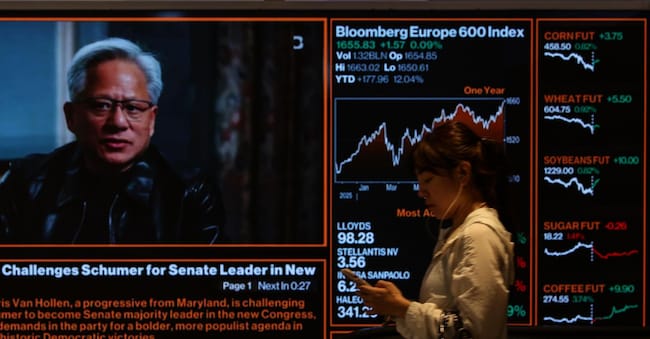
The scandal that has engulfed Jensen Huang, now the former CEO of Nvidia, does not end with the resignation of the powerful chip strategist 24 hours ago and the simultaneous appointment of CFO Colette Kress. The romantic affair that forced the man who had been at the helm of the chip giant for thirty years – indeed, who was also its co-founder – to step down remains far from clear. The US intelligence community is, in fact, still trying to understand the nature of the link between Alice Huang – who had a relationship with Nvidia CEO Huang – and the Chinese government. According to CNN, which has spoken to several sources, the information gathered so far about her does not prove that she acted as a spy on behalf of Beijing. There is no consensus amongst US officials on the strength of the evidence suggesting that Alice Huang was recruited by the Ministry of State Security, the Chinese equivalent of the CIA.
However, it appears certain that Alice Huang held shares in companies that have benefited from Huawei, Nvidia’s main competitor in China. This previously unknown connection was uncovered by the private intelligence firm Tesari and reported by CNBC. The link to Huawei could raise further questions about the implications of the relationship.
At the same time, on the political front, the romantic scandal – which has also turned into a corporate earthquake – risks bringing down key figures in the Trump administration. US Secretary of Commerce Howard Lutnick is set to give evidence before Congress on the Nvidia case, according to US media reports. “Secretary Lutnick has agreed, of his own accord, to appear before the Banking Committee to answer their questions,” the secretary’s spokesperson, Kristen Eichamer, told NBC News.
Lutnick found himself at the centre of the controversy because, before the Trump administration gave Nvidia the green light to sell advanced chips to China, the Department was obliged to assess companies in terms of national security risks. Instead, according to US media reports, Lutnick has consistently taken a lenient stance on the sale of advanced chips to China, despite this being at odds with the Trump administration’s own position. The announcement, reports NBC News, comes after Republican Senator Tim Scott of South Carolina, chairman of the Senate Banking Committee, sent letters to Lutnick and Jensen Huang on Thursday.
Lutnick now finds himself in an awkward position; it is now being suggested that he went too far in protecting Nvidia’s interests. Against this backdrop, there is also a desire to understand the true influence of Huang – an ally of President Trump and one of America’s best-known and most successful business leaders – in holding back more timely intervention by the United States aimed at restricting the sale of Nvidia chips to companies such as Megaspeed, the firm where Alice Huang was a manager, the woman who was in a relationship with the Nvidia boss.

