Digital Economy

Nvidia: 'The ChatGPT moment of robotics has arrived'

Nvidia has released a new generation of available models designed to spare developers the most expensive and slowest part: pre-training from scratch.

by Luca Tremolada

3' min read

Translated by AI
Versione italiana

3' min read

Translated by AI
Versione italiana

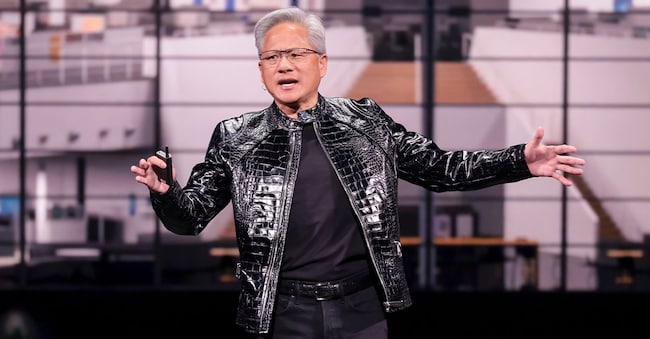
LAS VEGAS - The ChatGPT moment of robotics has arrived. And no, it's not a keynote slogan. It's a declaration of intent signed by Nvidia boss Jensen Huang, who at CES showcases his vision: robots that don't just perform, they understand. They see the real world, they reason, they plan actions. Like us.

In Las Vegas there were global partners. Boston Dynamics, Caterpillar, Franka Robotics, NEURA Robotics, Humanoid, LG Electronics. From mining sites to living rooms at home, robotics is entering a new phase: no longer single-function, expensive and rigid machines, but generalist-specialised systems capable of quickly learning different tasks.

Loading...

Jensen Huang puts it bluntly: 'The ChatGPT moment for robotics has arrived'. The metaphor works. Just as language models made text intelligent, now physical artificial intelligence models turn iron into brains. The difference is that here, if you get it wrong, you don't lose a sentence: you lose a bolt. Or an arm.

The real step change is not just in hardware, but in open software. Nvidia has released a new generation of models available on Hugging Face, designed to spare developers the most expensive and slowest part: pre-training from scratch. With Cosmos, Reason and GR00T, robots learn in simulation, on synthetic physics-based data, and then take the skills into the real world. It is like training a pilot in a simulator before he takes off. It costs less. It is safer. It scales better.

GR00T, in particular, is the key piece for humanoids. A vision-action model with reasoning capabilities, designed to control the entire body. Translated: balance, co-ordination, context. Franka, NEURA and Humanoid are already using it to simulate, train and validate new behaviours. Salesforce applies it to analysing robot videos in the field, halving incident resolution times. Healthcare is also entering the game, with surgical robots and endoscopes guided by real-time AI analysis.

Behind the scenes is the less glamorous but decisive part: simulation and orchestration. NVIDIA releases open source frameworks that bring order to today's fragmented and difficult-to-scale pipelines. Robotics policy evaluation becomes standardised, benchmarking automated, the transition from research to the real world faster. Robotics stops being a laboratory craft and becomes an industrial process.

In this scenario, the collaboration with Hugging Face is strategic. Robotics is the fastest growing category on the open source platform today. NVIDIA brings Isaac models and libraries, Hugging Face brings a global community of 13 million AI developers. In between comes an ecosystem that unites 2 million robotics developers with the open source world. Network effect. Acceleration effect.

Then there is silicon. Because without hardware, intelligence remains on paper. NVIDIA introduces the new Jetson T4000 module based on the Blackwell architecture. Four times the performance of the previous generation, 1,200 TFLOPS in FP4, 64GB of memory, low power consumption of 70 watts. Industrial price: $1,999. It is the ideal brain for autonomous and humanoid machines with stringent energy constraints. Jetson Thor becomes the standard for those who want to bring reasoning to the robot, not to the cloud.

NEURA launches a third-generation humanoid designed by Porsche, along with a more compact and agile version. LG shows a domestic robot designed to move around the home. Boston Dynamics and others integrate Thor into their systems to improve navigation and manipulation. Humanoid robotics moves out of prototype and closer to production.

Finally, heavy industry. Caterpillar extends collaboration with NVIDIA to bring artificial intelligence and autonomy to construction sites and mines. Excavators that see, machines that make decisions, construction sites that become intelligent systems. Physical AI comes down from the cloud and gets its hands dirty.

The feeling is clear: robotics is experiencing today what IT experienced with the advent of PCs and, later, smartphones. A common platform, open models, standardised hardware. A paradigm shift. And this time, more like an industrial roadmap than science fiction.

Copyright reserved ©
  • Luca Tremolada

    Luca TremoladaGiornalista

    Luogo: Milano via Monte Rosa 91

    Lingue parlate: Inglese, Francese

    Argomenti: Tecnologia, scienza, finanza, startup, dati

    Premi: Premio Gabriele Lanfredini sull’informazione; Premio giornalistico State Street, categoria "Innovation"; DStars 2019, categoria journalism

Loading...

Brand connect

Loading...

Newsletter

Notizie e approfondimenti sugli avvenimenti politici, economici e finanziari.

Iscriviti