
Dell: AI agents will revolutionise markets and healthcare, but who can afford them?
From the stage of the Dell Technologies World event in Las Vegas, Michael Dell explained that we are no longer faced with yet another piece of software to use in the company
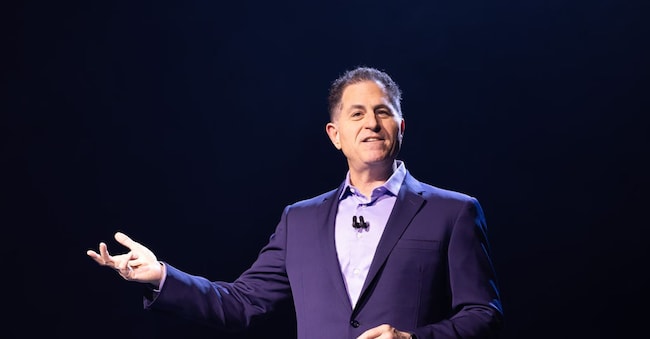
LAS VEGAS - The rapid growth of AI agent capabilities has made it clear to the world that artificial intelligence represents an unprecedented opportunity for businesses. Michael Dell, from the stage of the Dell Technologies World event in Las Vegas, explained that we are no longer dealing with yet another piece of software to be used in the enterprise, but with a true operating model that breaks down the barriers between imagination and practical execution. According to Dell, the best way to explain what is happening is to look at how Eli Lilly, a pharmaceutical company with 140 years of history, is evolving. Although not a tech company, Eli Lilly has always used large amounts of technology, in research but not only. Indeed, the most consistent use has been in manufacturing, where technical innovation and scientific method have been applied to dramatically increase the availability of vital medicines, as happened in 1923 with insulin or during World War II with penicillin. Today, that same drive towards scalability has led the company to adopt the largest supercomputer in the pharmaceutical sector, activated last February and equipped with thousands of GPUs, to enhance every stage of its operations to almost science fiction heights in the production process, where every single piece of medicine is subjected to 70 different photographs taken within milliseconds of each other to identify even the smallest defects that would elude an army of human workers.
Diogo Rau, Eli Lilly's Chief Information and Digital Officer, then goes on to explain how the use of digital twins has also enabled the optimisation of processes that experts already considered perfect, demonstrating once again how AI is able to add 'superhuman' skills that were unthinkable just a few years ago. In the scientific research part, moreover, the company has gone beyond modelling the shape of proteins, once considered the frontier of science, to the dynamic simulation of how they interact and collide in space and time. An innovation for which quantum computing was awaited, but which AI has succeeded in developing ultra-selective treatments capable of exclusively targeting specific classes of cancer cells, marking a turning point that could lead to the elimination of diseases as we know them today.
But those who want to use AI have to get their facts right. According to Michael Dell, we are at an existential moment for the global market, where companies capable of redesigning their work around artificial intelligence will gain competitive advantages at a speed never seen in history. The data points to a clear move towards hybrid AI, with 67 per cent of workloads already running directly 'at home' for businesses, between local data centres, edge devices and on-premise infrastructure. A move away from the public cloud is taking place to ensure total control over data and intellectual property, but above all over costs, which tend to be difficult to control. At the heart of innovation, in fact, is 'Agentic AI', or the development of autonomous agents equipped with memory and reasoning skills that operate like real digital workers, promising productivity gains of between 20 and 30 times compared to the past. The way they act, however, makes them a double-edged sword.
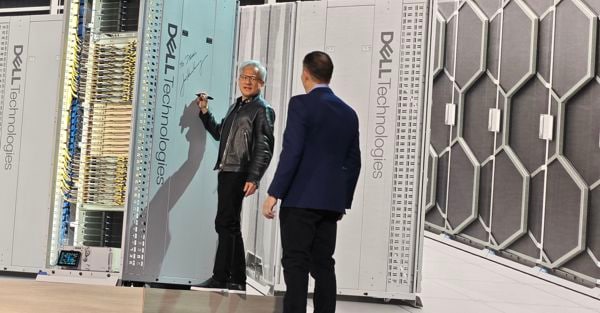
C

s Jensen Huang of NVIDIA, who also took the stage in closing, pointed out, intelligent agents require immensely more computing because they don't just respond to a command, but work autonomously for days using tools and checking results until the task is completed. This can cause costs to skyrocket and, to clarify further, Huang introduced the concept of 'counterless intelligence', promoting an architecture where companies own their own local computing capacity to eliminate the anxiety associated with token consumption and unpredictable cloud costs. Depending on the cases and needs, companies will be able to decide whether to equip themselves with the infrastructure to train models on their own data or to train them externally and then own only the computational part that is needed to run the agents within their walls, protecting trade secrets and allowing each individual engineer to orchestrate fleets of agents to multiply their creative and operational capacity. Michael Dell has made it clear that the technological part of innovation is ready: it is now up to companies to find the balance needed to put it to use.

