
Oil spill in the Navigli canals in Milan: severe damage to the environment and wildlife
Operations to drain the area and remove the oily substances are continuing. The authorities are working to establish the causes of the accident

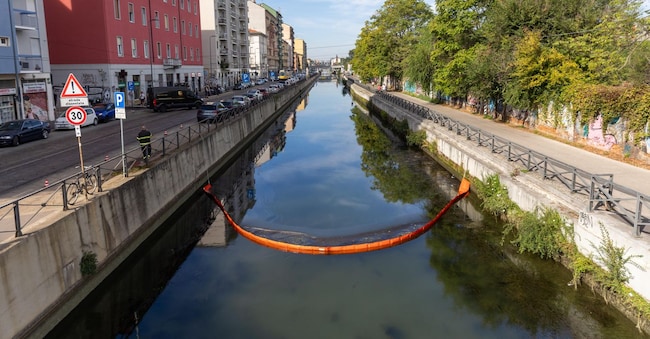
Investigations are continuing to determine the causes of the oil spill, likely diesel, which occurred on Friday 4 September in the Naviglio Grande in Milan. Initial reports identified a large oil slick, which required the intervention of the fire brigade and ARPA technicians in the Pontevecchio di Magenta area.
Measures to contain the spill
During the operations, officers from the local police forces of the municipalities through which the Naviglio canal flows were also mobilised. Initially, a number of floating barriers were positioned near Abbiategrasso, Trezzano sul Naviglio and Corsico, as the oil slick moved towards Milan. Barriers were subsequently installed in the Lombard capital to halt the spreading oil slick. However, the seven barriers did not completely stop the spill, which appears to have spread over approximately 28 kilometres and reached as far as the Darsena in central Milan. The measures managed to contain at least part of the hydrocarbons, but a portion – albeit minimal – also spilled into sections of the canals that run through the city. A smell of used oil has spread throughout the area, which is also very popular with tourists.
Drainage operations
The fire brigade pushed the oil slick towards a junction on Via Conchetta in Milan, at the intersection of the Naviglio Pavese towpath and Via Darwin. There is a lock at this point where the substance can be contained and drained off as much as possible. The aim is to limit the impact of the contamination on irrigation. During the operation, deep barriers were deployed to intercept as much of the hydrocarbon-soaked algae as possible, and rolls of absorbent material were also placed on the surface. The operation was largely successful and prevented widespread contamination of the Darsena and the Naviglio Pavese.
Operations are continuing outside Milan, along the Naviglio Grande, the Naviglio di Bereguardo and the Naviglio Pavese. As a precaution, the inlets feeding the irrigation canals have been closed, in order to prevent any potential contamination of the rice fields and the nature reserves within the Parco Agricolo Sud Milano. “From the very early hours, we have deployed personnel and equipment to contain the spread of the substance along the Navigli system,” says Alessandro Rota, president of the Consorzio Est Ticino Villoresi. “We are taking action at the Darsena and in Gaggiano, and we have closed the outlets of the irrigation channels to protect the rice fields and the nature reserves of the Parco Agricolo Sud. These measures will continue until the situation is fully resolved.”
Environmental damage
“The damage is certainly extensive, with serious consequences for fish and other wildlife, and a major clean-up operation will be required to restore the area as much as possible,” Claudio De Paola, director of the Ticino Park, told ANSA. “There is damage to biodiversity, with contaminated birds. LIPU has informed us that they are trying to treat a soiled swan,” he added, “and we understand that the Villoresi Consortium has commissioned a company specialising in remediation work.”

