Cars and corporate mobility

Old and polluting lorries: race to renew

The average age of Italian trucks is 19.8 years, among the highest in Europe. Diesel dominates and electric remains marginal

by Marco Morino

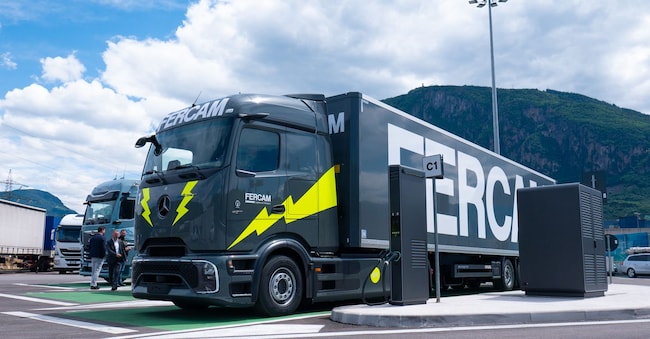
Il Tir elettrico eActros 600 di Mercedes-Benz: il veicolo è impiegato sulle lunghe percorrenze

4' min read

Translated by AI
Versione italiana

4' min read

Translated by AI
Versione italiana

Heavy fleets, trucks and lorries of 3.5 tonnes and above, urgently need to accelerate the ecological transition. The numbers say so and Europe demands it. The average age of Italia's truck fleet is 19.8 years, one of the highest in Europe, according to the latest report published by Acea (Vehicles on European Roads 2026). Out of almost one million vehicles on the road, more than 700 thousand are over 10 years old. Worse are only Greece (22.9 years) and Malta (22 years), while countries such as Austria and Luxembourg are under 10 years old. On the fuel front, the picture is equally critical. Diesel continues to dominate almost absolutely: according to Acea, more than 96% of trucks in circulation in Europe are powered by diesel, and in Italia the situation is similar. Electric vehicles account for barely 0.3% of the heavy fleet. By contrast, the European Union is imposing drastic cuts in emissions from trucks (-90% by 2040), with the aim of achieving climate neutrality by 2050 through progressive electrification and the use of hydrogen.

It is clear that, despite European ambitions on ecological transition, Italy's road haulage sector is struggling to align with decarbonisation targets. Countries that are showing concrete signs of change - such as the Netherlands, Denmark or Luxembourg - remain exceptions rather than replicable models. What is clear from the report is that Italia is indeed a road freight giant, but with an outdated infrastructure base. Its dependence on old, highly polluting vehicles risks becoming a brake on international competitiveness, especially in a European context that is accelerating, albeit with difficulty, towards more sustainable forms of mobility.

Loading...

A push towards fleet renewal could come from the 590 million state incentives provided by the government (Mit-Mef interministerial decree) to be spent over five years. While waiting for the implementing decree with the breakdown of resources by type of vehicle and fuel (first disbursements expected from 2027), it can already be said that the size of the funding and its time horizon allow companies to plan investments that the incentives granted so far, episodic and of modest size, had not allowed. Suffice it to say that the annual allocation for investments by haulage companies has never exceeded 25 million.

Says Riccardo Morelli, president of Anita, the Confindustria association representing road haulage and logistics companies: "The resources made available by the government offer companies the chance to accelerate the transition that is already underway. The process must be accompanied by a coherent European reference framework, which allows operators to choose the most suitable type of power supply, embracing technological plurality. At the same time,' continues Morelli, 'we are against the introduction of mandatory quotas of zero-emission vehicles in fleets'. According to Morelli, the vehicles used by road haulage companies have completely different functions from company fleets in the broader sense. "Putting these two realities together would mean ignoring the specificity of road haulage, which has completely unique economic and operational characteristics and which already today faces reduced margins, strong competition and the need for investment in order to remain competitive," Morelli adds.

Virtuous cases

So far the general picture. But even in Italy there is no shortage of virtuous cases of companies that are already investing strongly in fleet decabonisation. This is confirmed by a selection made by Anita for 'Il Sole 24 Ore' among its member companies. Here are some examples. 68.7% of the Bertani Remo group's heavy vehicles are powered by green fuel (clean fuels): Hvo (renewable diesel) and Bio-Lng (liquefied biomethane). Bertani has reduced the polluting emissions of its fleet by 13% in 2025 compared to 2024 and by 17% in 2024 compared to 2023.

The South Tyrolean Fercam Group is also at the forefront of the fight against emissions. As early as 2021, the company introduced Hvo as an alternative to traditional diesel, initially setting up its own distribution plant to ensure continuity of supply at a time when the fuel was not yet widespread on the market. In parallel, a gradual expansion of the electric vehicle fleet is underway.

In addition to the eActros 600 truck, manufactured by Mercedes Benz and already in operation, new vehicles were introduced on various routes: an additional electric truck for the Bolzano site, an eActros used in Serbia for a US customer in the food and beverage industry, and electric trucks operating on the Bolzano-Munich and Milan-Switzerland routes.

The Arcese fleet is 100% Euro 6: all vehicles can adopt the available alternative fuel (Hvo and Bio-Lng). In addition, the first Mercedes Benz eActors 600 electric truck used for shuttle service for Cartiere del Garda was delivered to Arcese on 1 October 2025. The vehicle will receive energy from the photovoltaic plant in Arco (Trento). To complete the fleet dedicated to this service, another 5 eActors 300 have already been ordered.

Codognotto's vehicle fleet is also undergoing a continuous process of renewal and innovation. Most of the trucks are equipped with advanced Gps systems, which make it possible to optimise routes, reduce empty trips and improve overall operating efficiency, with positive impacts also in terms of reducing emissions. In parallel, the company promotes the adoption of alternative fuels with low environmental impact and is introducing electric vehicles. In this context, it is worth mentioning the collaboration with Volvo and Ikea for the inclusion in the fleet of a 100% full electric vehicle dedicated to long-haul transport.

Gruber Logistics is among the most advanced operators in Europe in the decarbonisation of heavy transport. The company makes extensive use of advanced biofuels, which can reduce emissions by up to 95% compared to conventional diesel. In absolute terms, this translates into around 10,000 tonnes of CO₂ avoided each year. In addition, Grubel Logistics has started the electrification of its fleet with the first 12 electric trucks and has also been among the pioneers in hydrogen, recently commissioning the first hydrogen-powered truck operating in Italia in cooperation with Scania.

In 2025, Logicompany 3 (LC3) achieved an average CO2 emission reduction of 55% compared to 2018 values. The LC3 fleet is divided as follows: 65% Lng (liquefied natural gas) fuelled vehicles, partly Bio-Lng; 30% diesel fuelled vehicles, partly Bio-Diesel; 5% electric vehicles (Bev). Working in the temperature-controlled transport market, LC3 also uses sustainable solutions for trailer refrigeration such as liquid nitrogen and electric.

Copyright reserved ©
Loading...

Brand connect

Loading...

Newsletter

Notizie e approfondimenti sugli avvenimenti politici, economici e finanziari.

Iscriviti