
Old lorries and no support: the crisis facing small-scale hauliers in the South behind the roadblocks
According to the CGIA in Mestre, 40 per cent of businesses are unable to access the diesel subsidies. A third of the sector’s companies are concentrated in the South, where there have been fewer closures

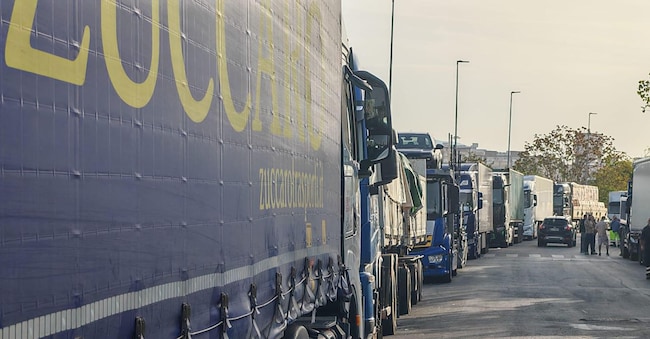
Four in ten businesses are excluded from tax relief on diesel. It is these figures that encapsulate the crisis facing hauliers in the South at the end of a gruelling week that has brought half of Italia to its knees. The estimate comes from the CGIA in Mestre, contained in a statement issued last February and referring to the whole country: it highlights one of the key issues at the heart of the protests.
Euro 3 or 4 vehicles
The operators are small-scale, with individual drivers at the wheel of vehicles that do not meet the necessary requirements to qualify for the discounts. Those working with Euro 3 or Euro 4 lorries are excluded from the tax credit for high fuel prices, which is reserved for Euro 5 and Euro 6 vehicles weighing at least 7.5 tonnes.
Minister Salvini has also confirmed this. Two, three or four lorries ‘not exactly state-of-the-art, i.e. Euro 3, Euro 4’. The regulatory provisions of the road haulage decree – approved in a great hurry at a Council of Ministers meeting convened just a few hours earlier to avert a standstill – apply to these vehicles. Consequently, lease instalments due between 1 November and 31 March 2027 may be frozen, without the contract being terminated. The government has also intervened regarding verbal agreements to provide relief to small businesses.
The decline of businesses over ten years
Meanwhile, the business landscape is shrinking. According to the CGIA itself, between 2015 and 2025 the number of active road haulage firms fell from 86,590 to 67,349 (-22.2 per cent). In the South, the decline stands at 13.1 per cent, compared with 30.8 per cent in Central Italy, and today the South accounts for over a third of the sector’s businesses, totalling 23,802. Campania (-5.9 per cent) and Sicily (-8.9 per cent) are the regions that have seen the smallest declines; Naples is Italia’s leading province with 3,984 companies, whilst Palermo and Caserta, along with Bolzano, are the only regions to have seen growth over the decade.
At national level, the CGIA notes that the decline is also due to mergers and acquisitions, which have primarily reduced the number of firms with a single vehicle, thereby increasing the average size and productivity of the entire logistics sector.

