Test drive in China

Omoda 7 Phev Super hybrid, preview test on Chinese roads: how the new SUV looks and drives

We tested the new plug-in hybrid model along a route of over 1,200 km between Shanghai and Wuhu
by Mario Cianflone

5' min read

5' min read

It boasts a sophisticated powertrain that is probably ideal at this stage of the energy transition where pure electric, especially in Italy, is not winning hearts and wallets.

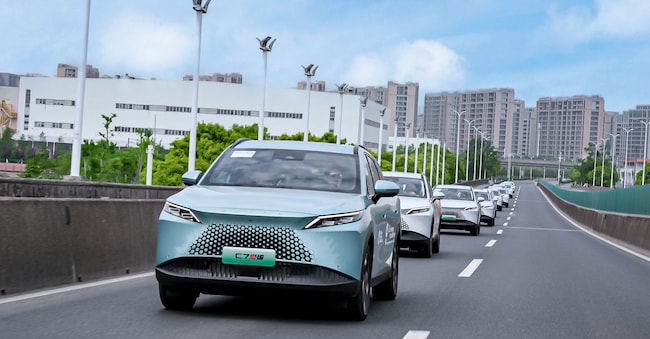
This is the Omoda 7 Phev, a medium-large suv with the same mechanicals and super hybrid platform as the Jaecoo 7 (Omoda & Jaecoo are the two global brands of Chinese Chery). To define this car merely as a plug-in hybrid is decidedly reductive because the synergy between the thermic engine, which in fact acts almost exclusively as a power unit, and the electric unit makes it possible to cut consumption and emissions with an autonomy that exceeds 1,200 km with a 60 litre tank. With good consumption in urban areas and also in extra-urban areas, provided you travel at 'code' speed. 60-litre tank. In fact, after depleting the battery, 100 km range, we recorded about 5 litres per 100 km.

Loading...

We tested Omoda 7, for the first time, on Chinese roads in a journey of over 1,200 km between Shanghai and Wuhu, the 'small' Chinese city with 'only' 2.7 million inhabitants where Chery is headquartered.

Omoda 7 PHEV, dimensions

The dimensions of the car confirm its positioning in the C-Suv segment: the Omoda 7 measures 4620 mm in length, 1870 mm in width and 1670 mm in height, with a wheelbase of 2730 mm. Luggage compartment volume is around 500 litres in standard configuration, expandable up to 1400 litres by folding the rear seat back completely down, thus offering versatility even for bulkier loads.

Omoda 7 Phev, tutte le foto

Photogallery11 foto

Omoda 7, the super plug-in hybrid system: structure and power

The drive system of the Omoda 7 Phev is based on a parallel hybrid configuration, where an internal combustion engine and two electric motors operate in synergy. The heat engine is a 1.5-litre turbocharged direct injection (Tgdi) with Miller cycle, capable of developing 143 hp (105 kW) and 215 Nm of torque. The thermal unit is flanked by two electric motors: the first is intended for traction and provides 150 kW (204 hp) and 310 Nm, while the second is dedicated solely to the generator function for recharging.

The Dht (Dedicated Hybrid Transmission) intelligently manages power flows between the three units, allowing smooth transitions between electric, hybrid and pure thermal modes. The overall power output of the system reaches 347 horsepower (255 kW) and despite these figures, the car is not a lightning bolt, especially in pick-up.


Omoda 7, battery and charging times

.

The Omoda 7 Phev is equipped with an 18.3 kWh lithium-ion battery. This battery pack ensures a fully electric range of up to 100 km, according to values estimated in the urban Wltp cycle, placing it among the best in its class. Recharging can take place either in alternating current, up to 7.2 kW via a domestic wallbox or public infrastructure, with a full recharge in about 3-4 hours, or in direct current, up to 40 kW, allowing 30% to 80% recharging in just 20 minutes.

Omoda 7, driving modes and regeneration

.

The system offers different operating modes that the driver can select as required. In Ev mode, the vehicle runs exclusively on electric power, while the automatic hybrid mode intelligently combines the two powertrains. There is also a Save mode to preserve the remaining battery charge for later use, and a Sport mode designed to maximise performance. The regenerative braking system, adjustable in several stages, allows energy recovery during slowing and braking, further improving overall efficiency.

Fashion 7, the design

.

The styling of the Omoda 7 is inspired by the taut, geometric lines of premium urban SUVs. The front features a large hexagonal grille with a diamond-patterned grille, flanked by full-LED light clusters with an L-shaped light signature and integrated daytime running lights. On some versions there is also Matrix LED technology, which modulates the beam according to the surrounding traffic.

The rear features an LED light band joining the headlights, increasing the visual perception of width. Aerodynamic details, 18- or 19-inch alloy wheels and a slightly sloping roof complete a muscular yet elegant aesthetic.

Omoda 7, chassis, platform and dynamics

The Omoda 7 Phev is based on a multi-energy platform, designed to accommodate both conventional and electrified powertrains. The central arrangement of the battery pack helps lower the centre of gravity, improving stability and road dynamics. The chassis adopts a configuration with MacPherson front suspension and multilink rear suspension, designed to offer an effective compromise between comfort and driving precision. The vehicle is equipped with a full range of Level 2+ Advanced Driver Assistance Systems (Adas), including adaptive cruise control, lane keeping assist, automatic emergency braking and traffic sign recognition.


Omoda 7: infotainment, connectivity and energy management

On board, the cabin of the Omoda 7 Phev is distinguished by its technological and digital approach, starting with the 256 colours of ambient light that can be combined with the driving mode or the type of music being played. The dashboard houses two displays: a central 15.6-inch one and a 12.3-inch one for the driver.

The highlight of the dashboard, the one that once again gives the measure of the hi-tech originality of Chinese cars, is the main display which, with a touch gesture, moves electrically from the centre of the dashboard to in front of the passenger. A useless function, designed to impress? No, on long journeys it is also a useful solution for entertaining the passenger. Certainly not the usual setting.

The infotainment system, which uses the Qualcomm Snapdragon 8155 SoC, is Ota (Over-The-Air) upgradeable and supports major connectivity standards such as Apple CarPlay and Android Auto. Convenient is the wireless smartphone charger with an impressive 50 watts. The on-board system allows real-time display of battery status, energy consumption, engine flows and regeneration. Via a dedicated app, the driver can monitor the state of charge, program recharging and preset the cabin climate control even remotely.

Omoda 7, driving and life on board. Our verdict

The new Chinese SUV, it must be said at once, is maniacally built and finished. Assembly is neat and precise. The quality of the materials is high. What's more, the Omoda 7 is fairly quiet, at least until you push on the gas, at which point, without too much verve, the thermal system intervenes with a decidedly unpleasant noise (like many hybrid cars). The verdict on roominess is also positive: we travelled with four in the marathon on Chinese roads and the Chinese SUV always proved comfortable, with flagship legroom.

Behind the wheel, the car behaves in a healthy manner, much better than other soft and swaying Chinese cars. Rolling and pitching are contained. The steering is good, while the brakes are effective in the final part of the pedal stroke and therefore not as modulable as on western cars.

Judgement suspended on Adas. The car used for the test, not intended for the European market, exhibited abrupt and erratic behaviour. This is an obvious software problem and the cars arriving between October and November, priced under 40,000 euros, should be in line with the manufacturer's standard.

Finally, the ergonomics. There are many controls accessible only from the touchscreen, including the Tesla-style rear-view mirror adjustment, which is unconvincing. Unoriginal are the steering wheel controls that, as happens in much Chinese production, seem to be taken from Tesla. Convenient is the Mercedes-style gear selector on the column, and the buttons on the centre console are easy to recognise.

All in all, the Omoda 7 Phev is a good choice, providing comfort and efficiency, and only finds its limitation in the still immature brand image.

Copyright reserved ©
Loading...

Brand connect

Loading...

Newsletter

Notizie e approfondimenti sugli avvenimenti politici, economici e finanziari.

Iscriviti