Healthcare

European Council 18-19 June addresses Ebola outbreak in DR Congo at Meloni's request

The European Union intensifies health and logistical coordination to counter the Ebola outbreak, while the WHO announces progress on cures and potential vaccines.

aggiornato alle 20:00

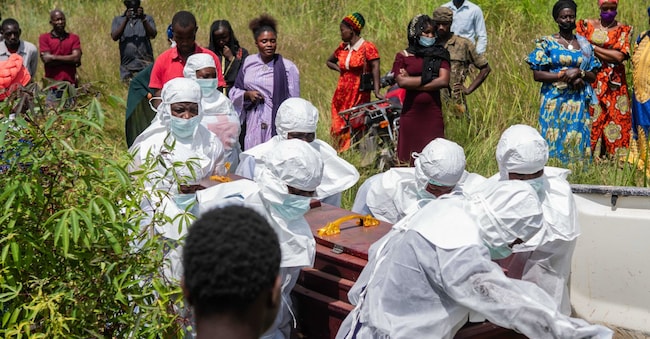
Gli operatori della Croce Rossa preparano una bara contenente il corpo di una vittima dell'Ebola per la sepoltura al cimitero di Rwampara, a Bunia, in Congo, sabato 23 maggio 2026. (Foto AP/Moses Sawasawa) APN

7' min read

Translated by AI
Versione italiana

7' min read

Translated by AI
Versione italiana

European Council President Antonio Costa has decided to add the Ebola epidemic to the topics for discussion at the European Council scheduled for 18 and 19 June. This was announced by a spokeswoman. The request had been made by Prime Minister Giorgia Meloni in a letter.

Ue and Meloni on Ebola

The European Commission confirms 'receipt of President Meloni's letter' and says it will reply 'in due course'.

Loading...

"We reiterate that the protection of public health is the Commission's top priority. We are closely following the evolution of the situation, which requires vigilance and coordination". This was stated by Eva Hrncirova, Commission spokesperson, recalling that the EU has "channels and tools to act quickly" and that it is "mobilising aid, logistical resources, expert support and health security tools to help affected countries and reduce the risk of further transmission".

Repubblica democratica del Congo, guarito paziente positivo a ebola

The first healing

Meanwhile, the World Health Organisation announced the first case of recovery of an Ebola patient in the epidemic raging in the Democratic Republic of Congo.

'DR Congo reported that on 27 May a patient recovered, left hospital and was discharged,' Anais Legand of the WHO told reporters, adding that it was the 'first case'.

New drugs and vaccines identified

In addition, the World Health Organisation has identified the most promising drugs and vaccines to be fielded against the ebola epidemic from the Bundibugyo strain in the Democratic Republic of Congo. However, especially for vaccines, it could take no less than 2-3 months for the new products to become available for testing.

In recent days, the agency's technical committees met and reviewed the available studies, identifying 'several products sufficiently promising to warrant priority evaluation in clinical trials', the WHO notes. On the vaccine front, the focus has been on two products: one is the heir of the Covid-19 vaccine developed by the University of Oxford, which in this case is working together with the Serum Institute of India. The other vaccine is developed by Iavi, a non-profit biomedical research organisation that develops vaccines and antibodies for HIV. At the moment it is 'the most promising', says the WHO, but the timeframe for starting trials is long: 7-9 months.

Therefore, 'it may not be an option to evaluate in the current epidemic'. The timeframe for the Oxford-Serum Institute vaccine is quicker (2-3 months), for which, however, 'further animal data are still needed'. This is why the already approved vaccine against the Ebola Zaire virus (Ervebo) is also being looked at carefully.

On the treatment front, the options analysed by the WHO are 'at different stages of development'. Here the focus fell first on the antiviral remdesevir (approved during the pandemic to treat Covid-19). Another product (MBP-134) is a cocktail of monoclonal antibodies developed from the samples of a patient who had contracted Ebola. Lastly, a monoclonal antibody (maftivimab), already approved as a component of a combination drug against the Zaire strain of ebola (Inmazeb). Some of these options, together with the antiviral obeldesivir, could also be useful in reducing the risk of developing the disease in those who have been exposed to the virus.

Oms: in DR Congo 125 confirmed cases, of which 17 deaths

The World Health Organisation (WHO) said that authorities have reported 125 confirmed cases in Congo, including 17 confirmed deaths. In addition, there are 906 suspected cases and 223 suspected deaths. Neighbouring Uganda has confirmed nine cases and one death, the Ugandan Ministry of Health said.

Negative test for doctor returned from Congo

The test performed on the Médecins Sans Frontières doctor returning from the Democratic Republic of Congo, who had come into contact with patients who tested positive for Ebola, was negative.

'This is a surgeon who has no symptoms, but has nevertheless authorised the test, which came out negative. The test was carried out at the Spallanzani in Rome, where the doctor is now in quarantine,' the Ministry of Health announced.

EU: first of all adopt exit 'screening' measures

The European Commission received the letter sent to the heads of the EU institutions by Prime Minister Giorgia Meloni calling for greater coordination in border controls in light of the Ebola outbreak in the Democratic Republic of Congo and will respond 'in due course', but for now the recommendation is to take measures to 'screen' people coming from the affected areas.

The member states' representatives in the Health Security Committee, the spokeswoman continued, 'also regularly discuss the issue oftravel management from the Democratic Republic of Congo and Uganda.

Last week, the Health Security Committee, in agreement with the Member States, issued an opinion stating that, at this stage, the most important measure to be taken is screening out of affected regions.

Nigeria, 21 out of 36 inland states at risk of importation

Nigerian public health authorities have identified 21 of the country's 36 states as being at 'high' or 'moderate' risk of Ebola importation, amid growing concern about cross-border transmission.

In a statement, the Nigerian Centre for Disease Control and Prevention (Ncdc) said recent Ebola outbreaks in parts of East and Central Africa have increased the risk of the disease being imported into Nigeria, although no confirmed cases have yet been recorded in the country.

Jide Idris, director-general of the NCDC, said the World Health Organisation's declaration of the Ebola outbreak as a 'public health emergency of international concern' underscores the need for Nigeria to strengthen preparedness efforts.

He also warned that the symptoms of Ebola are very similar to those of malaria and Lassa fever, which increases the risk of late diagnosis and further transmission.

With a population of over 242 million, Nigeria is the most populous country in Africa and the sixth most populous in the world.

In Italia towards new ministry circular

Transparent yes, but also reassuring: speaking on Unomattina about Ebola, Maria Rosaria Campitiello, head of the Health Ministry's Prevention, Research and Health Emergencies Department, makes things clear: "We have no cases of Ebola, no infected people in Italia".

The ministry, he adds, is preparing 'an ordinance and a circular that will clarify the risk assessment and enable every health worker, every region, to understand what to do if faced with a case that may be probable, possible or suspected'.

Ebola is scary. Campitiello recalled that in the minds of compatriots still lurks 'the unconscious reflex of the memory of the Covid pandemic, but we are not in that situation.

Bassetti: Meloni hit the nail on the head

"The Ebola situation is also continuing to worsen because of the USmyopia, which has cut off economic and health aid to Africa."

In Italia, on the other hand, 'Giorgia Meloni shows that she is further ahead than many others in Europe and has called for greater vigilance and coordination at European level'. Thus in a post on Facebook the infectivologist Matteo Bassetti on X, head physician at the Policlinico San Martino in Genoa.

Msf: DRC conflicts and more than 5 million displaced

The vagueness of the numbers of the Ebola epidemic, which has spread from the Democratic Republic of Congo to Uganda and may have reached South Sudan, is striking. According to the World Health Organisation, the Bundibugyo virus has caused 125 confirmed cases, 17 deaths and 906 suspected cases (with over 223 deaths) in the provinces of Ituri, North Kivu and South Kivu alone. But these are only estimates and suspicions.

"Responding to a serious Ebola outbreak is extremely difficult in a context characterised by a severe humanitarian crisis and ongoing armed conflicts in the eastern provinces of the country, particularly in Ituri and North Kivu," Doctors Without Borders told LaPresse LaSalute.

"The affected areas are characterised by insecurity, poor infrastructure, complex governance, chronic poverty, significant population movements and severely pressurised health facilities. All factors that hinder surveillance, contact tracing and timely treatment: key pillars of an effective response," say Msf.

More than 5 million internally displaced persons are concentrated in North Kivu, South Kivu and Ituri, with 96% of the displaced caused by armed violence. Indeed, in Ituri province in particular, clashes between non-state armed groups and government forces 'have intensified, causing the internal displacement of nearly one million people.

In the first three months of 2026, more than 100,000 new displaced persons were registered in Ituri,' Msf estimates. Here, the organisation is present with medical teams supporting health facilities and providing urgent medical care.

In the first four months of this year, in the provinces of Ituri and Tchopo, Msf carried out more than 66,000 primary healthcare visits and more than 800 surgeries at the Salama Hospital in Bunia.

The Democratic Republic of Congo has faced 16 Ebola epidemics since 1976. In short, 'we are not starting from scratch', Msf emphasises.

Dg of Africa Cdc: vaccine and drug against Bundibugyo within the year

"What we can say with certainty is that by the end of this year, 2026, Africa Cdc will ensure that we will have a vaccine and a drug against the Bundibugyo virus." This was assured by the director general of the African Centres for Disease Control and Prevention (Africa Cdc) Jean Kaseya, during yesterday's latest briefing on the ongoing Ebola emergency in the Democratic Republic of Congo, with cases also recorded in Uganda. 'To date we have no approved vaccines and drugs,' he explained, 'We have some candidates. I also received a message from the Russian health minister informing me that Russia has developed a vaccine. My team is working with the Russian team and all other partners to understand'.

In this regard, an expert from the African Union's public health agency team went on to specify that this Russian vaccine is targeted at theZaire species of Ebola virus and that meetings with Russian researchers will clarify why they believe it can also be effective against Bundibugyo.

Hantavirus: pharmacologist, experimental antiviral cru in France, Spain and the Netherlands

While the health authorities' focus is on Ebola, the Hantavirus outbreak has 13 cases and 3 deaths, with several patients hospitalised in the Old Continent.

Precisely in response to the health emergency linked to the ship Mv Hondius, the European Commission coordinated the dispatch of the first 1,400 doses of an experimental antiviral treatment to the member states that requested it: France, Spain and the Netherlands.

'This marks a crucial step in the management of a pathogen for which, to date, there are no officially approved therapies or vaccines,' Carlo Centemeri, a clinical pharmacologist at the University of Milan, told LaPresse LaSalute.

"Since the first reports, the European Commission has been in constant contact with the health authorities of the Member States to monitor the clinical evolution of patients and ensure rapid access to potential medical countermeasures. The timeliness of the request from Paris, Madrid and The Hague enabled the immediate activation of extraordinary supply channels,' the pharmacologist notes.

Copyright reserved ©
Loading...

Brand connect

Loading...

Newsletter

Notizie e approfondimenti sugli avvenimenti politici, economici e finanziari.

Iscriviti