
On the catwalk, lightness and intimism as a response to the turmoil of the present
From Lemaire to Wales Bonner, in search of a newfound serenity the collections subtract, lighten up, renounce all superstructures

3' min read
3' min read
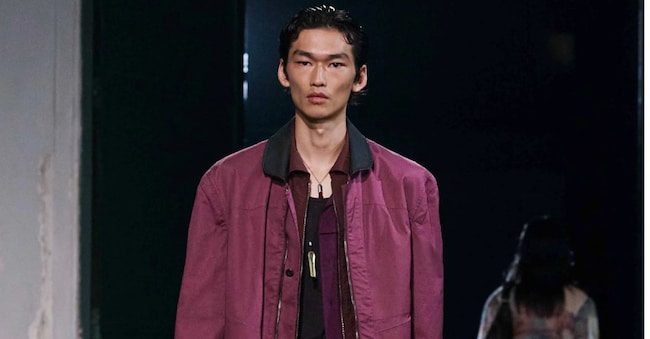
Scorching temperatures, sector crises, slow circulation of ideas, warmongering temperament are all producing evident results in fashion at the moment. The Paris fashion shows, like those in Milan, are a concrete demonstration of this: there is a subtraction, a lightening, a renunciation of all superstructures, be they material or conceptual, to explore a fluctuating and weightless dimension, serene and human, and to draw the figure of a fragile man, perhaps only in appearance.
At Lemaire, Christophe Lemaire and Sarah Linh Tran continue to explore the horizon of fashion as an expression of a barely idealised everyday life. They create clothes to be worn for real and to live in, not creations designed for posing. There is an inspired pragmatism in their design method that results in garments that everyone can interpret in their own way. Taut and gently severe, the new test comes from the idea of capturing, or perhaps just suggesting, the instinctiveness and calculation that guide everyday dressing as acts of individual representation. The experiment succeeds with ineffable precision, highlighting just how close the link is between style and psychology.
Speaking of the psyche, Hed Mayner, an author as influential as he is outspoken, abandons the boxy, enormous and protective volumes that brought him so much praise to investigate a lighter, more sensual silhouette, made up of lines that touch or reveal the body and impalpable materials. By exposing skin and forms, Mayner renounces the idea of the dress that shields and contains, accepting the risk involved, and finds a new vein that is light and present. The proof is convincing, but still seems to be suspended in limbo between before and after, between what was and what could be: it marks a gap, but one that needs further investigation.
The answer of Walter Van Beirendonck to the fat and inhuman times is his obstinacy in continuing to look at everything with the stars in his eyes, striving to find joy and lightness even where these are no longer. A difficult, perhaps impossible task, and it is no coincidence that Van Beirendonck's young men, with their high-contrast ensembles, seem to have stepped out of a disco club, or an artist's studio, to embark on an interstellar journey. The vision of lysergic infantilism both enlightens and immalinates.
The upper class elegance that permeates the work of Wales Bonner is poignant, at times decadent, but it does not stem from a desire to lock oneself in an ivory tower and reject the present. Rather, it is driven by an urgency to contextualise the sartorial exquisiteness and bland formalisms of a world that no longer exists in the present moment, with all its attendant frictions and anachronisms. His is essentially a delightful vision of style, one that is admired for its expertise and intact beauty, while the collaboration with Adidas, cunningly, keeps the house running.

