
On the road leading to my rainy villages
One day I drew up a map of a land that doesn’t exist. Just as Faulkner’s county forms the basis for the stories I’ve written. Alleys, farmsteads, villages: material for a novel

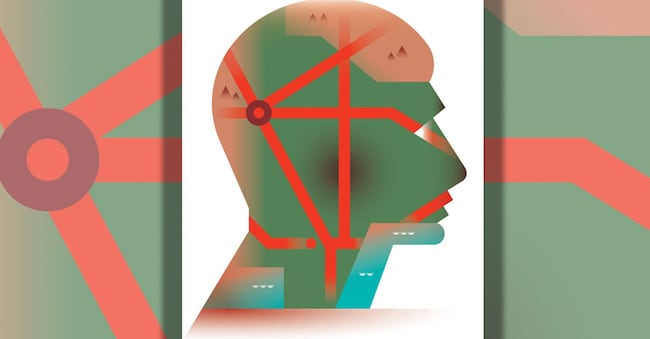
I must confess that I’ve always had a soft spot for the fiction of William Faulkner, ‘Uncle William’ as I used to call him back in my university days – a gentleman of refined manners who would sit in a rocking chair smoking his pipe, gazing into space, his feet propped up on the table. I liked the quirky way in which he constructed his stories, setting them within that imaginary map he had christened Yoknapatawpha County: a patch of land no bigger than a postage stamp, as he put it, which coincided with the state of Mississippi, where he was born.
One day, I too created the geography of a land that does not exist. I took a sheet of paper, closed my eyes and let my pencil run free: houses, stairways, small terraces, rooftops and chimneys framed by the gentle curves of the mountains that have stood there, unchanged for centuries. My stamp features many villages that would later find their way into my books – some in the titles (Celenne, Agropinto, Palmira), others within the pages (Vitalba, Caldbanae). And there are also scattered farmsteads (Spineta, Dragoni, Colonnella, Maldirupo, Camasta, Bruciapelo, Boccadilupo), small hamlets at the crossroads of footpaths with their rural multi-grade schools (San Martino, Camarda, Serra San Vito, Piana di Cartofiche), three shrines (the Madonna del Laudato in the centre, the Madonna del Carmine in the Civita woods, the Madonna di Pierno in the Bufita woods), a watermill, the Boschito railway signal box and two streams, the Levata and the Pidocchio, which flow into the Vitalba river. At the point I had reached, only the name was missing, but to resolve this problem I would have had to wait many years – at least until I stumbled upon that line by Dante, who writes in *Purgatorio*: “Then it rained into my lofty imagination”. He does not say ‘upon’ but ‘into’, suggesting that the imagination is a vast box in which memories, ideas, images and dreams are bathed by what falls from the clouds.
If the places on my map are figments of my imagination, it’s a sign that they’re drenched in rain. ‘Here they are,’ I kept telling myself, ‘here are my rainy villages!’ Now that I’d found a name for them, they were no longer just improbable lines drawn on a whim, structures seeking stability upon which autumn had continued to linger with its rains, but a sort of homeland where I could continue to dwell during the Milanese winters, to overcome the obsession with forgetting what my life had been like after leaving Lucania.
Every evening I would spread out the map, and the more I traced the lines with my finger, the more I saw those places blurring within me, losing the quality of memories and becoming dreams. The streets stretched out, the rooms where my childhood had been spent took on absurd proportions, and the faces and voices of the people I had said goodbye to were transformed into something governed more by the laws of imagination than by those of memory. So, in the end, everything took the form of a land that no longer existed, but which was represented by a sort of geography that my fears and hopes had altered and that only I could decipher. I would return to my rainy villages whenever I felt lonely, and I felt at ease within their walls, sheltered from my uncertainties, protected as if within the ancient cradle of my childhood. My memory had been transformed into a utopia, and my ‘postage stamp’ of land had definitively taken on the shape of the whole of Lucania, which was – and still is today – a small but distant region. It may seem like a contradiction, but that is how it is, and the time it normally takes to travel from the north to the south of the map – that is, from the Vulture area to Mount Pierno – defies any Western standard due to the winding roads and the unmodernised railways.
It is as if time were keen to lose itself in the bends of the roads, and it happens that even sat-navs lose their bearings, get stuck and leave motorists high and dry. It’s not uncommon to come to a junction and find yourself faced with two road signs pointing to the same place, but in opposite directions: do you reach Palmira, Agropinto, Celenne, Caldbanae or Vitalba by turning right or left? It’s hard to tell by looking at the map that has kept me company on those Milanese evenings, whilst I’ve been living as a voluntary exile, waiting for darkness to fall so I can make peace with my own ghosts.


