On the road to Kazakhstan, the 'state of nomadic men'
A travel story retracing the exploits of Genghis Khan and Tamerlane

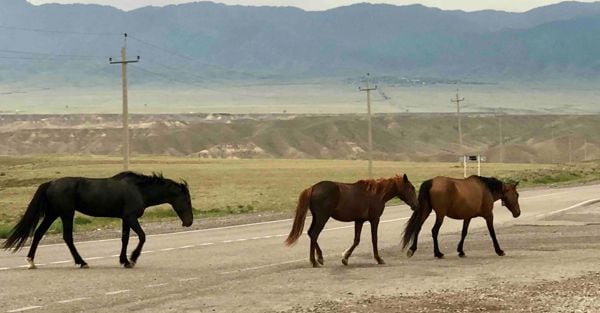
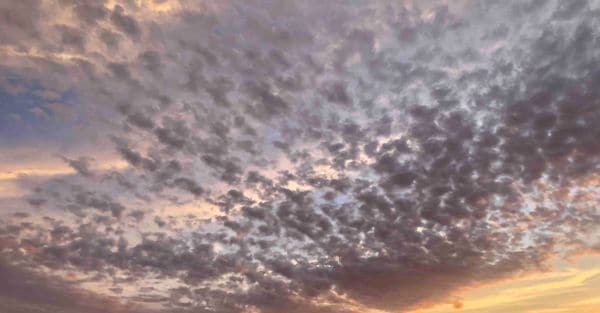
According to a famous definition, the Silk Road was the space where 'a virgin can walk undisturbed with a gold plate on her head'. A condition that mainly occurred with the 'pax mongola', an oxymoron evoking the absence of turmoil, but only thanks to the terror inoculated by Genghis Khan and his successors in the vast space from the Mediterranean to China, razing cities to the ground, building towers of skulls and using defeated rulers as stepping stools. Something similar happened in Otrar. I arrive there after a half-day's journey from Šymkent, driving across a semi-desert plain. Sand devils, herds of camels and horses in the wild accompany the route under a vast sky criss-crossed by flocks of fast-flowing clouds. Otrar was one of the largest oases on the Silk Road.
Kazakhstan means 'state of nomadic men'
Today, all that remains are a few ruins and a remote-sounding name in Turkestan, the southern region of Kazakhstan, a state the size of Western Europe, but with a population of not even twenty million, where Mongol, Persian and Russian influences have stratified and now, following Stalin's deportations, more than a hundred ethnic groups live. Kazakhstan means 'state of nomadic men' and for millennia, this name has indicated a territory of people devoted to herding and transhumance under tents called yurts in a climate ranging from freezing to scorching hot.
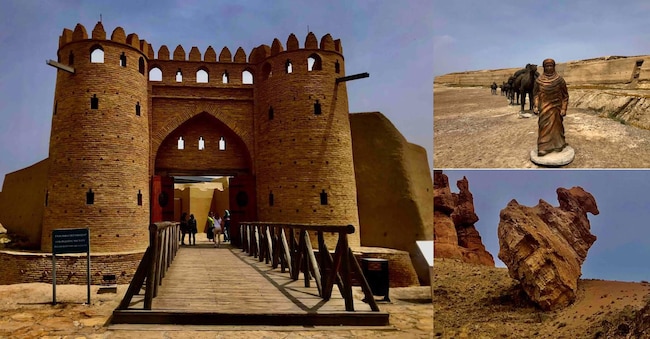
The remains of the legendary Otrar blend in with the reddish soil, creating varying degrees of ruin, between dust and stone. Around a walkway, at the archaeological site, I see bones poking out. "They are human bones. During and immediately after the destruction of the city, people were no longer buried, but left where they fell,' the guide explains. Otrar was a caravan oasis, an aggregation of fortified structures beside the Syr Darya river, at the intersection of several Silk Road routes. One of these structures has been reconstructed and is entered between two towers through an imposing, crenellated gate. Outside the walls a caravan of camels laden with goods, led by a Bedouin in desert attire, waits to enter. They are all obviously sculptures because camels are now only for fermented milk, the Kazakhs dress European-style and transport goods by truck.
The destruction of Otrar in 1220 was due to the massacre of a caravan of 450 Mongol merchants bringing silks, silver and precious furs to the city and was the premise for the subjugation of Khorasmia, an Islamic empire that included the cities of Samarkand and Bukhara, now in Uzbekistan. The merchants often supplemented their income by working as spies, but their mission was also diplomatic and to attack them was an affront also because they were envoys of Genghis Khan. The governor of Otrar, Inalčuk, would be punished by pouring molten metal into all his orifices.
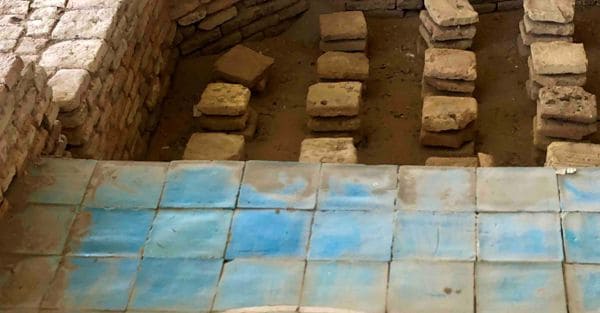
Among the most recognisable and colourful remnants of the Otrar ruins is a floor with circular basins and powder-blue tiles, among which a pattern of intertwined swastikas stands out. 'Swastika' is a Sanskrit term derived from 'swasti', 'well-being'. It is an auspicious symbol and, according to René Guénon, represents the rotation of the stars around the Axis Mundi. The Nazis, in their search for esotericism, adopted the symbol, 'rubbishing' it forever. "The Fall of Otrar", a sepia-toned film by Kazakh director Ardak Armiklulov, circulates freely on YouTube in fragments or full versions and looks like a classic of the Soviet avant-garde, but it dates back to the period of the collapse of the USSR (1991), and allows us to immerse ourselves in the atmosphere of the siege.