
On two wheels in the lunar setting of Lanzarote
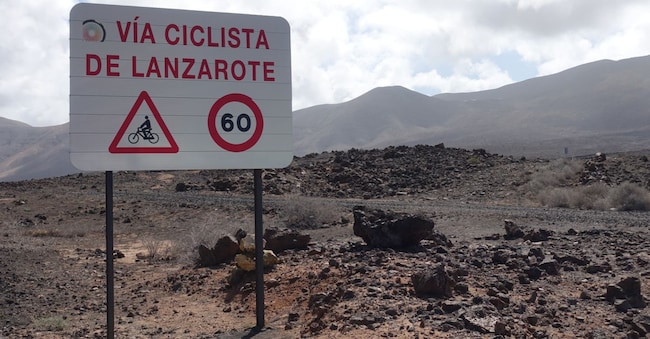
The island in the Canary Islands archipelago, in the middle of the Atlantic, has focused on tourism, without neglecting sustainability, betting on cycle tourism: a 180 km cycle path, which can be extended to 300 km, within everyone's reach with gentle climbs amidst lava and volcanic cones. The only risk is the wind...

6' min read
6' min read
"On the first of December 1730, between nine and ten in the evening, the earth suddenly opened up near Timanfaya, two leagues from Yaiza. The first night a gigantic mountain rose from the bosom of the earth and from its summit rose high flames that continued to burn uninterruptedly for nineteen days. Shortly afterwards a new chasm opened up from which a river of lava flowed out". Thus begins the diary of Don Andrés Lorenzo Curbelo, parish priest of Yaiza, a small village in the interior of Lanzarote, archipelago of the Canary Islands, Atlantic Ocean, off the African coast of Morocco, a remote fragment of Europe belonging to the Kingdom of Spain.
Curbelo was an eyewitness to a terrifying phenomenon: one of the most violent volcanic eruptions of modern times, which reshaped the face of Lanzarote, giving it its present-day appearance. Dozens of villages were destroyed. A large part of the island was flooded and submerged by rivers of incandescent lava. The eruptions lasted six interminable years: from 1730 to 1736. Then, just under a century later, new eruptions came back to ravage the island in 1824. After the cataclysm, 140 extinct volcanic cones and hundreds of square kilometres of lava fields, the so-called malpais, remained.
Where the primordial power of volcanoes, active until the day before yesterday, reigns
.In this strip of land, discovered by Europeans in 1312 thanks to the Ligurian navigator Lanzerotto Malocello, it is the primordial energy of volcanoes that makes and breaks. However, the events that have shaped the landscape do not date back to remote eras. The entire Canarian archipelago emerged twenty-five million years ago from the depths of the Atlantic. But the current appearance of Lanzarote is the result of intense volcanic activity less than three centuries ago. In a geological time perspective, it is like saying the day before yesterday.
While in Leipzig, Bach was composing the Well-Tempered Clavier, poor Curbelo watched in terror as the forces of nature, both destructive and creative, were unleashed, prompting the curate to ask the ecclesiastical and civil authorities for permission to leave the island, at least temporarily, since a decree by Philip V, King of Spain, forbade the approximately 4,000 inhabitants to seek refuge elsewhere.
It should be made clear at the outset that Lanzarote is on the circuit of international mass tourism, particularly from Germany, Great Britain and Northern Europe. Tourism arrived in the 1970s, more or less coinciding with the end of the Franco regime in Spain. And it was an opening aimed at intercepting the large tourist flows generated by the advent of low-cost airlines, which suddenly made the once remote and inaccessible Canary Islands a destination within everyone's reach. The pleasant climate twelve months a year makes the archipelago a favourite destination for pensioners from Northern Europe.


