
The future of oncology: challenges and opportunities
Digital Round Table RADIO 24 – 19 October at 3.00 pm. Moderated by Nicoletta Carbone

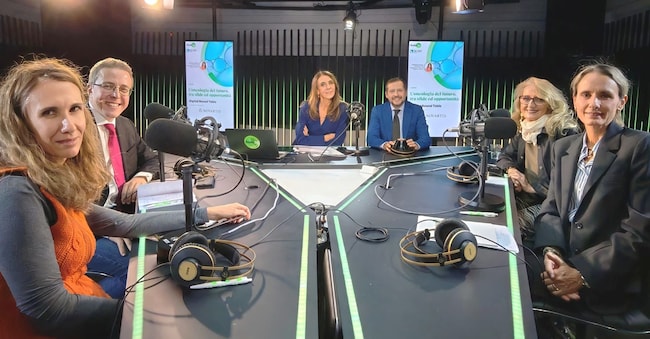
Cancer research has changed the course of many diseases: today, more people are being cured, living longer and, in many cases, enjoying a better quality of life. In Italia, over the last decade, cancer mortality has fallen by 9 per cent, with survival rates exceeding the European average. This is good news that brings with it a new responsibility: to ensure that scientific progress translates into tangible opportunities for all patients, regardless of where they live.
This is the central theme of the Digital Round Table, ‘The Future of Oncology: Challenges and Opportunities’, hosted by Nicoletta Carbone, a journalist and health correspondent for Radio 24. The discussion brought together key figures from the scientific community, institutions, industry and patient organisations to address a crucial question: how can the pace of research be translated into timely, sustainable and universally accessible solutions?
Representing the scientific community were Massimo Di Maio, president of the Italian Association of Medical Oncology (AIOM), and Giuseppe Curigliano, president of the European Society for Medical Oncology (ESMO), who were invited to take stock of the progress made and the new frontiers in research. The discussion also involved Emanuele Monti, president of the Lombardy Region’s Commission for Social Sustainability, Housing and the Family and a member of the AIFA Board of Directors, to explore the role of institutions in resource planning and in ensuring equitable access to care.
Alongside the institutional and clinical perspectives, the discussion also covered the topics of access to innovation and the development of new therapeutic solutions, with Roberta Rondena, Head of Value and Access at Novartis, and Marco Rago, Medical Head of Oncology at Novartis. On the subject of patient experience, Adele Patrini spoke on behalf of CAOS and Europa Donna Lombardia, bringing the associations’ perspective to the table. The clinical dimension was explored in depth by Professor Carmen Fava, a haematologist at the Ordine Mauriziano Hospital Trust in Turin, University of Turin, and by Claudio Vernieri, Associate Professor of Medical Oncology at the University of Milan, oncologist at the IRCCS National Cancer Institute Foundation in Milan, and Director of Research into Tumour Metabolism at IFOM, the Institute of Molecular Oncology of the AIRC Foundation.
One of the key issues concerns the time lag between the approval of a new treatment and its actual availability in different regions. Waiting times and regional disparities risk leading to unequal access to treatment. Reducing these gaps means strengthening healthcare networks, streamlining treatment pathways and ensuring consistent standards of care.

