
Ondina jumps over obstacles and prejudices
Glimpses and examples. The athlete won the 80 hurdles in Berlin '36, fascism 'used' her for propaganda. But her gold paved the way for the Italian women at the Games

5' min read
5' min read
First forever. Who will ever steal that record from her? Not even if a bionic woman is born. Before Sara, Valentina and Federica, icons of Italian sport, Ondina Valla ignited the pink revolution. Her gold medal at the 1936 Berlin Games was the first in Italian women's five-ring history. She overcame ten obstacles in 80 metres and the prejudices that nailed women to the corners of society. They only had to give children to their country, not go around Europe with their thighs out sweating and subverting the established order. Ondina ran out of the chorus, perhaps without realising it fully, but she opened the waters of a new era and Marco Tarozzi recounts her in Ondina. Il sorriso che ha cambiato il mondo (Ondina. The smile that changed the world), with a wealth of images and period newspapers.
Between Vittorio Pozzo's two world championships, Nuvolari's speed and Ginettaccio's first victories, the star of a young girl born in 1916, in Via della Ferriera, in Santa Viola, on the outskirts of Bologna, rises. After four boys, here was the long-awaited girl. Dad Gaetano, a workshop under the two Towers, named her Trebisonda, after the Turkish city on the Black Sea, to wish her dreams and wonder. Not an easy name, but the little girl does not care. She plays with her siblings, spends endless afternoons jumping rope and running: this is how her muscles are born, even if mother Andreana does not like it. And at school he shows his best. On 23 June 1927, at the Bologna Cup, he jumped 3.52 metres in the long jump and 1.10 metres in the high jump. It was impossible not to notice 'that slender girl with thick, frizzy hair and an impossible name', as Vittorio Costa, regional president of the federation, former athlete and talent scout, described her. She trained with her father's blessing and, at the first international meeting in 1928, at the Littoriale in Bologna, the one where the Bologna team that shook the world played, she won the high jump and the long jump. At that time, a friendship and rivalry was born with Claudia Testoni, also a sprinter, also from the Bologna Sportiva club and together at the Regina Margherita institute, a reference point for the city's middle class. In 1929, another international meeting with five countries and "Il Resto del Carlino" wrote: "Valla is 13 years old and has jumped marvellous measures for being so young, which, together with the confidence of style, testify to a class so sure of its maturity".
In 1930, the turning point: at the age of 14, he won the Italian titles in the 80 hurdles, the high hurdles and the high jump. He also changed his name. Marisa Zanetti, accompanist of the national team, shortened Trebisonda to Onda, and Ondina was a dive. Although the athlete, in 1994, explained that the nickname was born by mistake: a journalist misinterpreted the name Trebisonda as Trebitonda. From there to Trebitondina the drop is short, and definitive. Be that as it may, these were years of great racing, his talent was multifaceted and the results many: he was called up for the national team for the first time and set the first (of 21) Italian record, a 14" in the hurdles (his for 18 years, from 1937 to 1955, in the high hurdles). Then the 1931 Grace Olympics and the desire to go to the 1932 Los Angeles Games. But the Lateran Pacts had just been signed and the Vatican vetoed it: 'I would have been the only woman on the athletics team and so they told me that I would have created problems on a ship full of men. And that it was not acceptable to see a woman running undressed overseas'.
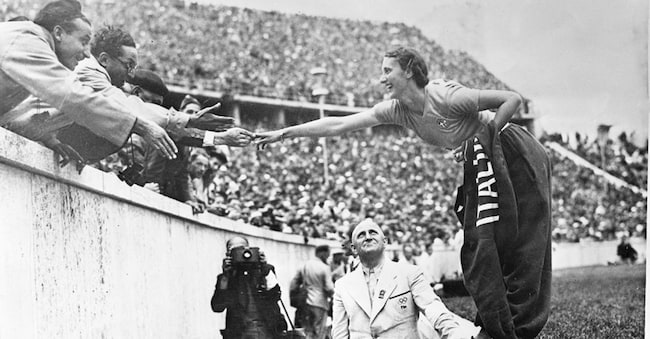
Four more years and Hitler's Germany, in a sort of sportwashing ante litteram, hosts the 11th Olympiad. Pure propaganda, exaltation of the Aryan race, great direction by Leni Riefenstahl. Italy participated with 13 women: the men were housed in the Olympic village, the athletes in a kind of impregnable military academy. Among them were Ondina Valla and Claudia Testoni, friends-rivals. In the 80 hurdles, 22 athletes are entered. The heats were held on 5 August: Ondina was a lightning bolt in the semifinals, 11"6, a world record. Then, the next day, the final, in front of 100,000 spectators and as many swastikas. Ondina could not lift her right leg and coach Boyd Comstock, called from overseas to speed up Italian athletics, handed the masseur Giarella some sugar cubes soaked in cognac: 'Make her swallow these, they will do her good'.
At the start six sprinters, also the Führer's favourite, Anni Steuer. Ondina believes: "My bib number 343 said it all, the sum gives ten, zero doesn't count, one remains. I was sure I would win'. Claudia Testoni starts well, Ondina recovers. One, two, three steps, hurdle. One, two, three steps, hurdle: "At 50 I was in line with the first ones, then I closed my eyes and threw myself on the wire. I felt the caress of the wire and my body became impalpable, empty, light'. Milliseconds, millimetres for Olympia's glory. After 45 minutes, the photo finish crowned Ondina Olympic champion, the first Italian woman in history: 'They said I had won only because I had thrown my chest forward. Bullshit, I wasn't that shameless. She was simply the strongest, so much so that Hitler wanted to meet her: 'He was small, ugly, ridiculous, like Charlie Chaplin did in The Great Dictator'.


