
One million satellites by 2040: risk of collisions in orbit
Benvenuti (Cps): ‘We need a supranational body to regulate the use of satellites"’
by Leopoldo Benacchio
 Aggiungi Il Sole 24 Ore
ai preferiti su Google
Key points
Progress is pitted against itself, and the battlefield is the sky. The question is: who will win? It is a question far less surreal than it might seem at first glance.
The question can also be phrased differently, in a way that too seems a little strange: is the sky a common good, or is it the new ‘Wild West’ – the one from those 1960s films about cowboys and Indians, which are now politically incorrect?
Dual-use: civil and military
On the one hand, progress has led us to utilise a very narrow band around the Earth, ranging from 200 to 2,000 kilometres, to place thousands of satellites that are now essential for our comfortable way of life, which is constantly supported by GPS, optical and radar observation of events for agriculture, marine conservation and a myriad of other applications, and, above all, for telecommunications: voice, data and now even the internet. The latter – the preserve of SpaceX, OneWeb and now Amazon too – began as a civilian initiative but has since proved, with the wars in Ukraine and the Middle East, to be extremely useful for military purposes. It has also shown us that everything orbiting the Earth always has dual-use applications, both civilian and military.
Here on Earth, we have dozens and dozens of telescopes and radio telescopes that have been studying the sky for decades; we have just inaugurated one – the Vera Rubin Telescope, named after the great scientist – which promises to provide us with exceptional data for studying the universe. We are also building the largest optical telescope ever conceived, the ELT (Extremely Large Telescope), with a primary mirror 39 metres in diameter. And this is being done by Europe, with excellent Italian industrial and scientific involvement, in Chile, where Europe already operates the four largest and most efficient telescopes in the southern sky. In the field of radio astronomy – stars and all other celestial bodies also emit electromagnetic waves of various wavelengths – we are building the Square Kilometre Array (SKA), a radio telescope equivalent to one square kilometre, comprising hundreds of antennas working in unison, spread across South Africa and Australia.
Welcome (Cps): ‘An organisation to manage satellites’
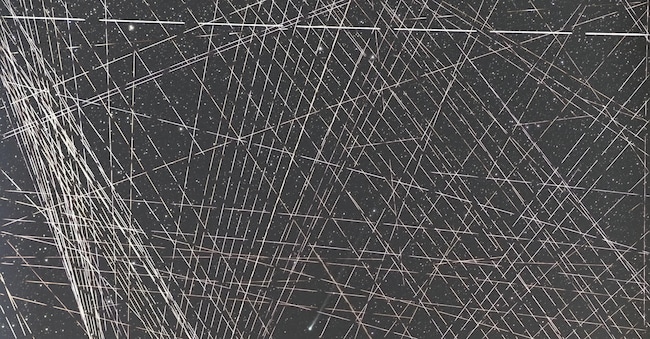
Quite simply, as the number of satellites increases, we risk completely obscuring these technological marvels. Yet we cannot do without them, even as other initiatives – which are, to say the least, questionable – are being proposed. For example, there are plans to use the sky, day and night, to display giant advertisements; or there is talk of a project to send enormous mirrors into orbit to reflect sunlight back towards the Earth’s surface at night, with disastrous effects on flora, fauna and our circadian rhythms, which are already severely strained by civilisation.

