
One year ago Satnam Singh, victim of forced labour, died in Latina
Today in the prefecture the summit with institutions and trade unions. Flai-Cgil: no step forward to prevent exploitation in the fields
3' min read
3' min read
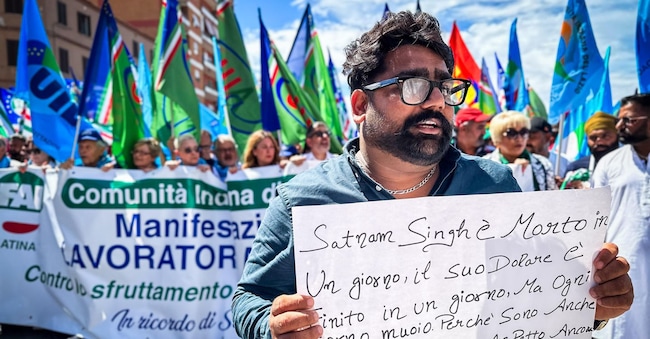
One year ago, in the Latina countryside, Satnam Singh bled to death. It was 19 June 2024 when the young Indian labourer, exploited in the Agro Pontino without a contract, was brutally abandoned in front of his home without an arm, bleeding to death, because his employer did not want to risk a hospital report. His death shook consciences. Thousands of people took to the streets to say no to 'caporalato'. On the emotional wave, even the government led by Giorgia Meloni promised a tough fight against exploitation in the fields.
A little over two months ago, on the first of April, the trial against Antonello Lovato, the agricultural entrepreneur for whom Satnam was working illegally, opened in Latina. In the meantime, Soni, the young Indian's wife, has found hospitality in a shelter in Latina thanks to a special permit. Three of the Indian youths who worked illegally with him also obtained a special case permit and are now workers for other companies, this time finally in order.
In order not to forget, in order not to turn off the spotlight on the 200,000 illegal workers who are still exploited in the Italian countryside, this morning at 11 a.m. the Prefecture of Latina is hosting a meeting to examine the initiatives to prevent and fight against 'caporalato' (forced labour) throughout the province. The table will be attended by the general secretaries of Flai-Cgil, Fai-Cisl, and Uila-Uil, as well as the provincial heads of Inps, Inail, the Labour Inspectorate, Asl, the provincial Carabinieri command, and the Guardia di finanza.
"It is tragic to see that, one year after the murder of Satnam Singh, the working conditions in agriculture in the Agro Pontino and other areas where the incidence of exploitation and 'caporalato' are high have not substantially changed,' says Giovanni Mininni, secretary general of Flai-Cgil, and a few announcements on the repression front introduced with the Agriculture decree last summer, practically all the problems remain on the table since none of the planned regulations have been implemented, and even on social conditionality we are groping in the dark'.
Immediately after the Satnam tragedy, the government had ordered some blitzes: 'In three days,' Mininni recalls, 'a third of the farms that were usually inspected in a year were inspected. Figures for 2024 from the Labour Inspectorate then speak of a doubling of inspections. But we have serious doubts about these figures, not to mention the fact that we are still talking about a 2% rate of inspected companies. A derisory quantity'.


