Europe in flames

Online chats fuelled by fear and a map of upcoming protests

Online traces of the ongoing protests in Italia and across Europe: from news channels to chat groups that spread false information and heighten tensions

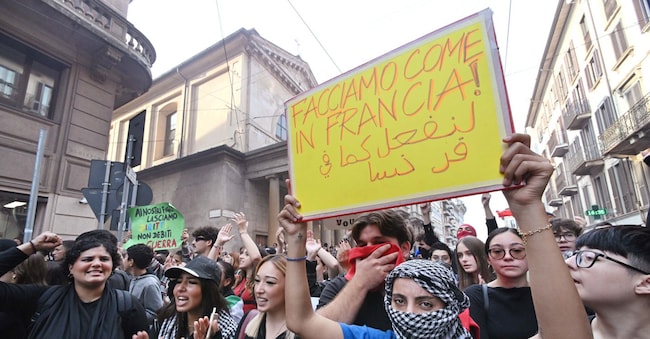
Manifestanti in via Broletto a Milano.  7146

3' min read

Translated by AI
Versione italiana

3' min read

Translated by AI
Versione italiana

Italia in Piazza is the name of the group that organised the protests in major Italian cities over the weekend of 17 and 18 October, some of which subsequently descended into clashes and acts of vandalism.

Social media played a central role in organising the protests, particularly in disseminating calls to action, practical guidance and useful information to participants. Just a few days after the launch of Italia in Piazza, the group’s founders set up an Instagram page, a TikTok profile, a Telegram channel and even an app to share official communications and updates. It is primarily through these digital tools that the demonstrations in various Italian cities have been promoted, with announcements, invitations to take part and explanations of the reasons behind the protests.

Loading...

The Italia in Piazza manifesto is also posted on the Instagram profile, which has just over 3,300 followers. The group describes itself as a ‘non-partisan demonstration’ and a ‘peaceful gathering of citizens’, invoking the right to assemble peacefully and without weapons enshrined in Article 17 of the Italian Constitution. Its stated aim is to ‘shine a spotlight on the issues we face every day’.

However, the most detailed updates and explicit messages can be found on the Telegram channel, which has over 4,000 subscribers. The channel is organised into sections grouped by topic: from the support chat to the rules and regulations, as well as official announcements, alerts and the general chat. There are also sections dedicated to photographs and videos of the events, as well as links to Instagram and TikTok profiles and the web app built using Lovable, a platform that utilises artificial intelligence and is used to facilitate the communication of new initiatives.

Another section then contains links to the regional groups, to make it easier for people living in neighbouring areas to coordinate with one another.

The posts published by the organisers are mainly informative. They specify the venues and times of the events and provide graphics to share on social media in order to reach a wider audience.

In the chat groups, on the other hand, members discuss possible initiatives and keep up to date with the main news concerning the movement. In general, several participants distance themselves from violent excesses and condemn acts of vandalism, deeming them ‘counterproductive’ to the aims of the protest.

False alarmism and ‘fear chats’

This is an important point to emphasise, particularly in light of the rumours circulating since Monday 19 October on regarding alleged attacks on schools and universities in Milan. There has been talk of groups of young people ready to force their way into schools and universities, set fire to the buildings, ‘rape the girls’ and ‘kill the future rich’.

The messages, forwarded by unidentified senders and lacking any verifiable evidence, have reached numerous pupils and, consequently, their families as well. At present, however, these are unfounded reports which risk fuelling fear and alarm amongst pupils, parents and school staff.

The 17 October Movement and the map of the uprising

Beyond these rumours, the demonstrations look set to continue. Following the protests that took place in several Italian cities over the weekend, the 17 October Movement has also been launched, which, via an Instagram profile and a Telegram channel, promotes peaceful and ongoing protest. The cities involved include Milan, Bologna, Turin, Rome, Florence, Padua, Bari and Genoa. The protests take place every Saturday at 3 pm.

Loading...

The organisation of the protests is thus becoming increasingly widespread and tailored to Gen Z. Among the most recent initiatives is the “Map of the Uprising”, an interactive digital map that lists public events announced across Italia and allows users to browse them region by region and city by city. The website allows users to explore the listed events and find those closest to their location.

The map does not only include demonstrations linked to the high cost of living and high fuel prices. It also features general and sectoral strikes, meetings and other public events. According to the platform, events are sourced from public sources, such as press releases, government websites and trade unions. The rules explicitly exclude violent actions, vandalism, instructions to commit crimes, insults and hate speech.

Another aspect concerns privacy. The website states that it does not request personal data such as name, telephone number or email address, with the aim of making the map easy and accessible to use.

Among the available features is the option to add events to your smartphone’s calendar, subject to approval by the administrators. This allows users to keep track of the dates and times of events, as well as any changes to the programme.

Copyright reserved ©
Loading...

Brand connect

Loading...

Newsletter

Notizie e approfondimenti sugli avvenimenti politici, economici e finanziari.

Iscriviti