
Only young people know how to find their way out of the maze
Zvyagintsev’s powerful film depicts Russia in the wake of the invasion of Ukraine, through a advert instructing employees to go to the front

A northern island, fringed with fir trees, comes into view through a pair of binoculars. The teenager Seriosha (Boris Kudrin) gazes at it from the garden of a beautiful house in a fictional Russian town, Krasnoborsk: thus begins Minotaur – In the Labyrinth of Power by Andrey Zvyagintsev. This opening sequence, within the film’s structure – an adaptation of Claude Chabrol’s Stéphane, an Unfaithful Wife – appears to be an end in itself; yet it ties in with the dazzling debut of the Russian director in exile in France, The Return, winner of the Golden Lion at Venice in 2003.
Previous films
In that heart-wrenching, harrowing film, two boys discover a strained parent-child relationship whilst on holiday on a wild, deserted island in northern Russia with their father, who has just been released from prison and whom they had previously known only through a photograph. Years later, in Loveless (2017), a teenager watches in astonishment as his father and mother, in the midst of a divorce, pass the responsibility for his care back and forth between them. In Leviathan (2014), an adopted son bears witness to the material and moral ruin resulting from an unjust expropriation, which leaves a trail of corruption in its wake. In *Minotaur* too, Zvyagintsev identifies the family as a mirror of Russian society in its power dynamics, pretences and positions of authority. The unifying thread is the same as in his other films: an aquatic setting, a bloody incident, and photographs. The key to this reflection lies in the ability of teenagers to view the world with a humanity forgotten by adults and a compassion that the Orthodox clergy tramples underfoot.
The plot
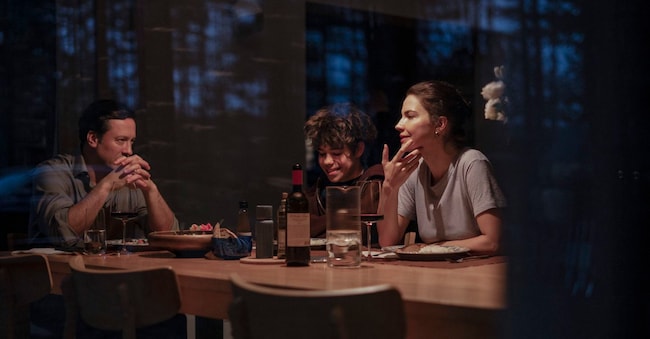
It is 2022: Gleb (Dmitriy Mazurov) is the chief executive of a successful company; he has a lovely home, a beautiful wife and a teenage son. ‘Possesses’ is the key word on which the film hinges, because the plot is woven around the possession and arbitrary power of the strongest. The invasion of Ukraine has just begun and many of his employees are fleeing to avoid being conscripted. He helps them escape, until the Motherland asks him to select fourteen workers to send to the front. Gleb does not know how to do this, does not want to do it, and finds himself at a crossroads: should he follow his conscience or obey the rules the regime has instilled in him, using the position of power he has acquired to his own advantage? He decides to play it smart, just as he teaches his son, who is being bullied at school: to face the enemy head-on, without ever striking first – at least on the surface. He does the same when he discovers that his wife Galina (Iris Lebedeva) is cheating on him – the root from which Chabrol’s film springs, though stripped of its thriller elements to offer a sociological and political perspective on contemporary Russia.
Covid and the invasion of Ukraine
When he first began thinking about the film, Zvyagintsev was recovering from the severe effects of Covid-19, which had affected 90 per cent of his lungs. Whilst in hospital – first in Germany and then in France – he was confronted by the harrowing images of the invasion of Ukraine: columns of tanks, conscripts, desertions, censorship. He realised that *The Unfaithful Wife*, on which he was working, could be an opportunity to present his anti-war perspective, drawing on the restrained yet powerful performances of Dmitriy Mazurov and Iris Lebedeva, and framing them with clean, powerful direction. The camera often pans to reveal the view from a kitchen or the stairwell of a council block, offering a glimpse of Soviet architecture in Russian dormitory estates (the film was shot in Latvia for censorship reasons). The sparse dialogue, written by Zvyagintsev himself with Simon Lyashenko, gives the protagonists plenty of leeway, allowing their humanity, doubts, regrets and pangs of conscience to surface. More than the words, it is the facial expressions of the superb Lebedeva and Mazurov that speak volumes, as does the absence of music – save for a few passing notes and the background track in a bar by Anohni (formerly Antony) and the Johnsons.
The title
The title of Zvyagintsev’s previous film, *Leviathan*, drew on the biblical mythology of the sea monster that cannot be defeated by man. *Minotaur* evokes the creature that devours human lives, imprisoned in the labyrinth of Knossos, and later slain by Ariadne and Theseus. It is not known whether Gleb and Galina will manage to find their way out of the labyrinth, but Seriosha, in the innocent and bewildered self-absorption of his adolescence, gazes into the distance through his binoculars towards the island. Just like our young people demonstrating for peace.


