
Open Fibre, 660 million state bailout for extra costs
Ultra broadband interventions in the budget law. Grants in white areas of up to 220 million per year in the period from 2027 to 2029

2' min read
Key points
2' min read
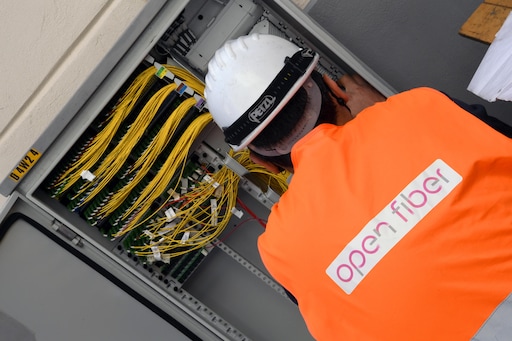
The budget law launches a bailout for Open Fiber, allocating up to EUR 660 million over three years to compensate for the extra costs of the white areas plan. Article 76, 'Interventi in materia di banda ultra larga' ('Measures concerning ultra-broadband'), envisages that, in order to complete the interventions relating to the concessions of the broadband plan in white areas (those with 'market failure'), by decree of the Ministry of Enterprise and Industry, in agreement with the Ministry of the Economy, contributions of up to EUR 220 million may be made for each of the years from 2027 to 2029. Any surplus resources will return to the availability of the State.
The Standard
.The regulation specifies that it will be up to the implementing party, i.e. Infratel, an in-house company of the Ministry of Enterprise and Industry, to present justified requirements for the disbursement of the extraordinary contribution. But this last step is clearly a formality, given that for months now, as the result of a long and complex round table, there has been an agreement between the ministry, Infratel and Open Fiber to rebalance the economic and financial plan of the three existing concession contracts, based on the extra costs presented by the company whose majority public shareholder is Cdp Equity (60%) alongside the Australians of Macquarie (40%). Open Fiber in particular referred to the extra costs of raw materials, the inflation effect, and the 20,000 kilometres of fibre optics to be laid in addition to those originally planned on the basis of a database of properties to be covered that in several places turned out to be inaccurate. The agreement drawn up with the ministry and Infratel actually concerns a total of 800 million in compensation and the difference, compared to the 660 million over three years envisaged in the manoeuvre, should be paid in the form of an extension of the concessions - there is talk of 7 years, which would bring two contracts to 2044 and one to 2046 - and takeover rights on expiry.
On the edge
.The government's move comes on the wire, while Open Fiber is called upon to finalise negotiations with the banks for an extension of financing based on a solid business plan. This issue is also closely linked to the other major project in which Open Fiber is involved, i.e. the Pnrr tender for the coverage of the grey areas, those with partial competition. And here, in the face of increasingly evident delays with respect to the mid-2026 deadline (see Il Sole 24 Ore of 20 October), the solution actually does not yet seem within reach. We are waiting for the outcome of the consultation on the replacement of some of the house numbers put out to tender, but in the meantime the government is already thinking of a plan B, which in the last resort could also include the inevitable request to the European Commission for an extension.


