Collecting boxes

Open prize draw for the limited edition of Warhol’s ‘Brillo Box’

Are they works of art, simple collectables or just boxes? The Foundation only grants the use of its logo for Avant Art’s limited-edition screen prints

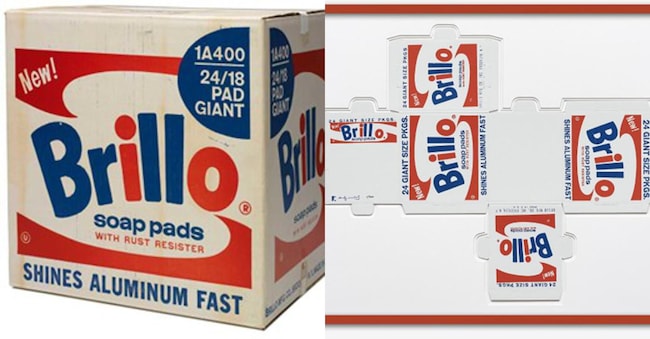
A sinistra un esempio delle scatole di cartone inviate in 500 esemplari dall’azienda Brillo e utilizzate nella mostra del 1968. A destra la scatola proposta da di Avant Arte Cortesia del Moderna Museet (sn) e di Avant Arte (dx)

8' min read

Translated by AI
Versione italiana

8' min read

Translated by AI
Versione italiana

From 30 September until 14 October 2026, anyone can enter the prize draw for a chance to win a ‘Brillo Box’ by Andy Warhol (1928–1987), valued at between 788 and 2,625 euros. These are not the famous ‘boxes’ from 1964, which fetch over a million dollars at auction, but 1:1 scale replicas, screen-printed on cardboard in various colours and produced in a limited edition of 100 by the London-based platform Avant Arte in collaboration with and under licence from the Andy Warhol Foundation for the Visual Arts. Although the initiative is contractually legitimate, it raises a number of interesting legal and ethical questions.  

What’s on sale?

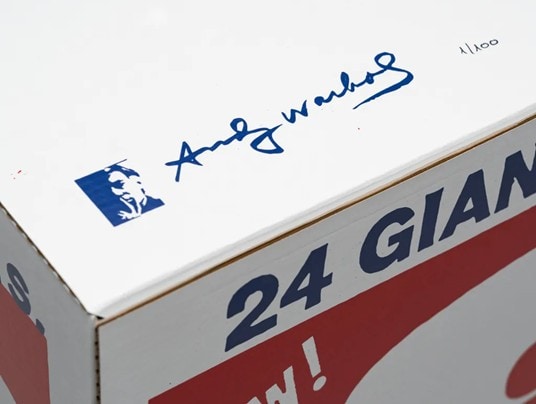
The ‘Brillo Box Collectable (Lifesize)’ is a screen-printed corrugated cardboard box, available in three colours, die-cut and creased. It is delivered flat (163.2 × 134 cm) and, once assembled, becomes a cube (43.2 × 36.5 × 43.2 cm), taking on the same dimensions as the original works. Each item is individually numbered, bears the Foundation’s logo (Andy Warhol’s signature is itself a registered trademark owned by the Foundation) and is accompanied by a certificate of authenticity. The certificate of authenticity, however, is not issued by the Foundation, as one might expect, but by Avant Arte, which produces the item under licence from the Foundation. The sales description refers to a ‘collectable’ and a ‘replica’, which ‘draws inspiration from one of Andy Warhol’s most famous works’, without ever using the term ‘work of art’. The Avant Arte’s website also notes that Brillo® is a registered trademark of a third party, Armaly Brands, which has been selling household cleaning products since 1908.
Loading...

Cortesia di Avant Arte


The originals

In the spring of 1964, Warhol had the joiners at his Factory make some plywood boxes to the dimensions of Brillo’s commercial cartons. Gerard Malanga and Billy Linich painted them by hand, after which Warhol and Malanga screen-printed them. The entire process took almost six weeks. The design copied was the one created for Brillo by James Harvey, himself an abstract expressionist painter. As can be seen from the table below: an original ‘Brillo Box’ from 1964 is therefore worth, depending on the version and provenance, between approximately 600 and almost 4,000 times more than the Avant Arte collectable.

LE ASTE

Loading...

Warhol’s vision and the work of the Factory

Andy Warhol did not create his works on his own; they were the result of the work of joiners, assistants and machines at The Factory. The artist’s contribution lay in the idea, in the poetics of the ‘choice’ to elevate ordinary packaging to the status of a sculpture. The execution of the work therefore took a back seat. If, therefore, the idea is at the heart of the work, a silkscreen print faithful to the colours and process of the originals preserves it intact.
Warhol himself, moreover, produced multiple ‘Brillo Boxes’ for the 1970 retrospective at the Pasadena Art Museum (later the Norton Simon Museum). One could therefore argue that seriality is not a betrayal of the artist’s poetics, but is in fact its very essence.

The artist’s print and the collectable

The Brillo Box cardboard boxes, produced during Andy Warhol’s lifetime, are, to all intents and purposes, original works of art, as the artist authorised and was able to supervise their production.
In Italia, the Copyright Act No. 633 of 22 April 1941 (LdA) protects works of sculpture (Article 2, paragraph 4) and, since 2001, also works of industrial design ‘which possess creative character and artistic value in their own right’ (Article 2, No. 10). Under Article 145 of the LdA, copies ‘produced in limited numbers by the author or under his or her authority’ are also considered ‘originals’.
The Avant Arte collectable, as such, is not a new work of the intellect, because it does not contain innovative and original creative choices, but is classified, precisely, as a collectable – that is, a replica, intended for a collection, produced after the artist’s death from an existing work dating from 1964.

If one were to frame this case within the context of domestic legislation, the collectable in question would therefore constitute an expression of the exercise of the right of reproduction (Article 13 of the Copyright Law) licensed by the Foundation, the holder of the economic rights – the economic rights under Anglo-Saxon copyright law (which are also freely transferable under US law pursuant to Section 201(d) of Title 17 of the US Code – Copyrights).

The practice of authorised multiples following the artist’s death is, however, not new. To give just one example among many, the Musée Rodin continues to cast bronzes in limited editions of 12 numbered copies per model or original plaster cast (Article R122-3 of the French Intellectual Property Code), following a rigorous historical and scientific process supervised and validated by ad hoc committees, thereby enabling the dissemination of his work worldwide in accordance with the artist’s wishes.

Since the donation made by Auguste Rodin (1840–1917) to the French State in 1916 also included the intellectual property rights to the works themselves, as well as to the casts, models and moulds forming part of the artist’s body of work, the resulting casts – authorised and produced directly by the State Museum – are expressly declared to be authentic casts in every respect, even though they were produced posthumously, decades after the artist’s death (‘‘Le Penseur’, cast in 1928, was sold for approximately 11.2 million dollars by Christie’s Paris in 2022, whilst ‘Le Baiser’, cast in 1927, was sold for $2.4 million at the Hôtel Drouot in 2016).

A case similar to that of Rodin concerns works produced from casts by Alberto Giacometti, whilst in the case of Medardo Rosso, the posthumous works, created by his son and considered to be of lesser value, have been distinguished from the artist’s own works in the catalogue raisonné.

Loading...

Returning to Rodin, the museum shop, on the other hand, sells collectable sculptures, priced from 230 to 34,800 euros. These are reproductions of the artist’s works, made from resin and clearly and permanently marked as such, in order to prevent any confusion with the original bronze editions.

Similarly, it is well known that posthumous prints are produced from the original negatives of great photographers, such as Vivian Maier, Edward Weston and Ansel Adams. In such cases, the photographic negative is comparable to an engraving matrix, a mould or a cast, which allows for the legitimate posthumous printing of ‘modern’ photographs and, therefore, cannot be considered ‘vintage’, as they are not contemporary with the taking of the negative and were not produced personally or under the direct supervision of the photographer.

The distinction from the case of the ‘Brillo Box Collectables’ is clear: in the examples cited above, in fact, the posthumous works are derived from ‘generative’ templates directly traceable to the artist’s work and conceived from the outset, in the artist’s own intention, to be used in the future for the creation of new copies, in keeping with the very nature of the original medium. Avant Arte’s ‘Brillo Boxes’, although produced under licence from the Foundation and bearing the Foundation’s logo / Warhol’s signature (a measure which, incidentally, is essential to avoid infringements of copyright or the registered trade mark), represent a mere contemporary reissue in cardboard of a purely commemorative nature, as they are collector’s items.

The licence fee

Following Warhol’s death in 1987, the Warhol Foundation, which is governed by US law, holds the economic rights to the artist’s works. It was the Foundation itself that authorised today’s reproduction of the ‘Brillo Box’ as a ‘collectable’ – the very same organisation which, in the past, through its Authentication Board (disbanded in 2012), had set itself up as the strict arbiter of Warhol’s artistic legacy.
In 2010, for example, a number of wooden reproductions of the ‘Brillo Boxes’ were downgraded to mere ‘copies’ not authorised by the Foundation’s Authentication Board. The case concerned 105 boxes commissioned in Malmö in 1990 by Pontus Hultén, former director of the Moderna Museet in Stockholm and a long-standing friend of Warhol, and backdated to pass them off as authentic works from 1968. 1968 was, in fact, the year of the famous Swedish retrospective, in which some 500 commercial cardboard boxes—purchased directly from the Brillo company and assembled at the museum, with the artist’s alleged consent—were also exhibited. These were never presented as artworks, but might perhaps fall within the realm of collectables.

The difference between the two cases – Hultén’s and the present one – does not lie in the subject matter, but in the authorisation to reproduce the works and the manner in which they were placed on the market: in the former case, in fact, false claims were made regarding the date, the originality and the direct attribution of the works to the artist’s intent, in the absence of any evidence of prior authorisation or formal approval; the latter, on the other hand, declare their ‘nature’ as a ‘collector’s item’, a specimen / reproduction / replica of an original conceptual work.

In the contemporary art world, therefore, in accordance with the dynamics of the art market and the world of collecting, the decisive factor in attributing value to a work of art produced ‘posthumously’ lies in the institutional standing of the holder of the economic copyright. The formal authorisation to produce new copies and the corresponding licence issued by the Foundation legitimise these objects’ circulation on the market, fully integrating them into the body of certified reproductions of the Brillo Boxes.

Market contexts

What is clear, however, is that the two markets – the contemporary art market and the collectables market – do not overlap: those who take part in Christie’s evening auctions to bid for 1960s ‘Brillo Boxes’ may well be able to spend 2,625 euros on a collectable, but the reverse is not always true. It could also be argued that the replica boosts the original’s profile, thereby also increasing its value, particularly in aesthetic, emotional and social-identity terms.

Avant Arte, moreover, produces editions of the very highest quality in collaboration with the most interesting artists on the international scene, with the specific aim of making art accessible and more ‘democratic’, redefining ‘the way in which art is experienced and collected’, ‘support public access to art’ and ‘engage the next generations of patrons’, through a circular approach that yields significant social returns, with initiatives to give back to the community by supporting cultural institutions and funding public art projects.

A final point for consideration might concern the conceptual gap between the box sold in the supermarket (whose design was by James Harvey) and the art object, the arena in which the game of the ready-made is played out: a collectable made of cardboard, lacking the artist’s symbolic ‘presence’, thus risks reverting to what Warhol had, in the first instance, copied, namely mere packaging. The re-release of iconic objects therefore raises a number of particularly complex theoretical questions.

Finally, the conceptual and legal issue regarding the authority of a Foundation remains unresolved – forty years after the artist’s death and in the absence of ownership of moral rights which, as is well known, in the US are strictly personal and linked to the author’s lifetime (the VARA of 1990 was, in any case, enacted after Warhol’s death) – to legitimately override the artist’s original wishes. In the absence of any known information regarding specific instructions left by Warhol concerning the serial reproduction of his original works posthumously, one wonders whether the Foundation’s decision might go beyond the artist’s specific instructions, thereby crossing the line between the preservation of memory and the promotion of the author’s work on the one hand, and the redefinition of the scope of authorial legitimacy on the other – a legitimacy delegated by the art market to the decision-making authority of artists’ archives.

Copyright reserved ©
Loading...

Brand connect

Loading...

Newsletter

Notizie e approfondimenti sugli avvenimenti politici, economici e finanziari.

Iscriviti