
Open source and Ai, what is hybrid intelligence for the enterprise according to Red Hat
At the Red Hat Summit in Boston, the goal is to bring generative Ai and intelligent agents into production, addressing complexity and cost in the hybrid environment.
4' min read
4' min read
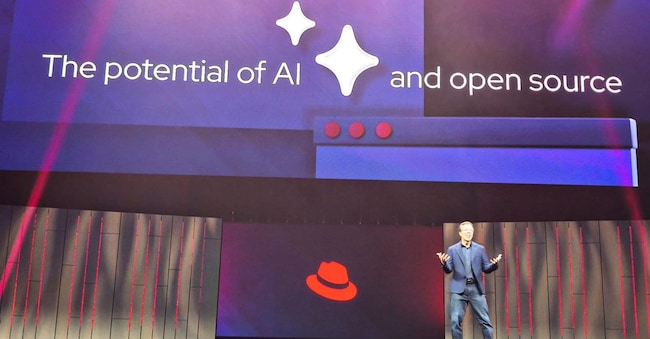
BOSTON - More than thirty years ago, Red Hat realised the revolutionary potential of open source as a driver of computer innovation. Today, with Linux boasting thirty million lines of code and becoming the most influential software in history, those open source principles remain the company's DNA - not just as a business model, but as a genuine corporate philosophy. "If pursued in the right way, these concepts can have a positive impact on artificial intelligence as well," began CEO and president Matt Hicks in front of the large audience at the Boston Summit. Translated? AI is no longer just a promise, but an infrastructure driven by the 'Any model, any accelerator, any cloud' vision at the heart of an ambitious strategy: to build a fully open, scalable and flexible architecture that allows enterprises to develop, deploy and manage AI solutions anywhere - from enterprise data centres to the public cloud, in hybrid environments or on edge devices. The ultimate goal? To break down the barriers of cost and complexity that today limit the adoption of AI, transforming it into concrete operational value for organisations of all sizes.
Inference: the AI engine that really matters
.The core of the strategy is clear: if the training of AI models represents intelligence in training, it is inference that puts it to work through the generation of meaningful output in real time. "It is in inference that the real promise of Generative AI is realised," emphasised Chris Wright, CTO of Red Hat. "For many customers, the priority is to get AI into production quickly, and this is where inference - the execution of models to generate answers - plays a key role in generating business value."
With increasingly large and computationally thirsty generative models, inference risks becoming the most expensive and difficult bottleneck to manage. To address this bottleneck, Red Hat has unveiled the Red Hat AI Inference Server, a new solution based on the open source vLLM project (already rapidly rising as a standard for open source inference) and integrated with technologies from Neural Magic, the company specialising in model compression and optimisation acquired earlier this year. The result? Faster, high-performance and cost-sustainable inference, optimised for different hardware and clouds. To support this, Red Hat is also introducing the LLMD project, developed together with partners such as Google and Nvidia, which orchestrates the distributed deployment of vLLM on Kubernetes. In practice, it makes it possible to go from GPU utilisation that often stops at 20 per cent, to an efficiency close to 100 per cent. Translated: less waste and more concrete AI.
Towards the age of agents: AI that understands, plans and acts
But Red Hat's focus is also on AI agents, intelligent systems capable of making decisions, planning actions and completing complex tasks autonomously. In practice, the 'next big thing' in enterprise AI, they do not just generate text, but understand the context, plan, decide and perform autonomously the steps necessary to achieve a goal, such as booking a flight, processing a refund or coordinating operations between systems, without human intervention at any stage.
To enable this future, Red Hat is integrating key technologies such as LlamaStack (by Meta) and Model Context Protocol (MCP) (by Anthropic) within OpenShift AI and RHEL AI, offering developers a complete set to build intelligent applications and autonomous agents. But the most significant step forward comes from the expansion of the collaboration with Google Cloud, announced at the Summit. The two companies are joining forces to make enterprise use cases for agentic AI scalable by merging Red Hat's open source technologies with Google's high-performance infrastructure and the Gemma family of open models through the Agent2Agent (A2A) protocol, designed to facilitate communication between AI agents and applications on different platforms and clouds.

