
OpenAi launches the Sora app and invades the social field of TikTok and challenges YouTube
The Sora 2 has already been launched, with the iOS app available by invitation only in the US and Canada.

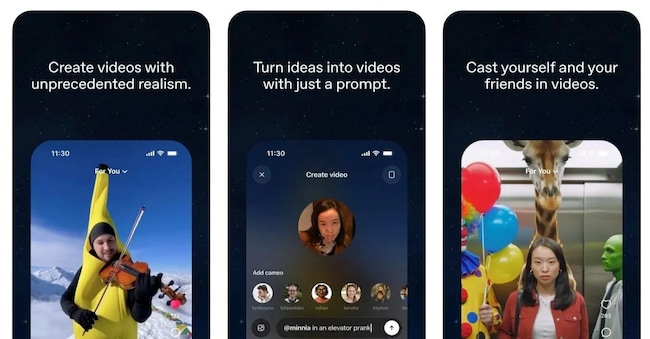
OpenAI presented Sora 2, an artificial intelligence model that generates videos from textual instructions, and a dedicated app for iOS. This is not just a technical update on the first Sora. It is a change of strategy. Sam Altman's company is entering directly into the social video terrain, the same terrain where TikTok, YouTube and Instagram operate. The difference is that content is not uploaded by users but generated within the app.
How it works.
The model promises more realism. Fewer physical errors, more consistent movements and synchronised audio. OpenAI speaks of a wider range of styles, from photorealistic to animation. Each video is branded with watermarks and hidden metadata. There is also a 'cameo' system: users can decide who can use their face or voice in videos and revoke consent at any time.
Tecnicaemente Sora 2 functions as a large multimodal transformation model: it takes a text or visual prompt and translates it into a sequence of frames with coherent audio. It does not build the videos frame by frame in a static manner, but generates them as if it were simulating a continuous scene with actors, objects and movements. This is the difference from Sora 1, which often struggled to maintain temporal coherence: a glass might change shape between frames, a character suddenly disappear, movements follow unphysical logic.
With Sora 2, OpenAI aimed at better modelling of the laws of the world. The system learns from large amounts of data not only to imitate the visual appearance but also the dynamics of events. For example, if a dog runs towards the water, the model tries to represent the impact with the surface and the resulting waves in a credible way. Another new feature is the management of audio: no more artificial soundtrack, but lip-synchronisation and background noise linked to the scene.
The real difference, however, lies in the app. The first Sora was a tool for those who wanted to experiment with generative AI, without a social context. Sora 2 becomes an ecosystem where videos are created, shared and edited directly within a feed. OpenAI does not just want to provide the technology, but to create the platform where technology becomes a cultural product.


