
OpenAI launches ChatGpt 5.1, the chatbot is more human (and customisable)
The Instant variant becomes faster and more collaborative, while Thinking calibrates reasoning according to the complexity of the task. Tone controls, selectable personalities are added

When you start thinking about .1, .2 and .3 it is never a good sign. On Wednesday 12 November, OpenAI unveiled the GPT-5.1 which is meant to be an update of OpenAI's GPT series: Sam Altman and his people describe it as "smarter, more conversational". So nothing revolutionary, but an evolution that is probably meant to introduce us to ChatGpt's new personalities. Altman's choice is to press the accelerator on the anthropomorphisation of the chatbot. One, none and a hundred thousand, one might say, or more directly: to each his own personality. The decision follows the policy change of 29 October. OpenAI changed the rules, for users adding more safeguards against harmful effects of chatbots. Here too, no substantial changes, just a desire to be clearer in the disclaimer where OpenAI distances itself from certain possible uses, always possible but theoretically forbidden. At the same time, it is true that it establishes some stronger and more immediate practical safeguards, but only for the most vulnerable users. So in short, OpenAi is becoming more and more human. That is why protection is needed. The rollout starts with paid users (Pro, Plus, Go, Business) and then extends to free or non-logged-in users.
What changes with Gpt 5.1
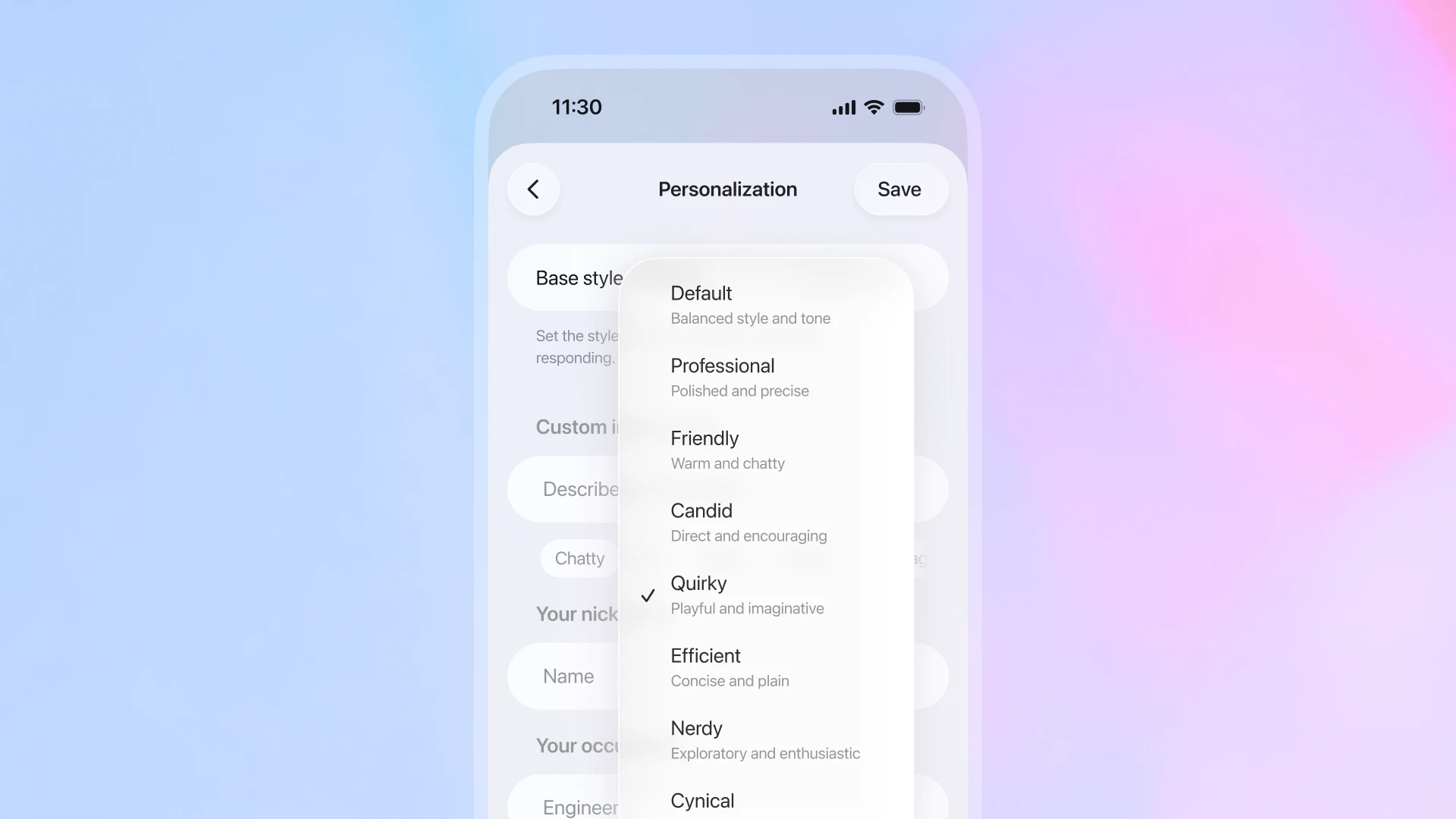
The real change from previous versions is one related to interaction and conversation: OpenAI claims to have listened to users who wanted not only 'intelligent tools', but also 'pleasant to converse with'. In this sense, options for customising the response style are introduced or expanded: for example, the presets 'Default', 'Professional', 'Friendly', 'Candid', 'Quirky', 'Efficient', 'Nerdy', 'Cynical'.
How the two variants Instant and Thinking change
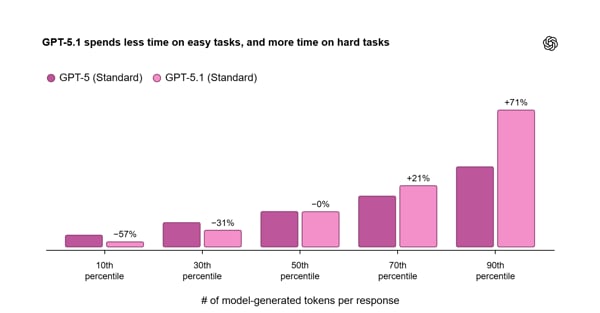
The two main variants are therefore enhanced: the first, called Instant, is defined as 'our most-used model, now warmer, more intelligent, and better at following your instructions'. The second, called Thinking, is designed for more complex reasoning: "now easier to understand and faster on simple tasks, more persistent on complex ones". In the official announcement it is explained that Instant uses an 'adaptive reasoning' mechanism: it can autonomously decide to 'think' a moment longer before answering if the request is more challenging, in order to give more in-depth answers while maintaining speed. Thinking, on the other hand, is said to be "roughly twice as fast on the fastest tasks and twice as slow on the slowest tasks" compared to the previous version. If left on auto as we have explained in previous guides, it is 'ChatGpt' that decides itself which mode to field based on the prompt.
What technically changes.
On the technical-use side, a few notes emerge: as some technology journals have immediately observed, while Instant improves on the previous Instant-version, the Thinking variant shows 'slight regressions' in some security criteria (e.g. forbidden content) compared to the previous GPT-5 Thinking version. In any case, OpenAI reports improvements in mathematics and programming tests such as AIME 2025 and Codeforces thanks to adaptive reasoning. In terms of context of use, it emerges that Instant is designed for everyday tasks, summaries, conversations, brainstorming; Thinking for complex problems, structured reasoning, techniques. The greater care in tone and style means that the user interface and conversational experience become as important factors as pure technical ability.


