
OpenAi launches ChatGPT Translate and challenges Google and others: how AI transforms translation
OpenAI launches a translator that customises translations by adapting them to contexts and recipients, marking a step forward compared to traditional tools.

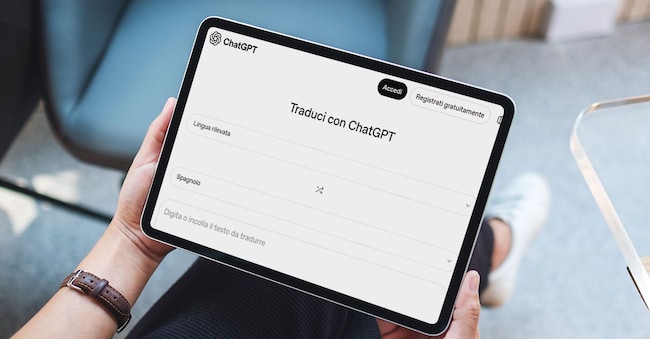
Chatbots, LLM templates, browsers, search engines and now translators: few, probably, have thought in recent months about what could be the missing link in the OpenAI ecosystem. And if it was legitimate to speak of a missing link, the company led by Sam Altman has taken steps to put a new stamp on its presence in an already largely manned field, namely that of machine translation. The announcement of ChatGPT Translate arrived quietly, without any particular trumpet blast, but it is not a simple extension of the chatbot used by 800 million people worldwide on a monthly basis, but rather an autonomous service designed to be an alternative to widely used tools such as Google Translate, for years a reference point for online quick translations.
The pluses and minuses of the new Open AI tool
The layout of the tool is deliberately familiar and includes two side-by-side boxes, one for the source text (which can be pasted from the desktop or dictated from the mobile browser) and one for the translated version, with automatic language detection and support for over 50 different idioms.
However, the real value of the tool emerges immediately after the first output: ChatGPT Translate in fact introduces a series of quick actions that allow the user to rework the translation according to the context, to make it more fluent, more formal, more academic or if necessary simplified for a younger audience. By selecting one of these options, the user is transferred to ChatGPT's main interface, with a prompt already set up and editable. And this, according to various experts, is the distinctive element of OpenAI's approach: translation is not an end point, but a starting point. The AI, in other words, does not merely return a literal rendering, but shapes the text according to tone, register and recipient, transforming it into 'tailor-made' content. The machine, in short, brings machine translation closer to content adaptation work traditionally entrusted to human intervention.
On the other hand, ChatGPT Translate remains an essential tool at the moment, as it only works with plain text and does not support document uploads, translation of complete web pages or real-time conversations. Image support, although indicated on the service's web page, is not yet available. On the language front, too, other translators maintain a significant advantage due to a much larger catalogue of languages. Having said that the challenge for supremacy in this field is being played out in a fast-moving environment (Google is working on Gemini to achieve targeted improvements in the rendering of idiomatic expressions and local variants), ChatGPT Translate is a strategic signal: machine translation is becoming an adaptive tool, increasingly intertwined with generative AI and the idea of content designed for specific contexts and professional uses.

