Artificial intelligence

Oracle: a business agent platform designed to make AI profitable

Staff now handle: bookkeeping, shift planning, procurement and logistics. Following the initial hype, companies are now looking for tangible results from artificial intelligence

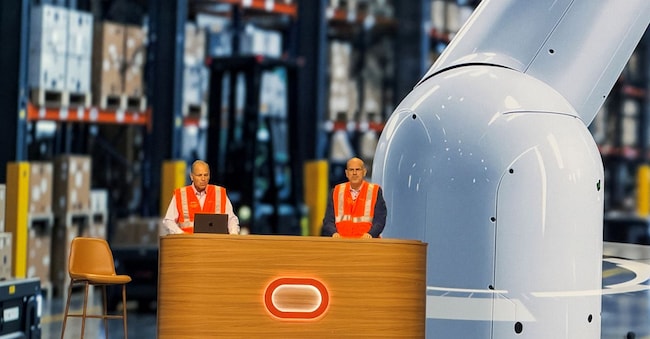
Da destra a sinistra: Mike Sicilia, co-amministratore delegato, e Chris Leone, executive vice president Applications Development di Oracle, sul palco di AI World a Las Vegas

4' min read

Translated by AI
Versione italiana

4' min read

Translated by AI
Versione italiana

LAS VEGAS – There is a hunger for tangible results amongst companies implementing AI solutions, and there is a hunger for returns amongst investors, and Wall Street is keeping a close eye on the promises and the fundamentals. It is against this backdrop that Oracle – a symbol of the infrastructure on which AI runs, thanks to its massive investments in data centres – is repositioning its enterprise management software as an agent platform.

The tech giant is integrating artificial intelligence agents into business processes: accounting, payroll, shift planning, procurement, logistics and sales. At AI World in Las Vegas, the group unveiled Fusion Claw, an engine that enables agents within Fusion – Oracle’s suite of cloud-based business applications – not only to analyse and make suggestions, but also to carry out the work itself, within the rules and approval thresholds set by the company. There are 75 ready-to-use agent-based applications, 25 of which are already powered by Claw. According to Chris Leone, Executive Vice President of Applications Development, they are ‘available immediately’.

Loading...

And they’re becoming easier to use: from now on, ChatGPT can also be used as a gateway to the management system.

Where do police officers work?

During the keynote speeches, several demos of how the agents are used were presented. Among the clients was Burger King Italia, which is trialling three agents using Oracle technologies: product availability, loss prevention and delivery disputes, which are verified by comparing the photo of the outgoing order with the customer’s photo.

Generally speaking, these are the areas where repetitive yet specialised work is concentrated. In finance, the Ledger application monitors balances and entries, reconciles transactions between group companies and prepares the documentation for the closing of accounts. In human resources, agents reorganise shifts when someone falls ill, check payslips and respond to employees’ enquiries regarding holiday entitlement and overtime. In the supply chain, they allocate materials and production capacity when supplies are running low, consolidate shipments to reduce transport costs, and identify purchases made outside of contracts. In sales and customer support, they redraw sales territories, identify service issues before they escalate, and determine the appropriate size of field technician teams.

“Up until now, AI has been used to assist with work,” said Leone. “Now it will be used to do the work.” And without set hours: “If your AI stops working towards a goal at five o’clock in the afternoon, when the employee goes home, you’re not taking responsibility for that outcome.”

The business management system that ‘disappears’

“AI should mean you hardly have to think about software at all,” said co-CEO Mike Sicilia in the opening keynote. “Why should anyone have to navigate through six systems just to do one thing?” The architecture is layered. Users no longer open menus and forms: they simply describe what they want to achieve. They do this via Agentic Home, Fusion’s new home screen. It is also a smartphone app with voice commands for the ‘tens of millions’ of users who do not spend their days in front of a computer: technicians, shop assistants, nurses and warehouse staff.

Fusion Companion handles these requests; it is a sort of intelligent switchboard that knows who the user is and what they are authorised to do, and routes the work: to a simple transaction, such as a holiday request; an agent-based application – that is, a programme built around a specific objective (‘deliver on time at the lowest cost’) that runs continuously; or, for longer and more complex tasks, to Fusion Claw, the specialist. Everything is based on data from the management system.

Fewer tokens per target

An agent that queries the language model record by record is very costly and makes more errors when dealing with large volumes of data. Oracle’s solution separates reasoning from execution to save tokens, the currency of AI. The language model plans and writes the logic, then the computation is handed over to traditional systems. Tokens are only consumed during the reasoning phase, and the system ‘takes notes’ on the paths it has already followed. In internal tests, Oracle says, reasoning time in subsequent executions is reduced by up to 50 per cent.

Who is responsible?

Greater autonomy requires greater safeguards. “More artificial intelligence does not mean fewer checks,” said Sicilia. “It is trust that enables AI to work.” Every time Claw is run, it operates within a set of rules defined by the company (policies, approval thresholds, procedures) and generates a ‘receipt’ detailing who decided what, regarding which data and with what alternatives.

Loading...

But if an agent makes a mistake, who is held accountable? “The person who defines the level of governance, the policies and the authority: that person is responsible,” replied Chris Leone to a question from *Il Sole 24 Ore*. “Let’s put a control framework (harness) around the agent. It cannot act outside the delegated authority.” If the harness breaks, “the fault lies with development”; if the agent makes a mistake whilst remaining within the rules, the responsibility lies with whoever wrote them. “It’s an engineering problem, not a people problem.”

The Wall Street Exam

On Wednesday, also at AI World, Oracle will hold its Investor Day. In the first financial quarter, which ended in August, revenue rose by 30 per cent to $19.3 billion and net profit by 60 per cent to $4.7 billion. However, the share price has lost more than half its value over the past year. The market is concerned about the cost of the race to build data centres. These initiatives also serve to demonstrate that, for Oracle, AI generates revenue and is not merely an expense. As Sicilia said, ‘the goal is no longer AI in businesses, but businesses capable of achieving more’.

Copyright reserved ©
Loading...

Brand connect

Loading...

Newsletter

Notizie e approfondimenti sugli avvenimenti politici, economici e finanziari.

Iscriviti