
Orban accuses Kiev of attempted sabotage at Turkstream
With the help of Russia and Serbia, the premier is seeking a comeback in the election polls. Challenger Peter Magyar counter-attacks: 'A planned operation under a false flag'

Less than a week before the elections, Hungarian Prime Minister Viktor Orban is accusing Ukraine of attempting to sabotage the Turkstream pipeline, which transports Russian gas to Serbia and Hungary. The timing of the operation is as suspicious as ever: the prime minister of Budapest has been behind in the polls for weeks and the risk that he will not be re-elected as leader of the country on Sunday is increasingly real. Thus, Orban is once again waving the bogeyman of Ukraine, after having tried throughout the election campaign to frighten his electorate with the fear of a widening conflict. And given the moment of utmost concern about world energy supplies, he also adds the phantom of a gas interruption to Hungary.
Orban has always been close to Putin's Russia and even behind this operation there seems to be Moscow's shadow. In fact, it is no coincidence that the discovery of two backpacks containing explosives near the incriminated gas pipeline on Sunday was reported by one of Russia's allies, Serbian President Aleksandar Vucic. It is also no coincidence that the discovery of the explosives took place near the Balkan Stream, an extension of the Turkstream into Serbian territory. And finally, it is no coincidence that the Kremlin was quick to point the finger at Ukraine: 'With a great probability, it can be assumed that some signs of interference by the Kiev regime will be discovered this time as well,' said its spokesman, Dmitry Peskov. The Hungarian Foreign Minister Péter Szijjarto also spoke of a 'failed terrorist attack by Ukraine': the very man who in recent days had confessed to reporting to Moscow what was decided in the EU Councils of Ministers.
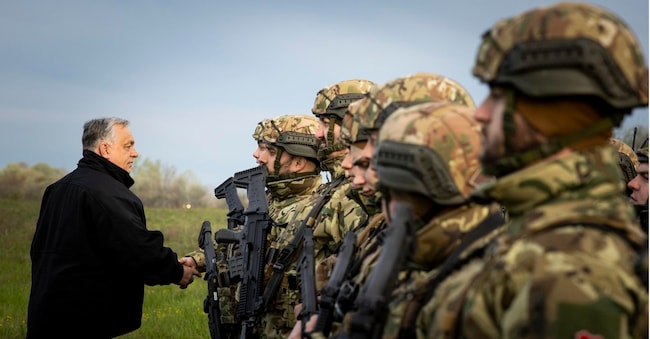
Russia has however made it clear that gas supplies to Hungary and Serbia are not at risk at the moment. But Orban still wanted to give maximum emphasis to the threats yesterday: first he called an emergency meeting of the Defence Council, then he personally inspected the Hungarian section of Turkstream and decided to send a contingent of soldiers to patrol the pipeline.
Peter Magyar, who will challenge Orban in the polls on Sunday and who in the polls is still the favourite, cries scandal: for weeks, he denounces, his Tisza party had been receiving signals from several quarters that something would happen 'by chance' in Serbia to the gas pipeline over Easter, and that something then did happen. "I point out," Magyar writes on Facebbok, "that they will not be able to prevent next Sunday's elections. They will not be able to prevent millions of Hungarians from ending the most corrupt 20 years of our country's history. If Viktor Orban and his propaganda use this provocation for an electoral purpose, it will be an open admission that this is a pre-planned operation under a false flag."
This is not the first time that gas and oil supplies from Russia have found themselves at the centre of both the Hungarian electoral battle and the tug-of-war between Orban's sovereignty and EU policies. In recent weeks, the Hungarian premier had already accused Kiev of deliberately damaging the Druzhba pipeline, which brings Russian oil to Hungary. Ukraine, according to Orban, is then deliberately slow to fix it, which is why Budapest imposed its veto on the EU's 90 billion loan to Kiev.


