
Orban in Moscow from Putin, chronicle of a stormy day
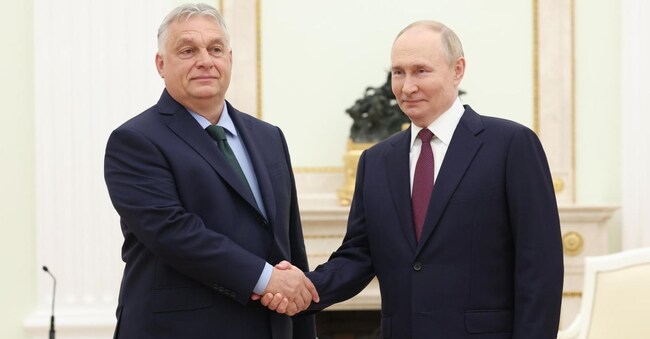
Upon arrival at Moscow's Vnukovo airport, Orban had a photograph posted on X with the logo of the European presidency. The wrath of Brussels

3' min read
3' min read
Viktor Orban did not pass on any message to Vladimir Putin from Volodymyr Zelensky. And the Hungarian Prime Minister's visit to Moscow - the Ukrainian Foreign Ministry confirms for its part - was decided without seeking Kiev's consent or approval. Which reiterates: 'The principle "no agreement on Ukraine without Ukraine" remains untouchable for our country, we ask all states to adhere strictly to it'. For Kiev diplomacy, the peace formula pursued by President Zelensky remains the only possible path, 'based on respect for Ukraine's territorial integrity'.
Putin's conditions inadmissible
.The conditions reiterated by Putin are at the opposite extreme. What the Russian president calls Moscow's 'peace initiative', and to which he has once again been able to give prominence with the help of Orban, starts from the demand for a withdrawal of Ukrainian troops from their own territory, the four regions that Moscow partially occupies and has already annexed to the Russian Federation, in addition to Crimea. Far from seeking compromises, Putin returned to insist on the demands he had already made in mid-June in a speech to the Russian Foreign Ministry: the Ukrainian renunciation of the regions of Kherson, Zaporizhzhia, Luhansk and Donetsk. "There are also other conditions," Putin added, "but these would be the subject of a detailed examination within the framework of possible joint work.
Political scientist Serghej Markov, close to the Kremlin, makes a clarification regarding Putin's 'other conditions': 'Obviously denazification, demilitarisation, de-derussification (of Ukraine),' Markov wrote on Telegram. 'But the withdrawal of the Ukrainian army is symbolically impossible for the West. So this demand implies the continuation of military operations'. At the end of the meetings in the Kremlin, spokesman Dmitry Peskov confirmed this: 'There are currently no preconditions for restarting negotiations on Ukraine.
Initiative not agreed with Brussels
Orban's entire day in Moscow - right from the first stormy reactions - was played out on the ambiguity of an initiative not agreed with Brussels, which the Hungarian prime minister had described in a radio interview as a 'peace mission' begun three days earlier, on 2 July, in Kiev, where Orban had a surprise meeting with Zelensky. Thus inaugurating the six-month Hungarian presidency of the EU, hinting at a turning point in the - hitherto frosty - relations between Budapest and Kiev. "You cannot make peace from a comfortable armchair in Brussels, waiting for the war to miraculously end," Orban had said, admitting, however, that he did not have the EU mandate to negotiate on Ukraine with Putin.
Stormy start for the Hungarian EU Presidency
But on arrival at Moscow's Vnukovo airport, Orban had a photograph posted on X with the logo of the EU presidency. Shortly afterwards, in the Kremlin, it was Putin himself who emphasised Orban's position 'not only as our long-standing partner, but as president of the EU Council'. The first European leader in the Kremlin since the invasion of Ukraine in February 2022.


