
Orsini: 'Europe changes pace or risks being crushed. On tariffs negotiate quickly. We need to simplify and support investments'.
The president of Confindustria: 'We risk deindustrialisation, the last commission took note of the mistakes made in the past, in particular not putting industry at the centre. But now we need the cure, very quickly, the answers are slow'

4' min read
4' min read
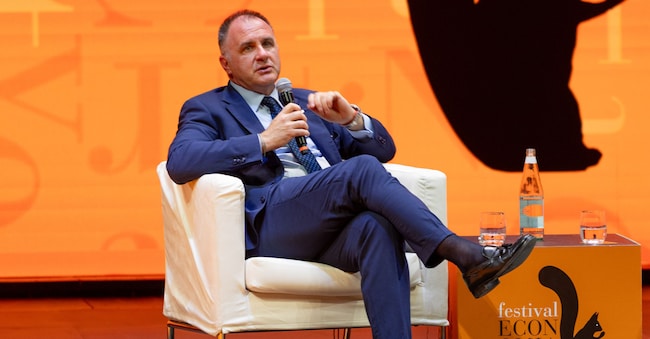
'Risks and fatal choices. Europe at the crossroads'. "It is a very apt title. I am a convinced pro-European, but Europe must change, if it does not change pace, at a time when there is an economic conflict, it risks being crushed'. Emanuele Orsini, president of Confindustria, began in this way when answering the first question from Fabio Tamburini, editor of Sole 24 Ore, who took his cue from the title of the Trento Festival of Economics, organised by the 24 Ore Group, together with Trentino Marketing, on behalf of the Autonomous Province of Trento, with the contribution of the city's Municipality and University.
'We risk deindustrialisation, we need to be faster, the last commission took note of the mistakes made in the past, in particular not putting industry at the centre. But now we need the cure, very quickly, the responses are slow,' Orsini urged. An urgency made all the more pressing by the threat of Trump's tariffs: 'in one day we burnt 143 billion. We must remain calm, I hope that the tug-of-war will turn into a handshake. But it must be done quickly: uncertainty penalises investment, we must rush quickly to negotiate. Our country exports EUR 626 billion, the US is our second largest market and a historic ally, we cannot lose it. We need to act on three levers: defence, energy and big-tech, the delta between the US and the EU is 80 billion, it is not unbridgeable," continued the president of Confindustria, answering questions from the editor of Il Sole 24 Ore, who touched on all current topics, from the EU to tariffs, the difficult situation in Germany, the drop in industrial production in our country, young people and the demographic crisis. These were the topics discussed in depth during the days of the Festival: 'a wonderful event,' said Orsini, 'putting economic issues at the centre is fundamental.
In response to the tariffs we also need to open up new markets: 'Mercosur, but also India and the Arab Emirates and Saudi Arabia, they have enormous potential'. Germany's performance is also a concern: 'our interconnection is very strong, if it goes wrong we are not happy, we need everyone in Europe to do well. Even as Confindustria we have always built alliances, if all the Confindustrias in Europe go together there is a more important critical mass'.
Action is needed, in Europe and in Italy. On Tuesday, the annual public assembly of Confindustria will be held in Bologna and will be attended by the Prime Minister, Meloni, and the President of the European Parliament, Metsola: 'we will make a big appeal to them,' Orsini said. We too, he said during the interview, must do our homework. Simplification is the most hotly debated topic. "In the last five years the EU has produced 13,500 regulations. The US 3,500. In Italy, OECD data, bureaucracy weighs 80 billion. We must simplify,' insisted the president of Confindustria. The risk is to jeopardise industry, and therefore work, welfare. There are some sectors that are doing well, others in difficulty: 'we risk losing those companies that are recognised by all as excellences, technologies cannot be changed by rule. We have sectors such as steel, glass, paper, which are penalised by regulations compared to other countries. We have companies like Fincantieri that have ten years of orders, with the problems we have today at Ilva, to which we need to give answers, then we will be forced to buy steel from India and China. An excellence such as Italian tiles, if we do not intervene on the speculation that comes from the Ets, risks going out of competition'.
Productivity in Italy has been falling for 26 months: 'both in Italy and in Europe we need to plan for the future. Investments are at zero point, we have to convince entrepreneurs to invest. We need support measures for investment,' Orsini stressed. 'We have no colour, we try to provide solutions for the industry. We need a sense of common responsibility and we need stable governments, because with stable governments you can give long-term answers. There is energy as a problem that harms competitiveness: 'I am happy that the narrative on nuclear power has changed, in the meantime we must build an energy mix that guarantees the country's national security'. The president of Confindustria urged the trade union to confrontation: 'when Landini tells me we can't meet, I would like to remember that on 7 April I sent him a letter, he and Cisl replied, not Uil. We sent another one two days ago. I don't do one to one meetings, I want to see them together'. The topics are many: 'we have to talk about productivity and safety contracts. To increase productivity we also need aggregations, Orsini emphasised, by bringing smaller companies together.


