30 million visitors expected

Osaka, a door to the future

13 April inauguration of the Italian Pavilion with Tajani and Vattani

by Vincenzo Miglietta and Nicola Filippone

3' min read

Key points

  • 'Designing Future Society for Our Lives'.
  • The Italian Pavilion
  • The mascot of Expo 2025 Osaka: Myaku Myaku

3' min read

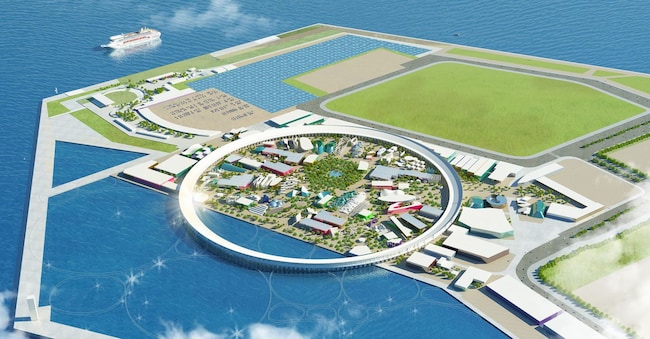
The Osaka World Expo will be held from 13 April to 13 October 2025 and will be attended by some 160 countries. Thirty million visitors are expected, up from twenty-five in Dubai 2020. The international community thus returns to Japan twenty years after the 2005 Aichi Expo, but this is not a first for Osaka, which hosted the Expo back in 1970. The theme chosen for this year's edition is 'Designing Future Society for Our Lives'. For six months, Osaka will be transformed into a global showcase where participating countries will present to the world the best of their ideas and projects in the field of tangible and intangible infrastructure on the Expo themes. Expo 2025 Osaka will take place on the artificial island of Yumeshima, located in Osaka Bay. With an area of 1.55 km2, the site will have a pavilion area in the centre, water in its southern part, and greenery in its western part.

The symbol of Expo 2025 Osaka will be 'the Grand Roof - Ring'. Designed by Expo architect Fujimoto Sou, it represents the philosophy of the World Expo: 'United in Diversity'. The structure, built entirely of wood, will have an internal diameter of approximately 615 metres, an external height of 17m and an internal height of 12m. The Ring will serve both as an outdoor walkway, from which visitors will be able to admire the entire World Expo area, and as a shelter in case of bad weather.

Loading...

VIRTUAL TOUR OF EXPO 2025 OSAKA

The mascot of Expo 2025 Osaka: Myaku Myaku

The mascot of Expo 2025 Osaka is Myaku Myaku, a shape-shifting creature in red and blue. The red part represents the 'cell', which divides and grows, while the blue part is the 'clean water', which transforms as it flows. Its name comes from the word 'myaku', which in Japanese means 'pulsation' and, in the widest sense of the word, life.

The Italian Pavilion

"Art Regenerates Life" is the theme of the Italian Pavilion at Expo 2025 inOsaka, designed by architect Mario Cucinella, Studio MCA - MarioCucinella Architects, as a modern interpretation of the Ideal City of the Renaissance, with its theatre, portico, piazza and garden, typical places of the urban and social identity of our cities. The Italian Pavilion will be inaugurated on 13 April by Foreign Minister Antonio Tajani and the Commissioner General for Italy at EXPO Osaka 2025 Mario Vattani.

Expo, Japan and Osaka

The first World Expo held in Osaka was in 1970 and it was also the first international exhibition held in Asia. Japan presented itself at that event as a country in strong economic growth, eager to recover from the severe damage suffered in World War II. The 1970 Expo was a highly successful event and Japan and Asia began to become a symbol of economic growth and cutting-edge technology. In 1990, again Osaka was the venue for the International Garden and Greenery Exposition, while in 2005, Aichi Prefecture, the capital city of Nagoya, hosted the World Expo with the theme 'The Wisdom of Nature'.

The Kansai region has a strong business vocation and is famous for being home to the headquarters of numerous enterprises, companies and research institutes covering a wide range of sectors, including the environment, life sciences, and technology and IT sectors. It is an area famous for its local and traditional handicrafts. The Osaka - Kansai area serves as an Asian hub for international trade and transport, and is an important hub for contacts and relations with the rest of the world and Asia. This region plays an essential role in the Japanese economy, industry and culture.

The Osaka - Kansai region is the cradle of Japanese civilisation. The Kansai area is rich in sites and buildings of historical value, many of them UNESCO World Heritage Sites. It also hosts important cultural events and is home to renowned Shinto shrines and Buddhist temples. This area is known for being the heart of many traditional performing arts such as Nō theatre and kabuki theatre, or manzai, a type of satirical cabaret. Osaka is well known for its cuisine. Since ancient times, this area has been the centre of production of famous typical products that were then exported to Kyoto and Tokyo. In the Edo period (17th to 19th century), Osaka developed such unique gastronomic forms that it is considered the home of Japanese street - food.

Copyright reserved ©
Loading...

Brand connect

Loading...

Newsletter

Notizie e approfondimenti sugli avvenimenti politici, economici e finanziari.

Iscriviti