
Oslo and the fascinating exoticism of the 'Bayadère'
The Norwegian National Ballet grappling with baiadere, Brahmins, rajahs, valiant warriors and shadow-populated realms

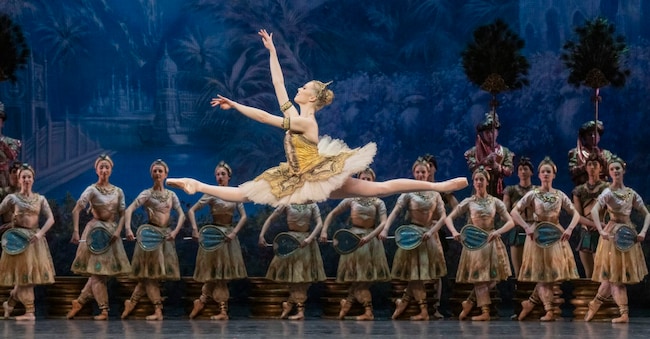
For various reasons, her name is among the most legendary biographies of 20th century dance and she is undoubtedly credited with promoting and disseminating one of the cardinal masterpieces of 19th century choreography. It was in fact thanks to Natalia Makarova that the first complete version of 'Bayadère' was staged in the West. It was 1980 and the famous Russian ballerina and choreographer, a transfugee of the Kirov, brought to the Metropolitan in New York the most famous Indian setting conceived on the pointe in a highly successful version that, in addition to remaining in the repertoire of the overseas company for thirty years, from 1989 began to captivate the English ballet company and shortly afterwards also the La Scala company.
Today the Norwegian National Ballet looks back to that historic New York premiere, inviting the unforgettable star with the extraordinary lyrical-interpretive talent to dust off the precious legacy enshrined in this title by Ludwig Minkus. So in Oslo we return to the intricate vicissitudes that innervate the dramaturgy of a ballet dedicated to baiadere, Brahmins, rajahs, valiant warriors and kingdoms populated by shadows. Grandiose emphasis, exotic fascination and evanescent juxtapositions outline this revival of the ballet, which has the merit of preserving the completeness of the intrigue with the well-known destruction of the temple that has been sketched in other versions.
The Norwegian Company
In one of the performances that followed, it was Grete Sofie Borud Nybakken who took on the role of the bayadera Nikiya, delivering a balanced and linear interpretative development from the afflictions near the sacred fire in the first act to the apotheosis of souls in the third act. A perfectly executed choreography is thus flanked by a well-founded dramatic research supported, all the more, by his Solor here entrusted to Alex Cuadros Joglar: a principal dancer endowed with good technical solidity although the refinement of his "tours en l'air" could be improved. Convincing is the "querelle" in the second scene of the first act between Nikiya and the Rajah's daughter given by Daniela Cabrera who enjoys discrete technical polish inscribed in a musicality that is not always fluid. Worth mentioning, in the last act, is the very valid variation of Idolo di Bronzo by the very young Giuseppe Ventura. Promoted with full marks the Kingdom of Shadows, in this scene marked by diaphanous spirituality we remember exemplary balance and synchronisms, credible visions and evanescent gracefulness in every segment.
A scenic, choreographic and dramaturgical structure, the one conceived in illo tempore by Natalia Makarova for the 1989 London edition, which also with the Norwegian troupe directed by Ingrid Lorentzen stands out for its integrity, effectiveness and quality.

