Transport

Altroconsumo: 'One in five high-speed trains is late'

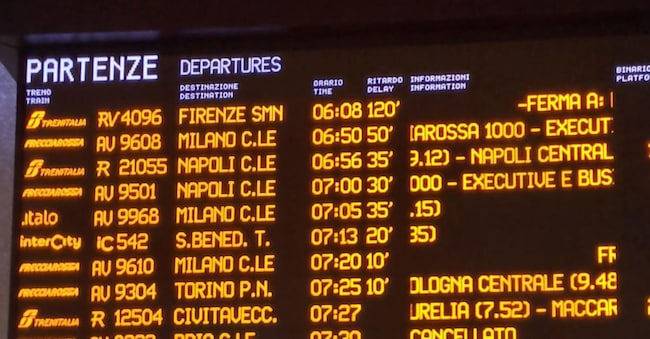
Almost one in three Frecciarossa trains is delayed, while Italo trains once in five. The worst figure concerns Intercity trains, which record 40% delays

by Marco Morino

5' min read

5' min read

In Italy, at least one in five high-speed (Av) trains arrives late. This was revealed in a new survey by Altroconsumo, the largest independent consumer organisation in Italy and part of Euroconsumers, presented at the Chamber of Deputies. The study compares the performance of the main train routes: Italo does better than Frecciarossa (Ferrovie dello Stato), while Intercity trains are the most problematic, with 40 per cent of trains accumulating delays.

During the meeting, the contents of the bill signed by the Honourable Maria Chiara Gadda (Italia Viva) were presented. The bill introduces new measures to protect travellers, with particular reference to compensation due in the event of train disruptions.

Loading...

Altroconsumo is committed to promoting fairer compensation for travellers who suffer inefficiencies. It has in fact launched a petition to ask the Italian and European authorities to raise the compensation percentages and lower the delay threshold for which the right to reimbursement of travel can be triggered. This would significantly increase the number of travellers entitled to compensation and provide more concrete and effective protection.

L’indagine

The Altroconsumo survey, conducted between 25 July and 5 September 2025, covered 54 routes, with over 28,000 surveys on Frecciarossa, Italo and Intercity services. In the high-speed segment, at least one train in five recorded delays and, for those routes where a comparison is possible, Italo performed better than Frecciarossa. The situation of the Intercity service is worrying, with delays averaging over 40%. For each monitored train, punctuality on arrival was measured. The analysis was carried out by monitoring for 43 days the information from the 'Monitor Arrivals/Departures live' web service of the Italian railway network (Rfi), a site open to the public, which allows the public to view departures and arrivals at stations and the accumulated delays. The analysis takes into account trains travelling between 6.00 am and 11.45 pm.

High-speed trains, says Altrocosumo, have been the leading service of the rail system for years now; they are the fastest and also the most expensive precisely because they are supposed to guarantee the journey in much shorter time. An example of this is the Milan-Bologna route, now covered in one hour compared to the approximately two hours offered by other types of train. The competitiveness of the Av line is undermined by the chronic lack of punctuality, as revealed by the Altroconsumo survey. Two competitors, Trenitalia and Italo, operate on the fast track: the study compared their punctuality levels.

On average, 31% of Frecciarossa trains are late

.

The analysis of Trenitalia (FS) fast trains covered 45 routes, from north to south of the country. On the main routes, the most popular and therefore the most frequent, such as Milan-Rome, Naples-Rome and Milan-Bologna, Altroconsumo monitored around one thousand trains per route. The Frecciarossa service reveals some criticalities: on average for the routes analysed, 31% of the red bolides arrive later than the scheduled time. A particularly critical situation concerns the connections involving the Adriatic route, where delays were recorded in well over 50 per cent of the trains surveyed. The most critical case is the Bari Centrale-Milano Centrale route, with over 70% of trains delayed. Another route with delays is the Salerno-Torino Porta Nuova: 53% of trains are overdue. With regard to the most significant route, i.e. Milano Centrale-Roma Termini and vice versa, the trains recorded as late are 18% and 25% respectively.

Italo late one time in five

.

For the competitor Italo, 25 routes were analysed and on average in 20 per cent of the cases the trains overshoot the timetable. Overall, Italo is more punctual than Frecciarossa, at least on the 25 routes surveyed on which both operators travel. For Italo, the most critical route is the connection between Napoli Centrale-Venezia Mestre, with delays detected in 40% of cases. The Reggio Calabria Centrale-Roma Termini route is also limping along: here 38% of trains are delayed. Even on the main route, i.e. Milano Centrale-Roma Termini, there are delays (in 15% of cases), even more so on the Rome-Milan route (around 19% of trains). Comparing the two rail competitors on the routes monitored by Altroconsumo, Italo is almost always ahead of Trenitalia. On average, 20% of Italo trains are delayed, compared to 26% of Frecciarossa trains. The same dynamic occurs on the main route Milano Centrale-Roma Termini and vice versa, where Trenitalia is more delayed.

Intercity black jersey

.

In addition to high speed, the analysis also checked the punctuality of Intercity trains. On average, Intercity trains are the most delayed trains in the survey. On the 24 routes analysed, trains were delayed 41% of the time. The situation is particularly critical on the connection between Reggio Calabria Centrale and Salerno, with delays recorded in over 80% of cases. The Adriatic route Lecce-Bologna Centrale and the Rome Termini-Taranto connection also know little about punctuality: here, delays are recorded in around 60% of the trains surveyed.

Travel times

.

Over the years, high-speed train journey times have become longer, yet delays continue to occur. This is demonstrated by the survey on the Milano Centrale-Roma Termini route, which is covered by high-speed trains that used to boast journey times of 3 hours. Today, those times no longer exist: the current route averages 3 hours and 20 minutes and, in the case of extraordinary situations, such as construction sites or works, the journey exceeds 4 or even 5 hours.

The issue of compensation

.

Currently, for Av trains, Trenitalia and Italo refund part of the ticket only for delays of more than 30 minutes. Altroconsumo explains: 'These are very high thresholds, considering that we are talking about fast trains and that Av is by definition a fast and punctual service. With the current rules, only a small proportion of delayed trains can enjoy compensation. For the majority of off-time trains, which are under the 30-minute threshold, nothing is provided.

This is why Altroconsumo demands that refunds be triggered after only 15 minutes of exceeding the timetable. For example, considering all the routes surveyed, Frecciarossa trains with delays of at least 15 minutes are on average 13%, while those exceeding the timetable by more than 30 minutes are 5.7%, and it is only this minority that are reimbursed. Those on Italo with a delay of 15 minutes or more are on average 7.8% of the total, while those with a delay of at least 30 minutes are 3.6%. Even in this case, the pool of refunds would widen significantly. According to the survey, lowering the threshold above which one is entitled to reimbursement would give compensation to a much larger group of passengers: on average, the passengers to be reimbursed would be about twice as many. And citizens would receive compensation at a much higher frequency.

Copyright reserved ©
Loading...

Brand connect

Loading...

Newsletter

Notizie e approfondimenti sugli avvenimenti politici, economici e finanziari.

Iscriviti