
Otherworldly journeys to other worlds
Visions and cognitive adventures in Ioan Petru Culianu's essay Out of This World. Otherworldly journeys from Gilgameš to Albert Einstein.

3' min read
3' min read
Travelling to parallel worlds, beyond shores already travelled, enriching one's individual experience, extroverting consciousness, extending and altering the ordinary perception of things. A literary mirage, a dream of contemporary science fiction, a possibility offered by the digital world - still unfinished and torn by fears and contradictions, the latter. But not only. This experience, in fact, has been lived and contemplated for millennia within all the great spiritual traditions of East and West.
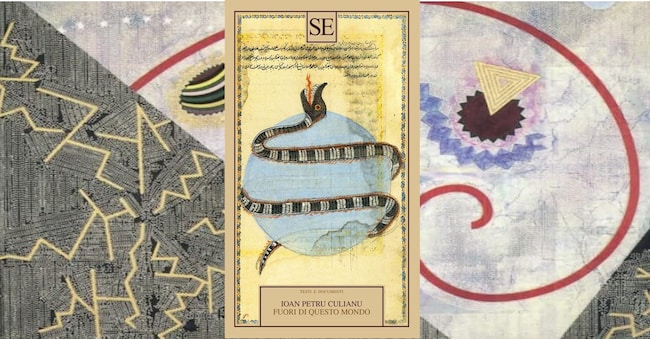
To this imaginative constellation - as real as it is fantastic - is dedicated the essay by historian of religions Ioan Petru Culianu (1950-1991) 'Out of This World. Otherwordly Journeys from Gilgamesh to Albert Einstein', recently published in Italy, in a new edition, by SE, with the title 'Out of This World. Otherwordly Journeys from Gilgamesh to Albert Einstein'. The study, with a comparative historical-religious slant, aims, in Culianu's own words, 'to provide a brief but exhaustive cultural-historical review of travels to other worlds (including heaven, hell, different planets, and much more), of otherworldly visions and other altered states of consciousness, as well as accounts of out-of-body experiences and apparent death'.
The approach, following the lesson of the master Mircea Eliade, is oriented towards a creative hermeneutics: the author does not limit himself to presenting the sources, but seeks to understand, in a holistic and profound way, the experience of the sacred that is witnessed in them. It is thus possible to follow Dante seamlessly on his journey from hell to paradise, the souls of the ancient Egyptians on their way to the afterlife, Gilgameš in the quête towards his ultimate destiny, shamans in ecstatic trance. Similarly, Culianu invites us to contemplate the otherworldly journeys attempted by practitioners of yoga and Buddhism, the epic of the Tibetan 'Bardo Thödöl', a Lamaist liturgy that provides guidance to the soul of the deceased, the threshold experiences of Jewish mystics, even the adventures of the 'Platonic space shuttle' (a captivating image with which he alludes to the idea of the soul as a 'vehicle' in the Platonic, Gnostic and mystery traditions).
"Journeys of the Soul"
.The philosophical, methodological and, indeed, existential implications are manifold. Our essence seems to reveal itself not only in our given humanity, but also - and perhaps, exclusively - in our attempt to go beyond it: beyond every barrier, limit, fence, beyond our own individuality. The ecstatic experience typical of journeys 'out of this world' leads man, according to Culianu, back to a common root, which goes beyond historical, geographical and linguistic distinctions that would otherwise be insurmountable: it is true 'intertextuality', which is not based on the actual circulation of texts, but on the processes of subtle circulation of mental models, through which we approach that book, full of mysterious characters, which is the universe. Here is the intuition that serves as the lintel of the essay, Culianu's methodological originality: 'The cognitive hypothesis of this book is that a simple set of norms should produce, in human minds and over a virtually infinite period of time, the same results'. Hence the constellation of the 'journeys of the soul' (as the first Italian edition of the essay, published by Mondadori in 1991, was titled), in all its kaleidoscopic beauty.
On the other hand, Culianu's cognitive perspectivism shows how the distinction between the 'internal' and 'external' world, subjective and objective, psyche and matter is nothing but a myth. Much less well-founded, however, than the multifaceted and pluralistic vision offered by the myths that the religious and sapiential traditions of all times have transmitted to us. This is why, in order to approach the mystical paths, it is necessary to elaborate an "equipment for the historian of the fourth dimension", i.e. a methodological approach centred on the dialogue between borderline knowledge - religious hermeneutics, fantastic literature and Einsteinian science - capable of opening up to other worlds, beyond incapacitating dualisms and obvious three-dimensionalities. If, as far as the doctrines of the soul are concerned, 'a return to the certainties of the past is quite improbable', following the rivulets of these traditions implements a glimpse into the future, where 'our minds will continue to multiply other infinite worlds, thus also exploring their own, unlimited possibilities'.

