
Oulu, European Capital of Culture and Nature
The city is a true natural paradise and a treasure trove of Finnish and Sami culture. Its exceptionally varied offer can satisfy the many demands of visitors, who are 'enchanted' by unspoilt parks and jewel-like museums such as the Raahe

Key points
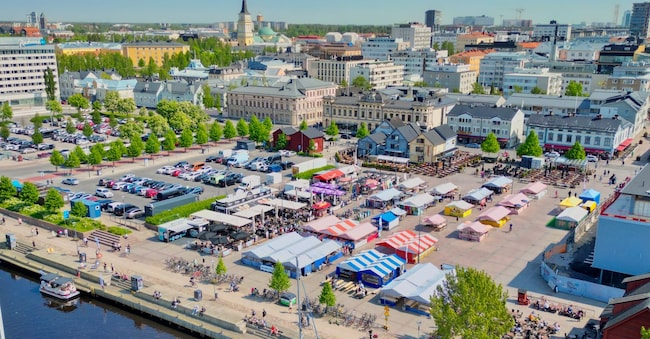
Four 'Gs' are needed to describe it: young, joyful, tasty, green... very green Oulu. For those few who still don't know, the Finnish city, an hour's flight from the capital Helsinki, is together with Trenčín in Slovakia the European Capital of Culture 2026. Young because the capital of the province of the same name, which is mirrored on the mouth of the Oulujoki River on the shores of the Gulf of Bothnia, has an average age of less than forty for a population of just over 200,000 residents; joyful because, along with the whole of Finland, it boasts the record for being the happiest nation in the world, and the smiles, courtesy and hospitality of its inhabitants provide ample confirmation of this; tasty because its cuisine, sweetened with forest fruits and aromatic herbs from the tundra, is a true delight: and if, in the afternoon, you taste the 'Voisilmäpulla', literally small 'butter-eyed brioche', capable of melting and enchanting even the most demanding palates, or the black 'mallas leipa (malt bread)' embellished with seeds and likenes, you will be truly astonished at such Nordic refinements; green because the green of its forests is a true paradisiacal enchantment: and this is well known in the land of Father Christmas, who has his home further north, in Rovaniemi. But if all this is certainly not enough to describe its charm, colours and flavours, know that Oulu, the capital of culture, offers a year-round programme of events that is unbelievable.
Under the slogan with the three 'Cs', 'Cultural Climate Change' - which says a lot about how much attention is paid in Finland to the environment and its effects on the territory, which are particularly evident here, especially in Lapland - as many as 3,000 individual events, 520 cultural projects, 40 partnerships, 260 volunteers involved for as many as 40 cities involved in various capacities in the project with 16,000 square metres of works remaining. Staggering numbers in short, capable of increasing the quality of life day by day in the city, its district and province and beyond. And so we start with the aspect of the programme that rewards Nature and green lovers in more ways than one.
Nature protagonist
A 320-kilometre-long route - passing through villages and towns with characteristic wooden houses coloured ochre, light blue or glowing rust-red - along the Baltic Sea (in Northern Ostrobothnia, to be precise, ed.) with the evocative name of the Flatland Route, forms the heart of the programme. It takes five to six days to cycle through the marvellous forests that stand out in compact green in this flat land, where birch trees dominate, outclassing even the many varieties of conifers that mark the territory with their pointed plumes. Among the trees, barbecue areas delight the patrons, who are also very young here, thanks to programmes that encourage survival courses in schools. And it is not so difficult in these woods, since the wood is supplied directly by the municipalities in all-weather storage cottages, and in the undergrowth, blue, red and black berries abound as never before, so much so that they fill the town markets with colour; and again, mushrooms of all kinds, for those who are able to recognise their goodness, are a superfine delicacy; but it is certainly not over yet: rivers and lagoons here are rich in freshwater fish. And if the bucolic picture still doesn't seem enough to you, you should know that in the huts, which are fully equipped with gigantic barbecue-braziers, where tasty salmon are grilled, musical accompaniment is also provided, with violinists, cellists and guitars playing the old folk scores, many of them expressly recovered recently. Which, in a fairy-tale setting, with water flowing everywhere and the coolness of the most reassuring greenery, is an irresistible invitation to dance and feast: the best and also romantic déjeneur sur l'herbe, here is, in short, a more than guaranteed certainty. Like kayaking or romantic walks along the banks of the rivers, and backpacking, adventure is guaranteed even for the most demanding hikers, since the smooth rocks that surround the rivers form a forest of rocks in the forest, while the rapids accompany the flow of the waters between the stone massifs with their noise. And with the sun, even sunbathing, unbelievable but true, lying on the rocks, will have its turn, with breathtaking panoramas all around that are lost in the sea. Dreamscape or idyll? I don't know, you do it!
Sami culture and beyond
However, if you want to take a break after the nature immersion, know that Oulu 2026, in addition to the wonderful and celebrated Lumo Light Festival Oulu, which is truly unmissable (with dates in November), will brighten up the darkest days, casting and reflecting glow on snow, bridges and houses. Because when the sun doesn't shine at these latitudes, we don't get discouraged and relaunch with a festival that is an enchantment for all ages, that is, when technology makes up for the nighttime darkness... (Let's not forget that Oulu is the headquarters and home town of Nokia, which has its futuristic yet traditional headquarters here: it is no coincidence that on top of its building there is an immense open-air sauna!).
Oulu then borders the land of the Sami, Europe's oldest indigenous population. A cultural unicum, made up of kindness and colours, of love for nature, celebrated in all its forms, and millenary traditions, for a population of non-settlers, mostly reindeer herders and fishermen, who branch out into the territories of Fennoscandia, known to most as Lapland, which stretches from central Norway to Russia, passing through Sweden and Finland. An immense and difficult territory, for a census population of 60 thousand people, who with their bright red traditional costumes, studded with white and blue embroidered squiggles, inhabit uncontaminated landscapes that include areas from Russia to Norway. Sensitive borders (the one with Russia in particular), which not for nothing are at the centre, with all their historical-evocative weight, of a special section of events dedicated by Oulu 2026 to the theme of peace, with artistic installations created for the occasion). But to return to the Sami, it will be their stories, at the centre of the events "Northern sounds, The sound of north", made up of folk music, myths, legends and tales ("Tales of a far route") that will make this fascinating and unmissable culture known, which unfortunately, numbers in hand, would otherwise risk disappearing. And precisely to the Sami and their language and culture is also dedicated the first opera, entitled Ovvllà, which will make its debut next January.

