Nicolò Govoni

"Our schools for the excluded. We encourage thought and freedom of expression'

The ceo of 'Still I Rise' tells the story and method of the association, which runs world-class schools for refugee and vulnerable children around the world

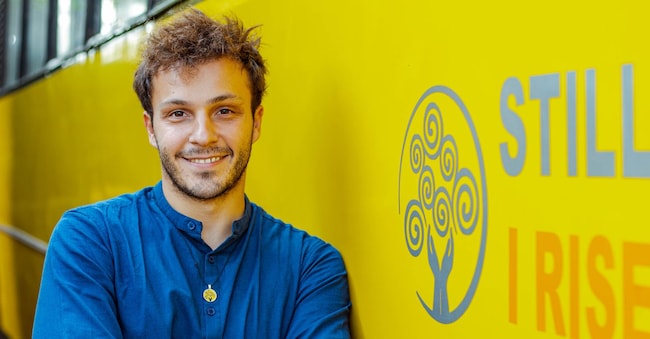
by Giovanna Mancini

Nicolò Govoni

6' min read

6' min read

"We were among the very few in the world to open a school just as schools were closing". It was December 2020, at the height of the Covid-19 pandemic, and Nicolò Govoni, with his organisation Still I Rise, inaugurated in Nairobi, Kenya, the first school certified as an IB World School (international baccalaureate) within a shantytown. A school of excellence, free of charge and aimed exclusively at refugee children and young people in the country's refugee camps.

He who today, at the age of 32, is president and CEO of a non-profit organisation that has opened six schools in as many countries and was nominated for a Nobel Peace Prize in 2018, but who has a school experience behind him that he himself describes as 'turbulent'. Or rather: 'disastrous'.

Loading...

What changed his destiny, after two failures and a move from the scientific high school to the linguistic high school, was a teacher, Nicoletta Fiorani, who believed in him 'when even I didn't believe in it', he recalls. "She saved my life, because she managed to stimulate a sense of responsibility in me". That sense of responsibility underpinned the choices that in 2018 led him to found - together with Giulia Cicoli and Sarah Ruzek - Still I Rise, the non-profit organisation that aims to offer world-class education to refugee and vulnerable children around the world. Today, the association has around 100 employees and 400 volunteers worldwide and, in its seven years of operation, has involved 70,000 children in its school programmes, with more than 150,000 hours of tuition. "If I had had a different kind of hardship as a boy, maybe I would be doing something else today. But having had difficulties in education, that is what I decided to commit myself to," says Govoni.

At the age of 20, he left for India with the idea of doing a few weeks of voluntary work in an orphanage in Tamil Nadu. "That experience was a watershed in my life, so much so that after finishing high school I returned to India, this time to Pune, to study at university, and stayed there for four years, until I graduated in journalism in 2017." Dates are not a detail in this story. During those four years, Nicolò returned to Tamil Nadu several times, for longer and longer periods. He became very close to the founder, Joshua, whom he describes as 'almost a second father to me', and to the children, particularly one, Anthony. But he also realises the limit of this way of volunteering (which in the industry is called 'volontourism'), which 'wasn't really doing people any good. It was good for me, but not for the children: for Anthony, my departure, every time, was a heartbreak, a new abandonment'. Again, a turning point: 'I like to think that, during those years, I went from being a tourist to becoming a volunteer: it sounds like a small thing, but it's not. I also trained in teaching because, through university, I was able to do an internship for Teach for India, part of a global movement called Teach for All'.Back to the dates: in April 2017 Nicolò graduated, with the prospect of enrolling in a master's degree in NGO management in New York. 'But life wanted me not to do that master's', he explains. In fact, the courses would not start until January 2018, so, not to sit on his hands, Govoni decided to do another stint as a volunteer, this time in Samos, Greece, in the refugee camp that housed Syrian refugees, where he was put to teach a class of 12-13 year-olds. Another dazzling experience: 'The situation was very serious, with a structure made for 650 people, which instead housed thousands, with peaks of 7,000 refugees at certain times and enormous inconveniences,' he recounts. There were no doctors or drinking water, you had to queue for three to six hours to eat, and the food was poor. There were no schools and no legal representation'.

In Samos, he met Giulia Cicoli and Sarah Ruzek and, together with them, he undertook to denounce the hotspot situation to the European Union and the UN, but the response was not what the three young people would have expected and, for this reason too, today Still I Rise by statute does not accept funds from governments or from supranational or multinational bodies that do not adhere to its code of ethics.

The organisation was founded at that time, with the first emergency school (Mazì, which means 'together' in Greek) opened on Samos, to provide protection and education for refugee minors aged between 11 and 17 in the island's hotspot. At the same time, Still I Rise also starts advocacy work to defend the human rights of its students. It also began to develop its own educational method, a pedagogical approach that puts the student at the centre, sees the school as a family, the teacher as a mentor and aims to stimulate thinking in the learner, rather than imparting notions.

This method - refined and structured over the years - is now at the heart of the Still I Rise system, which targets children and young people who have been cut off (for a variety of reasons) from a formal schooling pathway, with the aim of giving them a chance to re-enter and complete that pathway.

In that same period, Nicolò Govoni came into contact with the American School in Milan, which offered an international baccalaureate course, to which he would return several times. "I came into contact with an educational model very different from that of the Italian school: there, everyone was enthusiastic, starting with the students, who are encouraged to participate, to express their ideas, without fear of making mistakes or being judged". Govoni then convinced his partners to open such a school in Turkey, but a thousand bureaucratic and political obstacles slowed down the realisation of this project. When it finally sees the light, the pandemic arrives. "The school opens for three days, in March 2020, and then suddenly everything closes,' he says. Very difficult months began for us, because we were a very young reality, still made up exclusively of volunteers. Michele Senici and I, who had joined the organisation, decided not to return to Italy with the flights provided by the embassy, but to continue on to Kenya, where in the meantime another colleague, Giovanni Volpe, who had opened a company called Still I Rise under Kenyan law, had settled'. After an adventurous journey, to say the least, the two young men arrived in Nairobi in the summer of 2020 and, thanks to the fundraising carried out by the entire team, managed to open the international school, which officially opened in January 2021 and in 2024 obtained IB World School recognition, an eight-year educational pathway that accompanies pupils from primary school to graduation.

"It was our victory after the great defeat of Turkey, which, however, I recognise today, also taught us many things, including what to do and what not to do with governments,' says Govoni. 'The school in Nairobi is a reality of excellence and has allowed us to make a name for ourselves in the world and, therefore, to grow. In the following years, we opened two emergency and rehabilitation schools in the Democratic Republic of Congo and Yemen and a baccalaureate in Colombia in 2024. In the meantime, we have started work to open international schools also in India, in Mumbai, and in Southern Italy, as well as an emergency and rehabilitation school in South Sudan'.

To do all this - and to maintain an international team that works partly remotely, to manage the structure, and partly in the field, to run the schools - funds are needed. Govoni himself, who lives and works in Nairobi, often returns to Italy to promote fundraising initiatives, he gets involved himself through social channels, presentations of his books or musical performances, such as the one held last February in Rome, entitled 'A possible world'. On 14 June, however, the world premiere of the film 'School of Life', produced by Greenland and Rai Cinema, on the story of Still I Rise and its founder, will be shown at Biografilm in Bologna.

'We are an independent and transparent reality, living only on private donations,' explains Govoni. 'Last year we collected 3.5 million euro, less than we had budgeted, i.e. 4 million. For 2025 our goal is ambitious: we want to reach 5 million euro and, to do so, we must succeed in changing the composition of our donors, increasing the share of companies, which today are only 7%, while private individuals are 76% and foundations 17%. We also want to broaden the geographical base of supporters, particularly in the US, where we have charity status. So far we have not succeeded because all our energies have been absorbed by fundraising in Italy. But I know that we will succeed. Maybe already this year'.

Copyright reserved ©
Loading...

Brand connect

Loading...

Newsletter

Notizie e approfondimenti sugli avvenimenti politici, economici e finanziari.

Iscriviti