
Over the summer, drones transported around 8.5 tonnes of goods to the mountain huts
Over the summer in South Tyrol, 32 operations were carried out and 189 flights were made

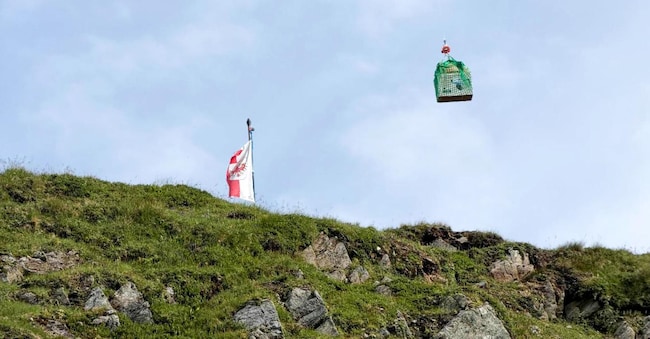
With the cable taut and the motors running at full power, the load rises slowly and silently, gaining altitude until it reaches a mountain refuge at 3,038 metres. The entire operation is carried out by an FB3 drone from FlyingBasket, a South Tyrolean tech company active internationally in the design and development of cargo drones for logistics. A service scheduled to run throughout the summer, developed in collaboration with the participating mountain huts and funded by the Department of Asset Management of the Autonomous Province of Bolzano. With 189 flights, the mountain huts received supplies more frequently, with a greater availability of fresh produce and greater flexibility in planning purchases. FlyingBasket also directly managed the collection of food from local suppliers and, on the return flights, waste was often transported back down to the valley.
“This summer’s trial demonstrates how innovation can become a practical tool to support our mountain huts and those who run them every day,” said Christian Bianchi, Councillor for Public Works for the Autonomous Province of Bolzano. Cargo drones enable more frequent deliveries, including of fresh produce, whilst at the same time transporting materials and waste back down to the valley, making logistics at high altitude more efficient. It is a project that combines technology, sustainability and a focus on the real needs of our mountain huts, whilst also promoting an innovative venture that was founded and has grown in South Tyrol.” The first season of mountain hut resupply, which began on 1 June and involved eight huts, will come to an end on 13 October.
“At first we were a bit sceptical, but even after our first experience we were pleasantly surprised,” explains Alain Untergassmair, manager of the Brigata Tridentina/Birnlückenhütte mountain refuge. The operations were well organised, with enough time between flights to sort out the supplies received, and being able to further increase the load capacity would allow us to make even greater use of this service in future. FlyingBasket’s logistical support was also particularly important to us; they collected the supplies directly and took them to the take-off point: a practical help with the day-to-day running of the mountain hut. It’s a service that, following this experience, we can certainly recommend.” A total of 189 flights were carried out over the course of 32 operations. The cargo drones delivered 7 tonnes to the mountain huts, whilst around 1.5 tonnes of waste, materials, equipment and luggage were transported down to the valley. The FB3 drone operated in a wide variety of alpine conditions, including variable winds, turbulence, low temperatures, cloud cover and lower air density at high altitudes. The aircraft, communication systems and crews had to operate as an integrated logistics system in one of Europe’s most challenging environments. The mountains also present a challenge that has little to do with lifting capacity: connectivity. On several routes, the FB3 had to fly round the mountains and over the ridges. On certain sections of these missions, the terrain made it impossible to maintain a traditional direct line of sight for radio communication between the aircraft and the ground crew. Where necessary, Starlink satellite connectivity or 4G mobile networks provided alternative communication links.
The aim of the project is to test the integration of cargo drones not merely in individual demonstration missions, but within the real-world, routine logistics of Alpine mountain huts. For huts not accessible by road or cable car, supply is in fact one of the main operational challenges. The cargo drone introduces an additional tool, to be integrated with other transport systems according to the characteristics and needs of each hut. ‘For us, this project represents an important step in pushing the technical and regulatory boundaries of cargo drone operations. By demonstrating these capabilities in real and complex operational contexts, we are creating a clear path for our customers to utilise the same technology in similar scenarios. Our aim is to tackle the most complex aspects at the outset, enabling customers to adopt a solution that has already been validated and to focus on their own operations,’ emphasises Moritz Moroder, CEO and co-founder of FlyingBasket. We have transported everything from fresh bread and vegetables to canederli and building materials, along routes with elevation differences of up to 1,500 metres, whilst also using return flights to bring waste and equipment back down to the valley. At several mountain huts, we managed to make deliveries right next to the kitchen entrance. Completing every scheduled operation throughout the entire season demonstrates what this technology is already capable of today. The experience gained this summer will feed directly into the development of the FB3 for high-altitude operations and into the next generation of FlyingBasket cargo drones.”

