
Swept into the air by an unusual John
Travolta becomes director to narrate a (beautiful) semi-autobiographical journey of a child from NY to LA

Wearing a generous white beret, round gold glasses, and a dark suit with waistcoat and tie, John Travolta approached the Cannes auditorium, where he was setting foot as a director for the first time, with a timorous step. The crowd had stood up, moments before, to sway to the beat of his old film trailers, clapping hands with the guy with the dimple on his chin, the blue, slightly squinting eyes, the tight trousers from Saturday Night Fever, the rock trousers from Grease, the bob from Pulp Fiction.
The audience in raptures at Cannes
When that slightly lost gentleman arrived on stage to ask the temple of the cinéphile to change lanes, no longer dancer, gangster, nice rogue of the street but relisatéur, one could sense his fear of having crossed the threshold of hybris. That it was not the move of a consummate actor, which he is, was confirmed by the slight silence to hold back emotion when Thierry Frémaux, festival director, surprisingly presented him with the honorary Palme d'Or. "This goes beyond the Oscar" (which he never took), he said bewildered. Viewers, waiting to see Night Flight to Los Angeles - written shot and produced by Travolta himself (on Apple) - would have gobbled up anything at this point. 'It's a very personal film,' Travolta shielded himself on stage, as if to ask: 'Don't take it too seriously'. Instead, it is a gem: graceful, ironic, delicate, so carefully detailed that it seems to have Wes Anderson as its protector.
The plot
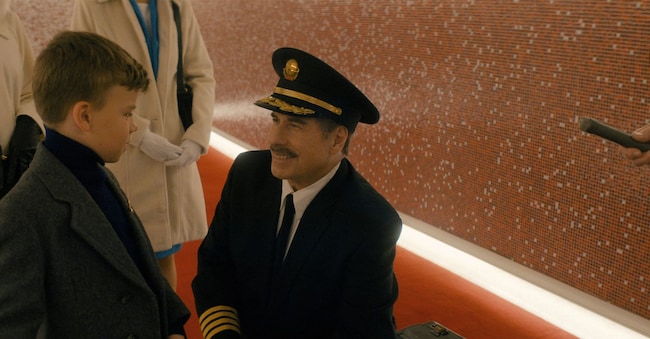
The protagonist is a young boy, Jeff (an excellent casting choice for Clark Shotwell), who is about to move from New York to Los Angeles with his mother, Helen, who is on the verge of entering Hollywood. It's all narrated in Jeff's voiceover, with a sly narrative, particularly about his mother's drink count and her chances of making her mark on the walk of fame. Jeff, John's alter ego as a child, is most interested in the fact that he will be able for the first time to ride in an aeroplane, the National Airlines DC-6, watch the turboprop start up, hear the noises. Jeff suffers the same thunderbolt that struck the director for aeronautics, prompting him from the age of 16 to take flying lessons, obtaining his pilot's licence at 22 with the qualification to fly jets. Since, in the film, his mother's financial means are limited, the journey is divided into several legs, which the story follows, stopover after stopover, from Denver to Chicago. This only multiplies the child's pleasure in being able to concentrate on the details: from the engines to the wings, from the weather to the waiting rooms, the fingers, the on-board service and the stewardesses. One of them, Liz, played by actress and model Olga Hoffmann, Helen's friend, will give them the first-class experience. But the other flight attendant, Doris - Ella Bleu Travolta, daughter of John, the female version of her father - is even more incisive: Jeff will have his first crush on her. In addition to Doris, Jeff meets various characters, such as the ten-foot-tall man, who add spice to the rhythm of a comedy inspired by the classics of the 1960s, illuminated by the director of photography, Paul de Lumen (!). Chelsea Turner's set design makes the first part of the journey look like a Hopper painting and Camille Jumelle's costumes give a retro touch, like the vintage uniforms for the stewardesses and Helen's white hooded coat, inspired by Elizabeth Taylor's in International Hotel. All spiced up with music by Mancini and Sinatra.
Costumes and music
Critics have judged the film to be an exercise in style, but sixty-one clear minutes of alchemy with the viewer, behind which a real life glimpses, are perhaps something more. Indeed, alongside the fairytale aspect of the film - based on the book of the same name written in 1997 by Travolta himself, Propeller One-WayNight Coach. A fairy tale for all ages - there are many signs of its history, which is anything but golden. First of all, the name of the little protagonist Jeff recalls that of Jett, the 16-year-old son who died of an epileptic fit in 2009. Then the choice for the role of Helen of Kelly Eviston-Quinnett, who for age could hardly be the mother of an eight-year-old boy. Kelly Eviston-Quinnett is head of the performing arts department at the University of Idaho - Travolta's mother taught acting - and is a Doula, a certified grief coach at the end of life. In addition to the loss of his son, Travolta suffered, six years ago, that of his wife, Kelly Preston, with whom he formed one of Hollywood's longest-serving couples. The film, then, is set in 1962: the new director seems to want to stop his world in the year in which he embarks on his journey to the Mecca of cinema and in which the American dream is still alive. A breath before the events that made the States lose their innocence with the assassination of JFK (1963) and then those of Malcolm X (1965) and Martin Luther King (1968). Choosing a family business, the whole battery of Travolta sisters and brothers are in the film: Ellen is Jeff's grandmother, Margaret the passenger Barbara; in minor roles, Ann, Sam and Joey are also in the film. Travolta takes refuge in the world of childhood to say something about himself, leaving behind a smile and lightness. Basically, he continues what he had done as dancer, making generations dance. In the cameo, the actor bows to the child he was. And the writer reciprocates him.
© REPRODUCTION RESERVED


