
"Benjamin Britten's 'Owen Wingrave' among the trulli
The anti-militarist opera runs until 3 August at the Festival della Valle d'Itria

3' min read
3' min read
Right. Wrong. Yes, no. No more mirrors of the present. We go to the opera to distract ourselves and dream, not to watch TV images. Discussions are flaring up at the Festival della Valle d'Itria, the fifty-first edition of the theatre-in-music programme in the Apulian town of Martina Franca, and how fertile these battles of thought and words are. For the first time there is a woman at the helm. Or rather, let us correct that: there is a woman composer, appointed artistic director with fine intuition. Silvia Colasanti, from Rome, has important commissions behind her and the next one will be at La Scala at the end of September: "Anna A." Achmatova, of course. Eyes open to the present, reflective, full of questions, that is how the playbill she has laid out sounds. The imprint is new and personal.
Tra i trulli
Some turn up their noses. Accustomed to the bel canto oasis among the trulli, pampered by pure beauty, endless disquisitions on past stars and vocal technique, suddenly finding oneself under the lapidary motto 'Wars and Peace' is quite a leap. Two of the three performances rest hard on the war theme.
Benjamin Britten
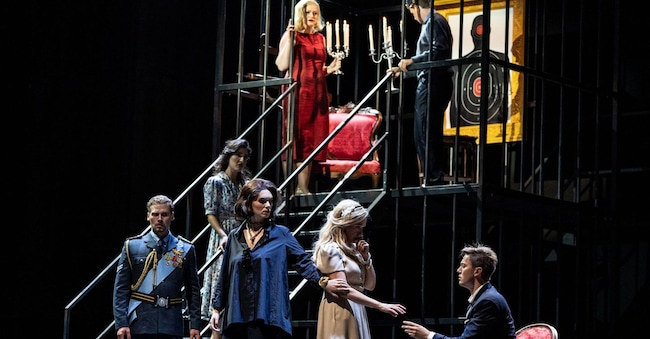
Dutiful and consistent in the staging of Benjamin Britten's anti-militarist opera 'Owen Wingrave'. In Italy, no one had noticed it until now, and that is precisely what the composers' flair is for. It is a prestigious feather in the Festival's cap, here where the hunt is on for forgotten titles. Written in 1971, a late and penultimate creation in the catalogue, the two-act score was created for the BBC, and two years later it will be staged at Covent Garden. The libretto is by Myfanwy Piper, the same as for 'Turn of the Screw', the same as for the ghost story from a Henry James short story. Here, however, we are poised between war and multiple ancestors: in the Wingrave family, the males have always given heroic proof in the field. All except young Owen, who dares to rebel. Äneas Humm plays him with total identification, his beautiful young baritone voice so theatrical in his tall, thin physique. The apologia for peace in the second act is memorable (how true are the words "peace is more difficult and heroic than war") and the final gesture, before darkness suddenly falls on the stage dominated by a picture gallery of portraits, identical and symbolically smeared with blood: James would like the boy dead, mysteriously crushed by ghosts in the castle room where no one dares enter. Andrea De Rosa's direction, intelligent, essential, like prose theatre, adds a gesture of defiance: he comes out alone, while the last lines of a subtle and cold script, punctuated by obsessive percussion, pass by, and lightning takes a glass from the long table where no one sits, in this house of dead males, except for his elderly grandfather, the terrifying general Sir Philip Wingrave. And right towards the ghost of the old man in the wheelchair, the excellent Simone Fenotti, tenor, in the part written for Peter Pears, contemptuously reverses the content, with winning anger.
We are all for Britten's pacifism. Genuine, by the way, proven as we know it on the skin. The rich Festival programme does well to recover the declaration to the Tribunal for inclusion on the list of conscientious objectors, signed by the composer in May 1942, and which seems to have been written by Owen Wingrave. On the other hand, one is a little taken aback the next evening, in the crowded courtyard of the Ducal Palace Rossini's 'Tancredi' is staged, three and twenty hours in total, with a thirty-minute interval. A little longer than usual, because there are two endings: the first conventional happy, as much as tasty, the second tragic, i.e. with the death of the protagonist. Less predictable, less conforming to the writing of the twenty-year-old Pesarese, and already presaging a senile melancholy, harmonically researched, spaced out over mysterious silences.
Owen Wingrave, Benjamin Britten, Itria Valley Festival, until 3 August

