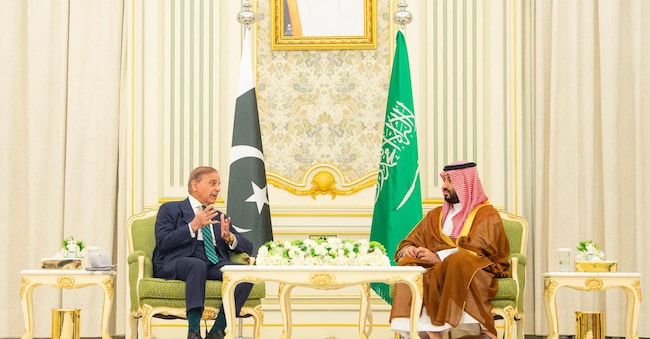
As for the timing of the agreement, Riyadh denied any connection with what happened in Doha on 9 September, when Israel attempted to eliminate what was left of the Hamas leadership with an attack that took the emirate's political leadership by surprise and infuriated it. "This is not a response to a particular country or event, but the institutionalisation of a deep and long-standing cooperation between two countries," explained a Saudi official.
That relations between Islamabad and Riyadh are strong is a well-known fact. Pakistan, which has the largest army in the Islamic world, has had a military presence in Saudi Arabia since the late 1960s in response to Egyptian involvement in the civil war in North Yemen and in defence of the holy sites of Medina and Mecca. This cooperation became more intense after the 1979 Islamic Revolution made Iran the most feared Shia power in the region, as well as an aspiring nuclear power. More recently, Saudi Arabia came to Pakistan's rescue in 2021 with a $3 billion loan, later refinanced in 2022, 2023 and in December 2024.
According to the book 'Eating Grass: The Making of the Pakistani Bomb' by Feroz H. Khan, a former high-ranking army officer in Islamabad, Riyadh has in the past provided its 'generous financial support' to help Pakistani scientists develop a nuclear programme in response to India's 1974 atomic test. According to the Bulletin of Atomic Scientists, Islamabad now has 170 nuclear warheads, compared to New Delhi's 172, and a sophisticated missile programme that would enable it to strike any major Indian city.
The reverberations of the agreement between Saudi Arabia and Pakistan are inevitably bound to be felt on this side of the Arabian Sea as well. First of all because of Pakistan's increased conventional deterrence capacity, given that Riyadh has a modern air force equipped with around 300 fighter jets of European (Typhoon) and American (F-15) production and financed by one of the five largest military budgets in the world. But also because such an alliance with Pakistan - a country with which India has fought three full-fledged wars and a series of more circumscribed conflicts such as the one last May - risks opening a furrow between Riyadh and New Delhi at a time when the two countries were intensifying their cooperation. Among the most ambitious projects in recent years is the one that aims to connect the Subcontinent to Europe via the India-Middle East-Europe Economic Corridor (Imeec), a response to China's Belt and Road Initiative that aims to create an alternative to the Suez Strait. Riyadh claims that relations with India are 'stronger than ever'. But New Delhi cautiously reserved the right to 'study the implications' of the agreement 'for national security and regional and global stability'.