
Milan in the Spotlight: from Via Monte Napoleone to the Galleria – art, cinema and jewellery
Just one kilometre of road bathed in robin’s-egg blue: two retail worlds, where stones and stars, Hollywood and Modernism, Pistoletto and Frankenstein come together.
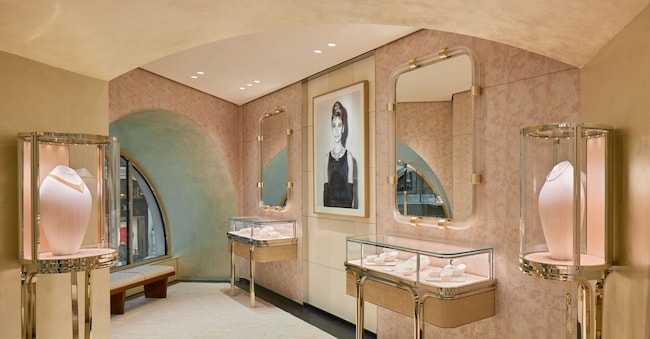
Thought and inspiration: a sophisticated designer always strikes the perfect balance between these values. And they do so by creating a piece of jewellery, just as they do by conceiving the design of a boutique where customers can go to choose it. This is the starting point for our conversation with Christopher Young, artistic director of the jewellery house that Audrey Hepburn made both iconic and pop. The meeting takes place to mark the opening of the Tiffany & Co. boutique in Milan’s Galleria Vittorio Emanuele, just 11 months on from another major opening in the city, on Via Montenapoleone, less than a kilometre away. “They are two nearby destinations, but they open up two different Milanese settings,” explains Young. “Whilst Palazzo Taverna, a neoclassical residence dating from 1835, is home to our main flagship store, here we find ourselves in an intimate and symbolic cultural setting that binds us even more deeply to Milan and its history.” It is a city he loves and visits regularly, partly due to his academic career: in addition to teaching on New York University’s Graduate Design Programme, he also frequently gives special lectures at the city’s Politecnico.

On entering the Galleria, Young points to the iron and glass vaults beneath which lie mosaics depicting the various continents – a tribute to cultural exchange across the world. He explains that, by a fortuitous yet curious coincidence, the entrance to the first American fashion house to open here is situated directly beneath the lunette dedicated to America. The link with the city is also evident in the cathedral’s sundial, built in 1786 by the astronomers of the Specola di Brera, which at midday projects the symbols of the zodiac onto the cathedral floor: here in the store, the zodiac signs created for the Marshall Field & Company in Chicago in 1914, under the direction of Louis Comfort Tiffany, son of the founder, can be found in mosaic form here in the store and on the ceiling inspired by the Tokyo Parliament building.

‘Everything evokes a cultured sophistication that expresses a distinctly Milanese elegance, and is part of our aim to create not just a shop, but a cultural landmark where craftsmanship, art, architecture and hospitality come together to create an extraordinary shopping experience that stands in stark contrast to the ordinariness of online shopping.’ Art is immediately apparent upon entering, with the ceramic installation by New York artist Peter Lane and two twin works by Michelangelo Pistoletto, Color and Light from 2016 (one of his works is already on display at the entrance to Montenapoleone). “Pistoletto is a unique Italian voice – conceptual and humanistic – perfectly in line with the brand,” continues Young. “I am particularly drawn to his exploration of reflection and the role of the viewer in the perception of a work that could be very similar to that of a piece of jewellery. His work is an invitation to step into the mirror, or rather to go beyond it, like Alice in Wonderland.” The tribute to the city of design and its architecture is also conveyed by the presence of lamps that Venini has handcrafted, drawing inspiration from Gio Ponti’s designs. This marks the beginning of the chapter on craftsmanship: whilst Venini provides the light, a Rubelli fabric serves as the backdrop to some of the most beautiful display cases. ‘I discovered this unique technique for working velvet with an extremely fine metal thread in their archives perhaps six years ago, and I was fascinated by the time required, the tools – an antique wooden loom – and the skill and dexterity of those who managed to weave such a masterpiece (such is the effort required that every quarter of an hour the artisan needs to pause work for a few minutes, ed); I have treasured this gem for years, waiting for the right opportunity to show it to the world’.

Here, it serves as a backdrop and setting for the display of some of the most beautiful pieces of jewellery from the maison’s archive. Indeed, in the store, alongside the contemporary collections – the Tiffany Icons, including HardWear, Lock and Knot – there are display cases paying homage to Elsa Peretti’s masterpieces, and in particular to her Mesh necklaces, which almost resemble fabric: naturally extremely light, with a silky feel to the touch, whilst evoking the armour of medieval knights. There are also displays featuring Jean Schlumberger’s iconic pieces, such as the Tulip necklace designed in 1959 or the Bouquet brooch from the early 1950s. ‘The exhibition’s concept,’ Young explains, ‘is deeply influenced by Modernism, that movement which, in the post-war period in a city like New York, was very much in keeping with the maison’s golden age and its major collaborations with the world’s finest jewellers. And also by the release of the film *i*/i*.”
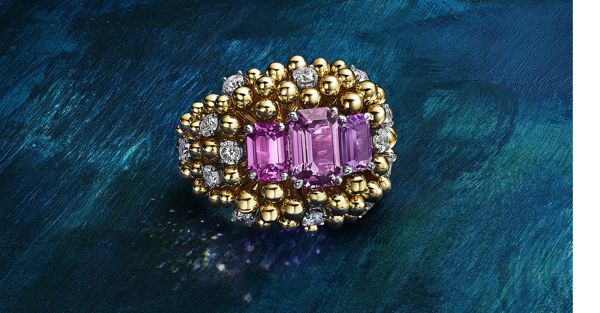
Cinema, incidentally, is one of the major sources of inspiration in Young’s work. “Cinematographic storytelling has always fascinated me and when I start creating, as well as drawings and sketches, I like to prepare storyboards that draw inspiration from that very world.” Among the contemporary directors he particularly admires is Guillermo del Toro, with whom the fashion house recently collaborated on the film Frankenstein: “It was an extraordinary experience and a great success: New Zealander Kate Hawley won the 2026 Oscar for Best Costume Design,” he says. “The film is also the perfect example of our working method: Guillermo’s creative genius has reinterpreted Mary Shelley’s nineteenth-century story. And something completely new has emerged. For us, too, the wealth of our archives – the brand’s heritage – must guide the minds of new designers. But what they create can never be a replica of the past. It takes creative thinking, but perhaps also boldness, to ensure that every Tiffany Blue Box – created using that colour code standardised by the Pantone Matching System and now produced entirely from eco-sustainable materials – continues to bring surprise and wonder to those who open it.”

