Training

Biomedical: the network of expertise from Palermo

Twenty new laboratories for the ITS Academy A. Volta and a partnership between ITS, businesses, the health service and the research sector. A national agreement on medical devices, whilst Sicindustria is calling on the Regional Government to recognise the new technical roles within the public health service workforce

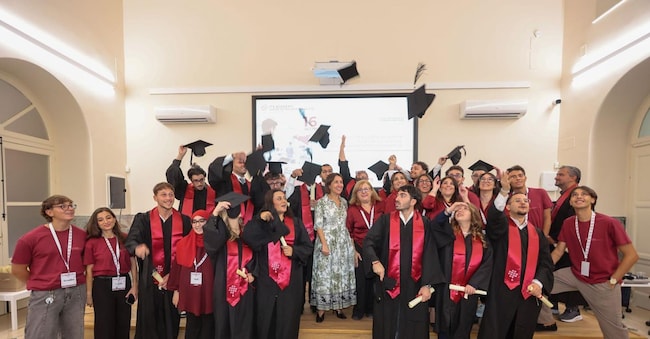
Un momento della proclamazione dei nuovi diplomati dell’Its Academy A. Volta di Palermo

4' min read

Translated by AI
Versione italiana

4' min read

Translated by AI
Versione italiana

Twenty new laboratories for the biomedical and biotech sectors, and a network bringing together training, business, research and the healthcare system. The three-day event organised in Palermo in collaboration with Sicindustria, dedicated to the professional skills required to drive innovation in healthcare and the life sciences sector, concluded with the inauguration of the Biomed and Biotech 4.0 Laboratories at the ITS Academy for New Life Technologies ‘A. Volta’.

The ribbon-cutting ceremony at the ‘Culla Tecnologica’ in Via Principe di Belmonte, in the heart of the city, took place following three days dedicated to new technical roles, links with businesses, applied research and social innovation. On the final day, speakers included, amongst others, Vincenzo Cusumano, Director-General of the Sicilian Regional Government’s Department of Education, and Riccardo Di Stefano, Vice-President of Confindustria for Education and Open Innovation.

Loading...

The ITS model and the southern Italy gap

Di Stefano linked the investment in the laboratories to a broader issue. “Southern Italy is experiencing a growth trend that is plain for all to see. This, however, must not lead us to believe that the gap has been bridged. The gap remains, but we are witnessing a positive trend that we must ensure we support.”

Hence the role of the ITS institutions, he pointed out, which have grown from around 11,000 to 40,000 students, with an average employment rate of nearly 90 per cent. ‘What this ITS and other exemplary Italian ITSs are trying to do is to break down one of the most deeply rooted taboos in our country: the idea that technical education is second-rate.’ He was also referring to the ‘4+2’ reform: “A young person can start their journey at the age of 14 and potentially graduate at 20 with a tertiary education qualification and a job.”

For Di Stefano, the priority now is to ensure continuity in investment: ‘It is, at last, an example of the responsible use of public funds, put to practical use for the benefit of our young people. But once the ribbon has been cut, these facilities call on all of us to continue our efforts, so that the investment made can yield lasting results.’

The agreement with businesses and the healthcare issue

In Palermo, a three-year framework agreement was also signed – in the presence of President Fabio Faltoni – between Confindustria Dispositivi Medici and the nine ITS Academy Foundations in Area 3, ‘Chemistry and New Life Technologies’. The aim is to establish a stable link between higher technical education and the manufacturing sector, and to anticipate the professional needs of businesses.

Faltoni explained that the sector employs over 130,000 people in Italia; women account for 41 per cent of the workforce, 7 per cent work in research and 3.4 per cent hold a PhD. The sector is worth almost 19 billion in domestic and export markets and comprises 4,648 companies. The agreement provides for a joint observatory on skills needs, co-design of training programmes, work placements, apprenticeships, job placement, applied research and technology transfer.

Profile recognition in public facilities

In Sicily, the issue of how to utilise these professionals within the public health service remains unresolved. Sicindustria has asked the Regional Government to allow the recognition and recruitment of technical staff trained by ITSs into the workforce of local health authorities (ASP) and hospital trusts.

“At present, access to the required technical roles is primarily linked to holding a university degree or traditional technical qualifications, with no adequate provision for ITC graduates in the biomedical sector,” emphasises Sicindustria’s president, Luigi Rizzolo. “It is therefore necessary to amend the regulatory and organisational framework, identifying roles that are consistent with the skills acquired and with the actual needs of the healthcare system.”

The president of the ITS Academy A. Volta, Maria Pia Pensabene, emphasises the importance of the network. “Our courses are designed to train highly specialised professionals, developed in collaboration with businesses and in response to the real needs of local communities. If the healthcare system is showing a growing demand for technical skills related to biomedical technologies, we must create the conditions to ensure that these skills can be effectively utilised and developed.”

Loading...

Pensabene also sums up the three-day event: ‘217 awards presented, 44 companies taking part in the B2B sessions with the students’. He describes Sicindustria as “a strategic bridge to the business community”, capable of identifying its professional needs and translating them into training programmes that are genuinely linked to the labour market.

Universities, research and innovation

The other strand is the partnership with the University of Palermo, the CNR, IEMEST and the Ri.MED Foundation on the relationship between vocational higher education, applied research and business. The aim is to bridge the gap between what is developed in laboratories and the needs of the manufacturing sector, making the ITS a link between knowledge, innovation and business demand.

On the final day, the discussion broadened to include innovation. Danilo Mazzara, from Skill for Equity, also proposed a sort of ‘StartCup’ for ITS institutions, modelled on Junior Achievement competitions, to bring together ideas and projects developed by students and link them to businesses and local innovation ecosystems.

“The ITS can become the cornerstone of an innovation ecosystem, a genuine hub capable of bringing together training, businesses, research and new ideas,” said Biagio Semilia. “It is a model that the Innovation Island Foundation, of which I am chairman, is following very closely, because it can help to create places within the region where skills are not merely developed, but are transformed into innovation and new businesses.” It is in this context that the opening of the Biomed and Biotech 4.0 Laboratories takes on a broader significance: not merely as new teaching spaces, but as a meeting point between education, healthcare, research, industry and innovation.

Copyright reserved ©
Loading...

Brand connect

Loading...

Newsletter

Notizie e approfondimenti sugli avvenimenti politici, economici e finanziari.

Iscriviti