
Palermo, the business plan for road infrastructure
Sicindustria presents three projects for the mobility of the city and industrial areas. President Russello: 'Let's think about project financing'
by Nino Amadore
4' min read
Key points
4' min read
It connects Palermo to the industrial area of Carini, on the western front, to Punta Raisi airport, and then on to Trapani and then to one of the most important wine-growing areas in the country, but also to Castellammare del Golfo and from there to San Vito Lo Capo, tourist areas of a certain importance for Sicily and beyond. And one could go on to demonstrate its strategic nature. Yet the A 29, a motorway conceived and built over fifty years ago, is a gut that risks paralysis for nothing: all it takes is a small accident and everything comes to a standstill. The local chronicles are0 full of such events.
A bypass for the A29, a motorway gut
.To lighten it and also provide a good service to the Carini area, where the new RiMed hub is also under construction, which will welcome (according to estimates) five thousand people a day, it would be enough to build a bypass, a link between Palermo and the industrial area of Carini that would become the third lane of this motorway gut: estimated cost, for the moment, of 150 million; construction time: a year or so. And this is one of the projects discussed at the conference entitled 'From Punta Raisi to Termini Imerese, the mobility of the future is already feasible', organised by Sicindustria Palermo. 'Unfortunately, companies can do no more than collect the needs of the territories, point out critical issues and urge politics,' explained Sicindustria Palermo president Giuseppe Russello. 'In this case we have gone further. We did not stop at the problem, but tried to identify solutions and possible funding channels as well. As if to say, we have the recipe. Now it is up to politicians, in particular, to take charge of initiating all the necessary activities to put the works on the ground and provide a sustainable mobility perspective for the city and the entire metropolitan area'.
A million vehicles every day in Palermo
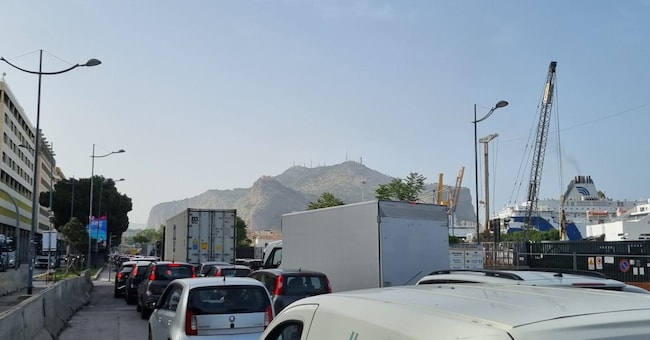
.And the real big problem remains Palermo with what is called the Circonvallazione (ring road) but which has been a clogged city street for years: Viale Regione Siciliana. "On average, one million vehicles circulate in Palermo on weekdays (between 950 and 980 thousand to be precise), with a drop of 20% on Saturdays and around 35% on Sundays," reads a Sicindustria note. The busiest artery, needless to say, is Viale della Regione Siciliana, every year crossed by more than 55 million vehicles, an average of 150,000 per day, of which 88% for the transport of workers/students commuting, 5% related to heavy or medium vehicles for goods transport that use the ring road to connect the two highways, 7/8% related to vehicles (trucks, vans) for goods transport within the city.
Three immediately tendered projects
.The (high) price is paid by the city, citizens and businesses. "And yet,' explains Tullio Giuffrè, lecturer in Roads, Railways and Airports at the Department of Engineering and Architecture of the UniKore of Enna, 'there are at least three projects, which can be financed and tendered under the new procurement code, that could radically change mobility and the impact of traffic on everyday life in just a few years. I refer, for example, to the Pedemontana, to the west sub-port tunnel that connects from Piazza Giachery to Viale Francia, and to the alternative bypass to the pair of road tunnels between Isola delle Femmine and Capaci, which would limit the impact in that area of all the vehicles that daily pour onto the A29 to reach the industrial area of Carini and the Falcone e Borsellino airport"..
The costs of lack of infrastructure
.According to Sicindustria, which cites a Finmeccanica-Ambrosetti study, the new motorway link between the A19 and A29, otherwise known as the Pedemontana (estimated cost just over one billion), would produce a series of positive effects in the order of 0.5 GDP points per year for the area involved, not to mention other benefits: recovery of diseconomies and inefficiencies, estimable at around 2.5-3 billion euros per year, thanks to improvements in congestion, logistics, accident rate and impact on the environment; recovery of useful time, estimable at least one billion euros per year, given the time spent travelling on an average day; development of industrial supply chains and their indirect impacts, estimable at least two billion euros per year.


