
Pampelonne, the dog named after the beach
One summer, many years ago, on the famous beach at Saint-Tropez, we decided to get a golden retriever as blonde as the sand. And nothing in our lives was ever the same again...

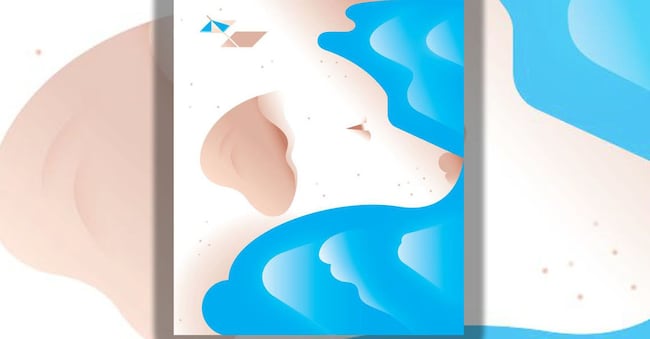
‘You’re mad,’ M. used to tell me. Or rather, he’d write it, bluntly, in response to my rambling emails – we weren’t yet communicating via emojis on WhatsApp – about that presence which, like a ghost, I felt lurking around the house at night and which was driving me – quite literally – mad. But this story needs to be told from the beginning, and this isn’t the beginning. Summer 2007. It’s us – and by ‘us’ I mean M., my husband, and our children, G. and S. – in Saint-Tropez, or more precisely in Ramatuelle on Pampelonne beach. Strictly the public stretch of beach; we’d never rented a sun lounger at Pampelonne. In France, the public beach isn’t like it is in Italia; it’s not a marker of social status, it’s not like Lido Mappatella with its vest tops and macaroni frittata. In France, it’s a breath of anarchic freedom. So there we were at Pampelonne, with our beach towels, a straw bag and a small blue-and-white parasol. Perhaps beach rackets had already made an appearance in our lives, but honestly I don’t remember, even though over the years they’ve become the undisputed stars of summers in Saint-Tropez. It was probably also the year we hired the Mini Moke with the straw roof. If I’m digressing, it’s to provide some context. Context is needed to understand what’s about to happen to us. It was one of those seasons in human existence when you’re so happy – so very happy – with a fleeting and ephemeral happiness – that you feel what Borges calls in a poem ‘nostalgia for the present’. And now let’s take Tolstoy’s phrase and turn it on its head: if, then, all unhappy families are unhappy in their own way and happy families are all alike, what do happy families do in moments of happiness? It’s obvious. They get a dog. The final nudge towards the decision came from a sign on the fence: a chocolate-coloured Labrador had been found along Pampelonne beach. We’d barely had time to ask before they’d already found him a new owner. But by then the idea of a dog had crept forcefully and insidiously into our lives; all we talked about was the dog that was due to arrive and our disappointment that the dog hadn’t turned up after all. At the kennels we visited, we chose a sandy-blonde Golden Retriever puppy who, although extremely shy, had boldly rubbed herself against our legs. Without hesitation, we named the puppy Pampelonne, after the beach.
Let’s leave the dog aside for now and talk about Pampelonne, which isn’t even part of the municipality of Saint-Tropez – apart from the very first part – but which is, to all intents and purposes, inseparable from that fishing village that burst onto the collective imagination thanks to an actress known for just a few films that nobody watches any more but which are nonetheless memorable: Brigitte Bardot. Enchanted by Saint-Tropez, where she’d filmed And God Created Woman by Roger Vadim because – as she stated in an interview – ‘there was nobody there’, a few years later Bardot bought a magnificent waterfront estate, La Madrague. The downside was that from then on, everyone knew her in Saint-Tropez, but that matters little. In Saint-Tropez, B.B. lived the epicurean life, keeping a low profile. She would even have liked to be buried in her garden, but she was not allowed to, and now her grave is in the Marine Cemetery of Saint-Tropez, a place of breathtaking beauty but where it is on full display to all passers-by. There are thousands of them, because the French coast is criss-crossed by a footpath that has now become a major tourist attraction: the Sentier du Littoral, also known as the ‘coastal walkway’. And so one of the most reclusive stars in the history of cinema is, for all eternity, on display before a procession of sun-baked tourists in hiking boots and carrying water bottles.
To sum up, B.B. settled in Saint-Tropez, which, despite itself, became hugely famous. But Pampelonne – this spectacular stretch of pale sand about five kilometres long – was in fact ‘invented’ by another figure who was destined to change the very essence of the beach, turning it into a symbol of transgression, glamour, promiscuity and excess: Paul Tomaselli, indeed the king of Pampelonne. Tomaselli, the pioneer and enabler of topless sunbathing at a time when the French gendarmerie disapproved, was the manager of one of Saint-Tropez’s most famous attractions, the Voile Rouge. The volume of the music, the exorbitant prices, the constant comings and goings of helicopters: all this helped to forge the legend of the Voile Rouge and expose it to public condemnation. Too much money, too much noise, too many parties.
The controversy over the fate of Pampelonne began well before we got the dog named after the beach. Since 2000, environmental groups have been campaigning to have it designated a nature reserve, calling for the removal of beach establishments to preserve the dunes and the ecosystem. In 2012, La Voile Rouge was demolished, and in 2018, excavators and bulldozers completed the clearance, sparing the historic beach establishments and granting very few licences. Now the beach is ‘almost’ intact and unspoilt, with venues blasting music at full volume – such as Nikki Beach and Casa Amor – set further back from the shore, and a few other beach clubs spared from the environmentalist ‘purge’, such as Tropezina, Club 55 and Cabane Bambou. There has undoubtedly been an ecological shift, but not an anti-capitalist one: the beach clubs where famous DJs play charge astronomical prices.
And what about Pampelonne, the dog? She didn’t like water and hated the sand. A bit of a scaredy-cat, lazy and good-natured. ‘Pampi’s just like us,’ said S, our daughter. Pampelonne hardly ever came to Pampelonne, except for her last summer when, at the age of 14, she was struggling to walk. In the photo on the right, she’s saying goodbye to ‘her’ beach. A couple of years later, our children – who’d by then left home – must have seen us looking so grey and melancholy that they suggested we get another dog. And here we are back in Pampelonne at eight in the morning with Olli swimming and galloping about whilst the donkeys comb the beach with the street cleaners. At that hour, there are only mummified hippie nudists and super-fit lifeguards – looking as though they’ve just stepped out of a Dolce & Gabbana photoshoot – setting out the sun loungers. Everything seems so perfect; it’s nostalgia for the present.

