
Pan Ducale will invest 2.5 million in the new factory
Food. Two-thirds of the turnover for the typical Abruzzo cake company comes from abroad The turnaround with diversification into quality products such as biscuits and macaroons, through to the D'Amo crisp

3' min read
3' min read
Pan Ducale is not simply the typical sweet of Abruzzo, but one of the products that best represent Italian agri-foodstuffs in the world. It is produced in Atri (Teramo) by a family business that combines tradition, craftsmanship and technological innovation. The original recipe dates back to 1200: legend tells of eggs, flour and almonds, a kind of pizza that the Duke of Acquaviva, whose family ruled Atri, liked so much that he ate it as if it were bread (hence the origin of the current name). In the 19th century chocolate and candied fruit were added and it has never changed since, a sort of commitment respected by the people of Atri, who used to make the Pan Ducale at home, by Pasquale D'Amario, who founded the company in 1967 with his wife Maria Rosaria: the two of them kneaded the cake in the back room of their Bar del Teatro and then took it to be baked in the town's oven. And after 50 years of activity came the recognition of Marchio Storico by the Ministry, celebrated with a plunge into the past, re-proposing the very first box of the cake in a limited edition tin version.
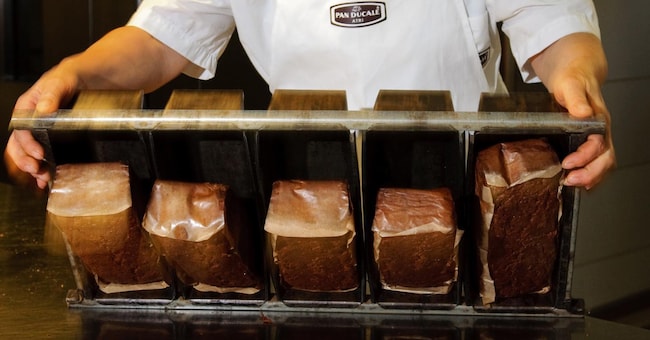
"The company has grown over time, without ever losing the family aspect,' explains Paola D'Amario, who with her brother Danilo and sister Claudia represents the second generation. Starting with the attention paid to the choice of raw materials: the flours, centrifuge butter, cocoa and almonds, which are selected one by one by our collaborators'. The manual part is followed by robotic machinery, 'to protect consumers and to achieve maximum food safety'. And it is precisely on the new technologies that the D'Amarios will invest 2.5 million over the next three years: the new lines will be housed in the new production site, in the industrial area of Atri, which will be operational within two years.
This, too, is the sign of a company that wants to continue growing: +7% turnover in 2023 to 5.5 million, +10% the forecast for 2024, with two thirds of production continuing to go abroad and, in particular, on the counters of the large-scale retail trade in the United States, Canada and England. "We also have a positive trend in Asia," emphasises Paola D'Amario, who is also in charge of the marketing and development area. "For us, it is a market that exalts us because we are dealing with the local gastronomic heritage that has a strong identity, as is also the case for our Pan Ducale. The challenge, both on the domestic and foreign markets, also passes through a diversification of products, maintaining the brand name: crackers, panettone, biscuits, crumble, amaretto. The line will be enriched by the end of the year by a chocolate-covered biscuit, which required a long period of planning and internal organisation, 'because behind the launch of a food product there is always a very complex process that takes time'.
Just like the one that led to the birth of the D'Amo crisp, chosen as an innovative product among the more than one thousand selected this year by the technical jury of Cibus in Parma: not fried, gluten, allergen, lactose and saturated fat free, it is produced in Matera. The idea comes from Danilo D'Amario, who found in entrepreneur Paolo Moliterni, owner of Bontà Lucane, an equally attentive partner in the search for healthy and tasty products. 'In addition to the strong innovation,' concludes Paola D'Amario, 'it is a product that has great commercial value and is in line with market demand, which is in no way willing to deviate from food quality and safety.

