
After wood, panelling meets glass and ceramics
From decorative elements to contemporary architectural features: wall coverings adorn walls with innovative materials

From maximalist to minimalist. Perhaps the person who, more than anyone else, ushered the most exuberant of architectural elements – was Le Corbusier, and he did so with the famous Cabanon, his tiny holiday home in Roquebrune-Cap-Martin with its warm walls of plywood and oak. It was a minor revolution, spearheaded by the leading figure of the Modernist Movement, realised in a space of just 13 square metres with the help and talent of Charles Barberis, a Corsican carpenter of Piedmontese origin.
Wood takes centre stage
Today, panelling seems to be enjoying a new lease of life, thanks to new interpretations and materials that have brought it back to the forefront of interior design. Vertigo is a revolutionary new project designed by Giulio Iacchetti for the Trentino-based company Fiemme Tremila which, as the designer himself explains, ‘is nothing more than a wooden plank with a deep longing for the sky’. Here, the wooden plank curves and becomes architecture, connecting the floor and wall into a single surface. The modular system, comprising curved planks joined side by side via interlocking joints, thus envelops the space, creating a reassuring cocoon-like effect. Vertigo’s Triplostrato structure ensures stability, flexibility and durability, whilst the BioPlus treatment, based on natural oils and waxes, protects the material, allowing it to remain alive and breathe freely. Furthermore, thanks to BioPlus, the surface of this remarkable panelling emits natural terpenes capable of improving indoor air quality.
Wood takes centre stage in yet another of the interesting projects showcased during the latest Milan Design Week: *La Boiserie*, an interpretation of the classic decorative wooden panelling system by the design studio david/nicolas. Acting as a bridge between the contemporary and the traditional, the proposal by the two Lebanese designers – with studios in Beirut, Milan and San Francisco – skilfully balances bespoke craftsmanship with the possibility of mass production, resulting in a system that is both functional and expressive.
Beyond its decorative role, La Boiserie is designed as a structure capable of accommodating bespoke cupboards, console tables and built-in furniture in which functionality and ornamentation coexist. What’s more, the modular system designed by David Raffoul and Nicolas Moussallem can now be customised to seamlessly integrate hi-fi systems into the home.
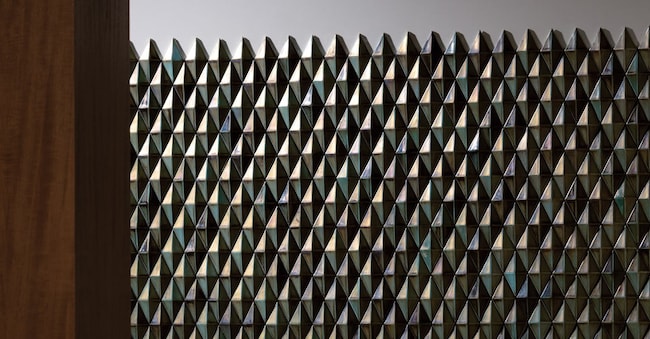
But contemporary boiserie also looks beyond its name – ‘bois’ means ‘wood’ in French – by cladding walls with new materials. Ceramic boiserie appeals to both sight and touch. Decorated with iridescent glazes and gold leaf, or enhanced by the soft matt finish of porcelain, Botteganove’s designs stem from the evolution of ceramic mosaics, reinterpreted in collaboration with designers such as Cristina Celestino, Chiara Andreatti, Studiopepe and Zanellato/Bortotto, who also serve as artistic directors at the Nove factory. Whether you choose to clad an entire room or highlight a single wall, these hand-crafted and hand-decorated panelling pieces lend a strong personality to exquisite, contemporary interior designs.
Brand connect


Newsletter RealEstate+
La newsletter premium dedicata al mondo del mercato immobiliare con inchieste esclusive, notizie, analisi ed approfondimenti
Abbonati