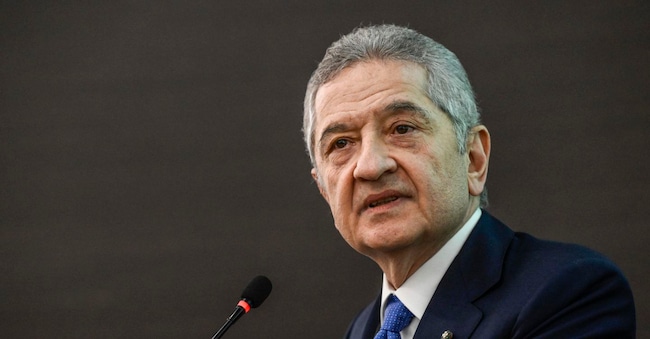
The Governor of the Bank of Italia

Panetta, technology cannot replace central banks in money

Governor warns of the real risks of stablecoins

by Nicol Degli Innocenti

Il governatore della Banca d’Italia Fabio Panetta ANSA/CIRO FUSCO ANSA

4' min read

Translated by AI
Versione italiana

4' min read

Translated by AI
Versione italiana

Technology is not enough: the role of an independent and credible central bank remains indispensable for 'secure' innovation. This was stated by the Governor of the Bank of Italy, Fabio Panetta, in a speech he gave today at the Embassy of Italia in London on the topic 'From interconnection to stability: the development of cross-border payments in a fragmented world'.

At the meeting, organised in cooperation with the Institute of International Finance and the Committee on Payments and Market Infrastructures of the Bank for International Settlements, Panetta emphasised the need to strengthen cross-border payments, both to foster global trade and integration, and to help the most vulnerable segments of the global population.

Loading...

The issue of cross-border payments, the governor emphasised, is not only technical but "also social, since it affects the most vulnerable people. They are geopolitical instruments'. In fact, remittances from emigrants have increased by 60% in the last decade and the forecast is that they will continue to grow, given the increase in migration flows.

"In the process of modernising the economy, cross-border payments still remain an unfinished business," the governor said. Nevertheless, payments across national borders often remain slow, expensive and constrained by fragmented rules. This is not only a financial issue. It is a challenge for the world economy, a test of its ability to remain interconnected in a context of increasing strategic rivalry. Strengthening cross-border payments does not only fulfil an economic need: it is a prerequisite for making the global economy more efficient and inclusive'.

Technological innovation can be a valuable aid but cannot replace the role of central banks, Panetta said: Although digital transformation may change the monetary architecture, its foundations remain unchanged. Technology can make the use of money more functional, but it cannot replace the credibility of an independent central bank and the authority of the state - the essential elements on which the trust placed in money rests

In some countries, households and businesses rely on stablecoins to make cross-border remittances and payments, because they promise faster transfers and, for users in countries with weak currencies or controls on capital movements, an alternative form of store of value to official channels.

However, there is no solid evidence of the efficiency of stablecoins, Panetta warned, pointing out that according to a preliminary analysis conducted by the Bank of Italy, payments made with such instruments do not offer systematic cost advantages.

"What's more, the use of stablecoins entails real risks, such as 'ransom races'; threats to monetary sovereignty in smaller economies; irreversible losses due to operational problems - lost access keys, programming code errors, cyberattacks; and serious fears for financial integrity when operators use opaque networks and infrastructure," he said. Added to this is a crucial question: who is liable in the event of disputes when payments take place on a digital ledger (the distributed ledger) with no jurisdiction of reference'?

Lagarde: Su euro digitale passi avanti, non solo mezzo di pagamento ma dichiarazione politica

There is certainly no need to close down innovation, but more regulation is needed, but that alone is not enough: 'We need efficient payment solutions, anchored in the security of central bank money,' Panetta explained. 'The answer we have to give payment users is clear: not just rules, but better alternatives. Many are already operational, others are being developed'.

To accelerate the path to better alternatives, collaboration between countries and institutions is essential, and reaffirming the purpose of the Roadmap launched in 2020 by the G20 and which has since made significant progress. Initiatives such as the introduction of harmonised messaging requirements according to the ISO 20022 standard (which Panetta called the 'lingua franca' of payments) are already producing tangible signs of change in payment systems globally.

Despite this infrastructural progress, none of the four G20 targets (speed, cost, transparency and accessibility) have yet been achieved in the remittances segment, so there is still a lot of work to be done. The important thing is to continue working together and above all to avoid fragmentation. "The risk is that the proliferation of parallel, loosely connected or politically segmented systems could reduce interoperability, increase costs and erode the efficiency gains that the G20 Roadmap aims to achieve, benefiting low-income countries in particular," he warned.

Europe "is already moving in this direction: Tips, the instant payment system of the Eurosystem, is now the regional platform for cross-border payments and is in the process of being connected bilaterally with other countries on cross-border payments". So, in conclusion, the governor said, 'interconnect to strengthen stability: this is the guiding principle and the way forward'.

To a question on the prospects for the dollar, Panetta replied that 'there are no easy alternatives, as the dollar dominates cross-border payments, but certainly the euro can play a greater role and we have been working for some time to strengthen it. The international financial system is dollar-centric, but we would prefer it to be multipolar'.

Copyright reserved ©
Loading...

Brand connect

Loading...

Newsletter

Notizie e approfondimenti sugli avvenimenti politici, economici e finanziari.

Iscriviti