
Paralympics, Ipc: 'Russians and Belarusians like everyone else, let's not politicise'
President Andrew Parsons: 'This is what the General Assembly democratically decided, the decision cannot be overturned'

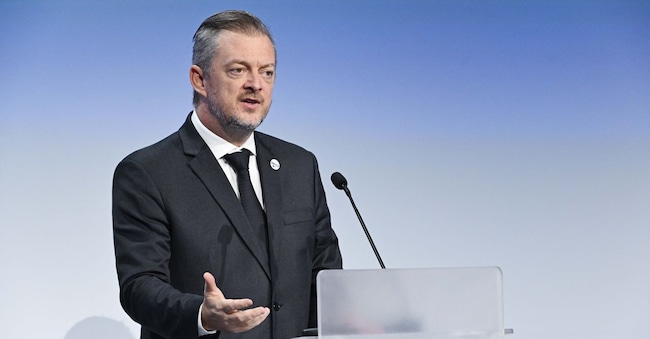
'More than the boycott, I am concerned about those who use this moment as a pretext to politicise the Paralympics'. This is how Andrew Parsons, the president of the Ipc - the International Paralympic Committee - responds to Il Sole 24 ORE regarding the fear that the Ipc's decision to admit Russian and Belarusian athletes with uniforms, anthems and flags to Milan Cortina 2026 may distract attention from the athletes' sporting achievements, given the controversy raised by quersta choice.
A handful of days before the start of the Milan Cortina 2026 Paralympic Games, and only a few hours before the arrival of the flame in Italia, the International Paralympic Committee's decision to allow six Russian and four Belarusian athletes to compete and wear the colours of their respective nations continues to cause controversy. After Ukraine, the Czech Republic, Estonia and Poland also decided to boycott the opening ceremony on 6 March at the Arena in Verona. 'We regret this, but we respect and accept their decisions,' Parsons commented. After the cancellation of last Friday's press conference, Parsons broke his silence on the controversy on the sidelines of the 'Passion Without Limits' event at the Allianz Tower in Milan to celebrate the 20th anniversary of the partnership between the insurance partner and the International Paralympic Committee.
"The Ipc General Assembly decided in September to revoke the suspension of Russian and Belarusian athletes. This means they must be treatedlike any other athlete,' reiterates the Brazilian sports executive, in his third term at the helm of the Committee. He speaks of a decision taken by a majority vote of a democratic body, which it is therefore not his duty to share but to implement. That is why 'there is no legal way to prevent Russian and Belarusian athletes from participating', he says, 'this decision cannot be overturned either by the board or by me'. A move that did not convince the Italia government - ministers Tajani and Abodi said they were explicitly against it - nor the IOC. 'We are different organisations, each with its own bodies, and sometimes we make different decisions. It has happened before, there is no consequence in our relationship, which remains one of dialogue and respect,' assures Parsons. "We work to minimise the impact on the Paralympics of these different positions, also to protect the athletes, who must be able to compete in the best possible environment," is the Ioc president's hope.
Asked if he could confirm that some of the Russian athletes allowed to compete were soldiers, he replied no: 'I don't know. We don't ask someone if he was a soldier, we look at his abilities as a sportsman. In any case, the president recalls, 'the experience of Sir Ludwig Guttmann' - the first to organise Games for people with disabilities, in 1948 in Stoke Mandeville - 'originated from there, from the rehabilitation of disabled soldiers at the front', who were otherwise left to die.
His fear is that the decision - which has sparked public debate recently, but dates back to September 2025 - will be used as a pretext to politicise the event, when so many people who are now announcing the boycott had already decided long ago not to attend the Open. 'The Czech Republic, for example, already warned us in December that it would not participate, in order to focus on the athletes' athletic training,' Parsons explains.


